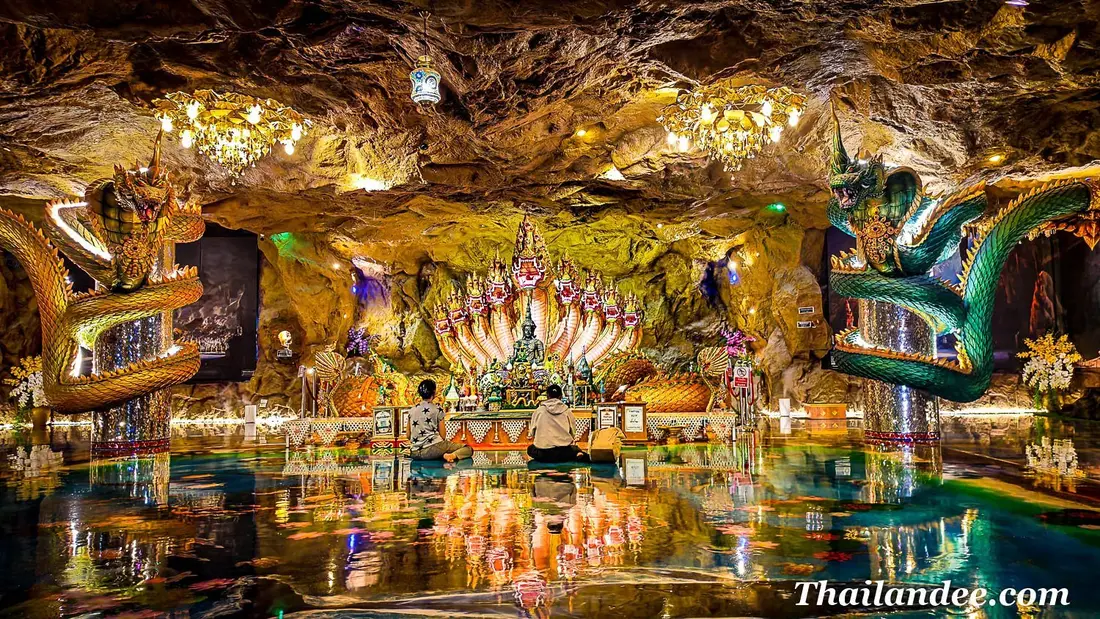
Located eight kilometers from Don Mueang Airport, Wat Weluwanaram is still relatively unknown to foreign tourists, but it's gaining popularity thanks to its Naga Cave, which is increasingly featured in videos on social media. In my opinion, it's not necessarily one of Bangkok's must-see attractions. The temple's history: It was founded around 1901 during the reign of King Rama V. Originally called Wat Kok, it later acquired the nickname Wat Phai Khiao, meaning "Green Bamboo Temple," due to the abundance of bamboo on the grounds. Its current name, Weluwanaram, comes from the Pali word Veluvana, meaning bamboo forest. For a long time, the temple was a local pilgrimage site, mainly frequented by residents of the Don Mueang district. Later, a chedi was built, the space of which was converted into an artificial Naga Cave, considered Bangkok's first. Today, it's the temple's main attraction, drawing both foreign and local visitors. Inspired by the mystical shrines of northeastern Thailand, this cave captivates visitors with its colorful lighting and, of course, the giant Naga serpents that coil around the pillars. The most impressive feature is a colossal 108-headed Naga representing Ananta Nakarat. The atmosphere is mystical and almost magical, and the cave is undoubtedly beautiful and unusual for Bangkok. However, the journey from Bangkok's city center (I'll explain how to get there below) might not be worthwhile, especially for a first-time visit, given the many other attractions. Also, as mentioned, the cave is man-made and smaller than it appears in Instagram videos. What are Nagas? Nagas are sacred mythical creatures that hold great significance in Buddhism and the folklore of Southeast Asia. In Thailand, they are generally depicted as gigantic, sacred serpents, sometimes with multiple heads, that bring protection and prosperity. Many legends surround them, particularly in Isan, the northeastern region of Thailand. According to legend, the Naga king Mucalinda protected Buddha during a storm by spreading his many heads over him. This scene is frequently depicted on Buddha statues. What else is there to see besides the cave? Above the cave is a chedi, but you can only climb it to the platform, which doesn't offer a spectacular view. Across the road is the original temple with its ordination hall, which houses a large golden Buddha surrounded by four walls covered in vibrant frescoes. These frescoes contain a fun little game: you have to find the six superheroes (or rather, five superheroes and Doraemon) pictured on a poster at the entrance.
Free entry. The Naga Cave at Wat Weluwanaram is open daily from 8:30 am to 5:00 pm.
To get to Wat Weluwanaram by public transport, the easiest way is to take the RED LINE to Don Mueang station (alternatively, a train from Hua Lamphong station, which costs only 5 THB but runs much less frequently) and then take a motorbike taxi (60 THB) or order a taxi or ride-hailing service via the GRAB app (or an equivalent service), which costs about 100 THB.
Wat Weluwanaram (Bangkok Naga Cave) is a temple. When visiting a temple in Thailand, there are some rules to observe: appropriate clothing (knees and shoulders should be covered), remove shoes upon entering the building, be quiet, no hugging or kissing, do not point your feet at the Buddha statue, and do not smoke.
How to get there
How to get to Wat Weluwanaram (Bangkok Naga Cave)? The easiest way to reach Wat Weluwanaram is by public transport. Take the RED LINE to Don Mueang station (alternatively, take a train from Hua Lamphong station, which costs only 5 THB but runs much less frequently) and then take a motorbike taxi (60 THB) or order a taxi or ride-hailing service via the GRAB app (or a similar app), which costs about 100 THB.




Community
Comments 0
Start the conversation.