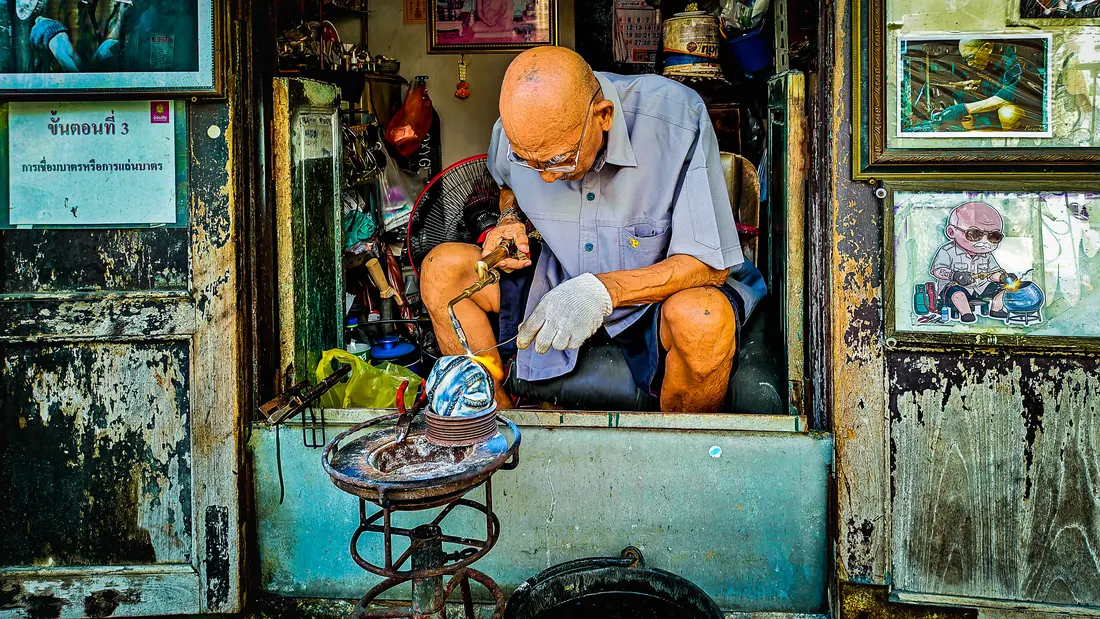
Just a short walk from the Golden Mount Temple (Wat Saket) lies Soi Ban Baat, one of Bangkok's most unusual neighborhoods. This narrow alleyway is home to Thailand's last community of alms bowl makers, who craft the bowls used by Buddhist monks on their morning alms rounds. This traditional, non-mechanized craft has been passed down for over 200 years and is now unique in the country. The history of Soi Ban Baat: The exact origins of the community are unclear. Some sources say it was founded by artisans who arrived after the fall of Ayutthaya, the former capital of the Kingdom of Thailand. Others believe it was a Khmer community that settled in Bangkok in the early 19th century. In 1782, King Rama I founded Bangkok on Rattanakosin Island and established several small artisan villages, including Ban Baat. In Thai, alms bowls are called "baat." The name Ban Baat literally means "village of alms bowls." The community flourished in the mid-20th century when nearly every family made their living from this craft. Today, only a few continue this tradition, making Ban Baat a rare place to discover a sadly disappearing craft. The bowl-making process: Authentic alms bowls for monks must be made of steel, according to Buddhist rules. Strolling through the alleyways, you can watch the artisans hammering, welding, and shaping the bowls in their small workshops. The rhythmic hammering is part of the neighborhood's character. The artisanal production is particularly complex, involving numerous steps performed by various specialists. Within the community, a small, signposted path leads you through the eight main steps of bowl making: 1. Shaping the rim, 2. Assembling the bowl, 3. Welding the bowl, 4. Grouting the seams, 5. Shaping and decorating the bowl, 6. Smoothing the surface, 7. Deburring and fitting, 8. Filing and final polishing. The entire process takes three days. While you won't be able to observe the artisans at every single step, the path allows you to watch them at work. The longer you stay, the greater your chance of witnessing the impressive work of this community in the heart of Bangkok. Feel free to approach and take your time – visitors are warmly welcomed! You can also purchase traditional bowls or decorative replicas on-site and help preserve this living cultural heritage.
Entry is free. The artisans of Soi Ban Baat work daily, except on Buddhist holidays, from 9 am until evening. You'll probably have the best chance of seeing some of them at work around 10 am. Stroll through the narrow lanes, chat with them (some speak a little English), and support them by buying bowls.
To visit the artists' community of Soi Ban Baat, it is recommended to do so on foot before or after visiting Wat Saket (Golden Mountain), which is less than a 10-minute walk away.
How to get there
How do you get to the alms bowl making community of Soi Ban Baat? To visit the Soi Ban Baat artisan community, a walk before or after visiting Wat Saket (Golden Mountain) is recommended, as it is less than a 10-minute walk away.




Community
Comments 0
Start the conversation.