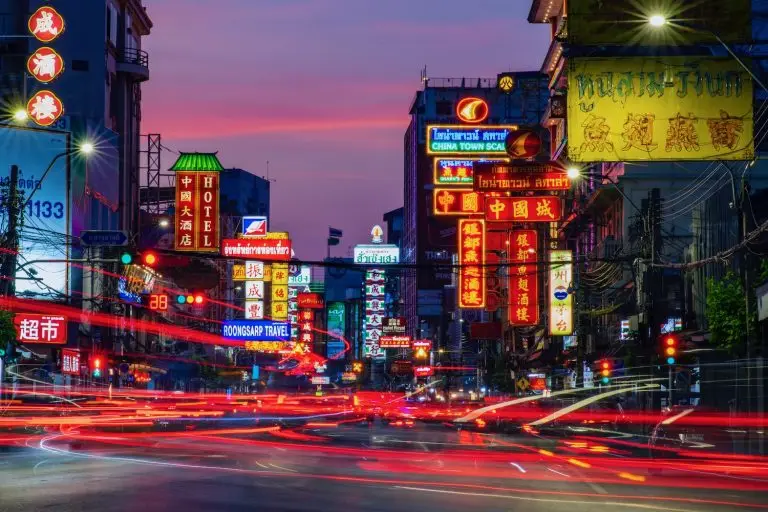
Bangkok's reputation precedes it, for better or for worse. One of the biggest criticisms? The disastrous traffic and the resulting agony of navigating it.
The good news: Bangkok is actually a fairly easy city to navigate, at least once you've grasped its layout and logic and accepted certain customs. The even better news? This article is my summary of almost 15 years of Bangkok experience in just a few paragraphs.
Getting around Bangkok can be hell – but it doesn't have to be. Here's how you can trade the hustle and bustle of Thailand's City of Angels for a halo of tranquility.
Understanding Bangkok's Design
To get around Bangkok effectively, it's essential to know the city map. Bangkok can be roughly divided into "Old Bangkok" and "New Bangkok," with the latter located east of Old Bangkok. Old Bangkok is further subdivided by the Chao Phraya River: Thonburi lies on the west bank, while Rattanakosin Island (Bangkok's tourist center) is to the east. South of Rattanakosin is Yaowarat Chinatown.
For most travelers, modern Bangkok can be divided into three or four areas surrounding Lumphini Park, Bangkok's central park. Clockwise, starting in the north, these are Siam, Sukhumvit, Sathorn, and Silom. In addition, destinations far north (such as Chatuchak Market and Don Mueang Airport – DMK) and east (Suvarnabhumi Airport – BKK) of Bangkok's modern city center are also relevant for foreign visitors. While further subdivisions exist, I recommend focusing on this general overview to begin with.
How to get around in Bangkok
BTS SkyTrain
In New Bangkok, the BTS SkyTrain, usually just called "BTS" by locals, is the most common mode of transportation. With only two lines, which meet at Siam (where Siam Paragon and CentralWorld are located), the system is extremely easy to use: the Sukhumvit Line runs north and east from Siam, and the Silom Line runs south and west. Popular stations on the Silom Line include National Stadium (MBK Center), Saphan Taksin (Sathorn Pier), and Sala Daeng (Silom Road), while the Sukhumvit Line stops at Asok (Terminal 21), Mo Chit (Chatuchak Weekend Market), and Phaya Thai. The latter is the hub for the Airport Rail Link.
Subway (MRT)
Another way to get around Bangkok is via the MRT, the city's subway. For most tourists, the Blue Line (which for many years was the only line) is the most convenient. This circular line connects stations in newer Bangkok, such as Sukhumvit, Lumphini, and Silom, with those in older Bangkok, such as Wat Mangkon, Sam Yot, and Sanam Chai. Bangkok's two railway stations are located at Hua Lamphong and Bang Sue. From there, you can transfer to the Airport Rail Link at Phetchaburi and reach the Chatuchak Weekend Market via Kamphaeng Phet. The newer Purple Line, which serves Bangkok's northwestern suburbs, is not useful for most tourists.
Public and private riverboats
Traveling by boat in a city as large as Bangkok might seem unusual at first, but it's actually very practical considering how many sights are located directly on the river. The city's chaotic traffic (which you avoid by boat) is another advantage. If you're staying in New Bangkok, take the BTS to Saphan Taksin. From there, you can take a boat to Tha Tien Pier (home to Wat Arun, Wat Pho, and the Grand Palace) or to Phra Athit, which is just steps away from the backpacker district of Khao San Road. Alternatively, you can take a boat along the Saen Saeb Canal, from the Hua Chang piers (near MBK) and Pratunam (near CentralWorld) to the Panfa Lilat pier near the Golden Mountain in Old Bangkok.
Grab and Taxis
If you absolutely need a private vehicle in Bangkok, you essentially have two options. The first is to hail one of the brightly colored taxis that weave through Bangkok's congested streets. However, this presents a major problem: drivers often refuse to use the meter (and instead demand an exorbitant flat rate), and sometimes they even refuse the fare altogether. The second option is to use the Grab app, essentially the Uber of Southeast Asia. While this is more transparent (the price is displayed before booking) and guaranteed (a driver cannot refuse the ride once they have picked you up), you are still at the mercy of Bangkok's traffic.
Other ways to get around Bangkok
To get from the airport to central Bangkok, you can take the Airport Rail Link from Suvarnabhumi. From Don Mueang, there are two options: either take a taxi directly or a bus to Chatuchak Park MRT station. Within the city, alternative transport options are available, including motorcycle taxis (if you're willing to accept slightly less safety compared to regular taxis in exchange for more speed) and tuk-tuks (auto-rickshaws), which are iconic but also overpriced. The Bus Rapid Transit (BRT) is less common. Keep in mind that while some parts of Bangkok are walkable, you'll need other means of transport to travel between them.
How bad is the traffic in Bangkok?
To be perfectly honest, the traffic in Bangkok is so bad that I only use a car in absolute emergencies. During the years I lived in Bangkok, I traveled by train, boat, and on foot at least 90% of the time. I only took taxis (except for motorbikes) for Grab rides to and from the airport outside of train hours and at the insistence of my companions.
Of course, your experiences may differ. Without my local knowledge, for example, getting around Bangkok exclusively by public transport can be intimidating. This is especially true since Grab, while not always reliable, will still get you from A to B. Generally, though, I recommend following my example as closely as possible, particularly once you've learned the intricacies of navigating Bangkok. But reliability aside, is it safe to use Grab in Bangkok? Absolutely.
More frequently asked questions about navigation in Bangkok
Is Uber available in Bangkok?
Uber ceased operations in Bangkok in the mid-2010s – that's the bad news. The good news? The Grab app, which took over Uber's Southeast Asian business, works almost exactly like Uber. I recommend downloading it before you arrive in Thailand.
How do you get around in Bangkok?
As a global city, Bangkok can be explored via a diverse network of rail, bus, road, and waterways. While taxis are plentiful and inexpensive, Bangkok's traffic shouldn't be underestimated. Therefore, I recommend familiarizing yourself with the public transportation system and using it as often as possible.
Is Bangkok a pedestrian-friendly city?
Some parts of Bangkok are reasonably walkable, but there are a few things to keep in mind before venturing out onto the streets. These include the heat (and, in some seasons, the smog) that pollutes the air in Bangkok, as well as the often poor quality (or lack thereof) of sidewalks. It's also fair to say that pedestrians in Bangkok don't necessarily have the right of way.
Conclusion
I hope this post has helped you find your way around Bangkok more easily. Having lived in the city for so long, I've been able to form my own impressions, which I believe will be clearer to you than a map or most other guidebooks. I don't mince words when it comes to the truth. For example, although taxis are cheap and readily available in Bangkok, I take the train or walk (instead of driving) as often as possible – the traffic in Bangkok is simply too bad. Do you like my way of explaining things? Then book me to plan your trip to Thailand.




Community
Comments 0
Start the conversation.