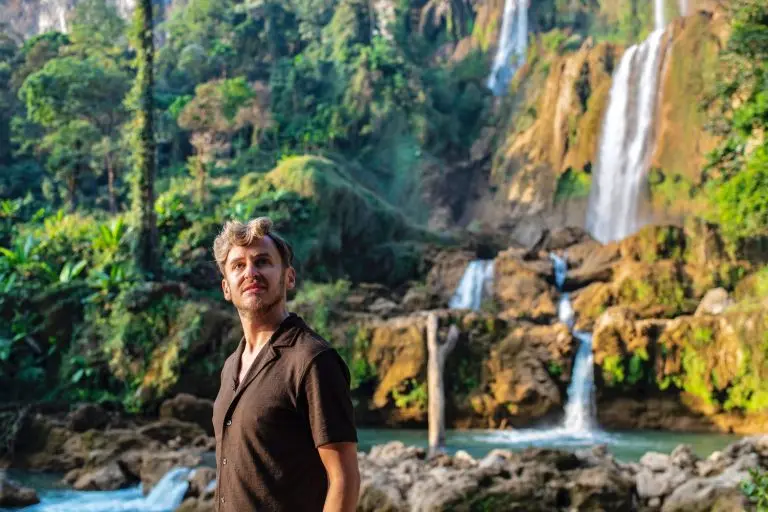
The idea of visiting Thi Lor Su Waterfall came to me almost two years before my actual trip. It was early 2024, and in my naivety I had convinced myself that I would only need a few days in Tak Province and that I could get there from Mae Hong Son in a few hours.
I didn't need much research to realize my mistake. I quickly discovered that Tak was not only much farther from the rest of northern Thailand than the distance as the crow flies suggested, but that its most famous destination (the aforementioned waterfall) was even more remote and would take even more time to reach.
The good news? If you're reading this, it means I finally made my trip – and survived! The bad news? While my trip to Thi Lor Su was a unique adventure, I'm not sure it was worth the price and all the hype (though with one caveat, which I'll get to later).
Why it took me years to visit Thi Lor Su
Originally, back in 2017 when I was living in Bangkok, I wanted to visit Tak province (though not Thi Lor Su). As was common practice at the time, I planned to fly to a city (in this case, Mae Sot) and decide what to do once I was there. Honestly, I can't remember why I ultimately cancelled the trip. I suspect it had something to do with Mae Sot's dubious reputation (which I'll be writing about in another post soon... stay tuned!).
Knowing this, and also considering it took me two years to visit Thi Lor Su after finally adding it to my list, you can probably imagine why I felt a certain unease when the tour vehicle picked me up at Mae Sot Airport for the four-day drive to Umphang. And not just because of the copious amounts of dried mud along the roadside, which my mother-in-law had warned me about and which might complicate my journey—although that certainly didn't make things any easier.
How my trip to Thi Lor Su went
Late arrival, early departure
It was well past my usual bedtime when we arrived at the spartanly furnished guesthouse of Umphang Adventures, the company that had organized my tour. In contrast, the early start they had advertised (breakfast at 7 a.m. and departure at 8:30 a.m.) was a very convenient time for me, allowing me to explore the town a little. There wasn't much to see, of course; Umphang is just a town compared to the surrounding area.
A rainbow-colored amuse-gueule
Instead of leaving for Thi Lor Su promptly at 8:30 a.m., we went on a short rafting trip (we – that was me, my guide, and a boatman I would never see again) on the Mae Khlong River. The trip was pleasant, but nothing special; the highlights were the aptly named Rainbow Falls and a large bamboo forest that concealed a natural hot spring. "That means they'll die soon," my guide remarked, drawing my attention to the many flowering bamboo trees.
Camping right on your doorstep
After our rafting trip and a simple lunch, we reached the Thi Lor Su campsite and headed straight for the waterfalls. That was a mistake – the light was far too harsh to photograph them. We quickly returned to camp; the guide set up my tent and lit my campfire, and as the sun slowly set, I went back to the waterfall, which looked much more beautiful in the softer light. I came back again the next morning, and the waterfall was in all its glory.
Mystery surrounding the village of Karen
The next day—or rather, the same day, considering I'd gone to the waterfall that morning—was the most exhausting. We hiked over 16 kilometers to a Karen village that made Umphang seem like Bangkok by comparison. There was no electricity or cell phone reception, and no paved roads led through or to the village. It was truly miserable spending the evening there, no matter how friendly my host (who called himself "Cha Tea") was, and no matter how much I respect the locals and their dignity.
The question of timing
The next day—the last day—we covered almost as much ground as on the first. I felt like kissing the ground when the pickup truck finally arrived hours after we'd set off. I was incredibly grateful for this unforgettable experience and looked forward to editing my photos. But I was also a little wistful: Had I perhaps been there at the wrong time of year? The waterfall was still impressive, but the rainy season had been over for months, as the dust in the air confirmed. Would it have been more worthwhile in November or December than at the end of January?
Do you really need a tour to visit Thi Lor Su?
As I mentioned before, the roads from Mae Sot to Umphang, and from there to Thi Lor Su and the surrounding areas, are in poor condition. During the rainy season, they are covered in mud, which dries into a thick, crusted layer during the dry season. This makes driving difficult, especially with a rental car that you don't want to damage. Nevertheless, I saw many local Thais traveling independently.
The greatest benefit of a Thi Lor Su tour lies in communication. Those who don't speak Thai will find it difficult or even impossible to get around in this region of Thailand (figuratively speaking – not referring to the roads). While the drive to Thi Lor Su Camp and the relatively short walk to the waterfalls themselves are quite straightforward, visiting other destinations in the area independently can be arduous or even impossible.
Other frequently asked questions about the Thi Lor Su Waterfall
Where is the Thi Lor Su Waterfall located?
Thi Lor Su Waterfall is located in Tak Province in northwestern Thailand. More precisely, it is about a four-hour drive from Mae Sot Airport, near the town of Umphang. Due to the distance and the poor road conditions in the area, at least one overnight stay is necessary to visit the waterfall.
How do I get from Bangkok to Thi Lor Su Waterfall?
Getting from Bangkok to Thi Lor Su is a bit of a roundabout route, but not difficult. After flying from Bangkok to Mae Sot, you'll need to drive for four hours to Umphang. Depending on your arrival time, an overnight stay there might be necessary. In some cases, you can continue on to the campsite in Thi Lor Su on the same day and hike to the waterfall from there before nightfall.
How difficult is the hike to Thi Lor Su?
The "hike" to Thi Lor Su is actually more of a stroll. The entire path from the campsite is paved, and although there are a few dozen steps, it's very easy to manage. Based on my own experience and the people I observed on the 20- to 30-minute walk, only someone with exceptionally poor fitness or health would have difficulty reaching the waterfall.
Conclusion
Thi Lor Su Waterfall is an unforgettable destination – and not just because the journey there is so arduous. The waterfall itself is simply magnificent, and even if you travel off-season, as I did, its size and splendor are immediately impressive. On the other hand, the entire experience is unnecessarily complicated. This isn't meant as a criticism of Umphang Adventures, whose staff significantly simplify the planning, but rather as a damning commentary on infrastructure development in rural Thailand. Perhaps I'll go back someday, but I'm in no hurry. Need help deciding if Thi Lor Su is right for you? Then book me to help you plan your trip!
Community
Comments 0
Start the conversation.