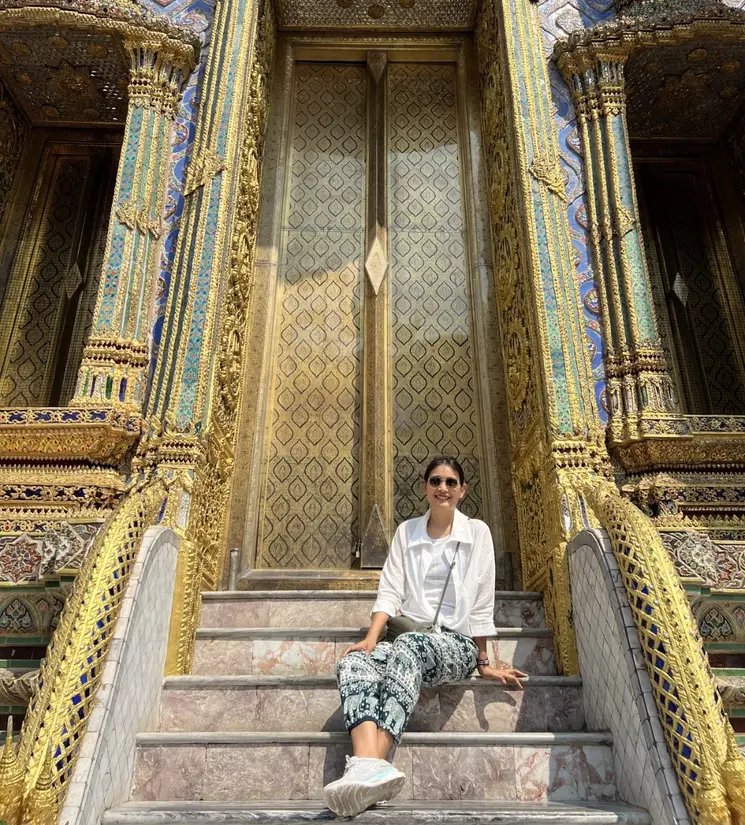
We've visited several temples in Bangkok, but none can architecturally compare to the Grand Palace. This sprawling complex, built in 1782, houses intricate mosaics, glittering spires, royal halls, golden chedis, and one of the most revered Buddha statues in the world. The only downside to this incredible place is the enormous crowds: the Grand Palace is Bangkok's most visited attraction, and the throngs of people start arriving as early as late morning.
Before our visit, this wasn't entirely clear to us, and we thought arriving at 10:00 AM would be perfectly sufficient. However, by that time the queues were already very long, and we had to push our way through a huge crowd of tourists to see the various sights. This didn't detract from the experience at all – quite the opposite. If you're wondering whether a visit to the Grand Palace is worthwhile: the answer is a resounding yes – it's one of the most beautiful temples in Thailand. As with all tourist attractions, however, some planning is necessary to get the most out of your visit.
An Introduction to the Grand Palace
The history and prestige of the Grand Palace are ever-present. It served as the official royal residence and political center of Siam for almost 150 years after King Rama I made Bangkok the new capital. Its location in the heart of the old city makes it ideal to combine with a visit to Wat Pho (home of the Reclining Buddha) and Wat Arun on the other side of the river. Unlike most other parts of Bangkok, this area is excellent for exploring on foot, with fantastic street food stalls and charming little boutiques on every corner.
The absolute highlight is, of course, the Temple of the Emerald Buddha (Wat Phra Kaew), which houses a small but culturally significant Buddha statue carved from a single block of jade and draped in gold fabric. Furthermore, a visit to the Grand Palace offers the opportunity to wander through courtyards where kings once resided, admire stupas covered with thousands of gold tiles, and follow the mythological stories depicted in the murals that wind around the inner cloister. If you are passionate about Buddhism, art, and architecture, you will have an unforgettable time at the Grand Palace.
What to see at the Grand Palace
Ramakien Gallery
Once we finally had our tickets, we were first given a tour of the Ramakien Gallery—a continuous mural stretching for two kilometers along the inner cloister (and considered the longest of its kind in the world). Although we didn't fully grasp the intricacies of the "Ramakien Epic," based on the Indian Ramayana, we were blown away by the detail and artistry of the paintings. There are 178 different panels to explore, all telling stories of heroes, fierce battles, and glimpses into everyday life. It turned out this was Cam's favorite spot in the entire complex.
The Temple of the Emerald Buddha (Wat Phra Kaew)
Upon leaving the gallery and entering the open courtyard, one sees Wat Phra Kaew with its famous Emerald Buddha. The small statue may seem unassuming at first glance, as it is only 66 centimeters tall and not even made of emerald, but it symbolizes royal authority and is believed to possess powers that bless the land. Only the king is allowed to touch it, and three times a year he changes its robes to mark the changing of the seasons. The exterior of the main chapel (Phra Ubosot) is magnificent with its multi-tiered roofs, glass decorations, and gilded window frames.
The Temple of the Emerald Buddha
Yaksha guardian statues
The Yaksha statues are colorful, mythological figures from the Ramakien epic. These giants are about five meters tall, wear magnificent armor, and protect the Emerald Buddha. They are among the most photographed sights in the Grand Palace, and we couldn't resist taking countless photos of them either. The Yaksha statues can also be seen at Suvarnabhumi Airport – they symbolically protect travelers on their departure and are meant to ward off bad luck from the airport.
The Royal Pantheon and Library
Both the Royal Pantheon and the Library (Phra Mondop) are located on the upper terrace—one of the most visually stunning areas of the Grand Palace. The Royal Pantheon boasts blue walls, gold accents, and gilded doors, while the Library shines with green and gold mosaics and features doors inlaid with mother-of-pearl. This was Kat's favorite spot for photography, as the imposing golden doors provided perfect backdrops for Instagram photos.
Phra Sri Rattana Chedi
You can't miss the Phra Sri Rattana Chedi, as its large bell shape dominates the upper terrace. Its style is modeled after the historic stupas of the ancient capital Ayutthaya, which in turn were inspired by the Buddhist architecture of Ceylon (Sri Lanka). The craftsmanship is exceptional: thousands of golden mosaic tiles cover the chedi, making it shimmer in the sun. The Phra Sri Rattana Chedi is definitely worth a quick stop to take some photos before exploring the other sights of the Grand Palace.
Phra Suwannachedi
Among the most impressive structures in the Grand Palace were the two identical Phra Suwannachedi stupas, located in close proximity to the Phra Sri Rattana Chedi and instantly recognizable by the figures on their bases. The chedis are supported by 16 Yaksha statues and 4 monkey warriors, posed as if lifting the structures themselves. It was fascinating to view them up close, and even more wonderful to photograph them.
How to get to the Grand Palace
By MRT (subway)
To reach the Grand Palace comfortably and affordably, taking the MRT to Sanam Chai station is undoubtedly the best option. This station is one of the most beautiful we saw in Thailand – with its gold and white columns, marble floors, and ceiling medallions, it gives you the feeling of entering a palace even before you arrive. From here, it's only a 10-15 minute walk to the Grand Palace. Simply take Exit 1.
By BTS Skytrain and ferry
Arguably the most scenic route to the Grand Palace is via the BTS Skytrain to Saphan Taksin station. From there, walk to Sathorn Pier and take a ferry north to Tha Chang Pier (directly in front of the palace). This journey along the Chao Phraya River is a relaxing way to avoid traffic and discover some of the sights along the riverbank.
Other ways to the Grand Palace
If you're staying near Khao San Road or in the wider Rattanakosin district, you can easily reach the Grand Palace on foot. An early morning visit is highly recommended to avoid the heat. Alternatively, a short tuk-tuk ride is a great option (and always a lot of fun). Be sure to negotiate a fair price before starting your journey and don't fall for scams – for example, the "The palace is closed today" trick. This is almost never true, except on major holidays, during state visits, or for large ceremonies.
Frequently asked questions about visiting the Grand Palace
When should I arrive at the Grand Palace?
The Grand Palace opens daily at 8:30 a.m., so you should arrive right when the gates open. Even an hour later, you can expect long queues, large crowds, and oppressive heat. While there will still be some visitors and tour groups at 8:30 a.m., it's nowhere near as hectic as at midday. We recommend planning your arrival the evening before and setting an early alarm to make the most of your day.
How much does a ticket for the Grand Palace cost?
Foreigners pay an entrance fee of 500 THB to enter the Grand Palace, while Thais enter free. This is significantly more than most other temple entrance fees in Bangkok. For example, the Golden Mount (Wat Saket) costs 100 THB, and the giant Buddha at Wat Paknam is free. In our opinion, it's worth paying the extra for the Grand Palace – especially if you arrive early in the morning and can enjoy the peace and quiet. Tickets are available on site. Alternatively, you can book a private tour of Bangkok's three main attractions, all located close to each other: the Grand Palace, Wat Arun, and Wat Pho.
What is the dress code for the Grand Palace?
The dress code at the Grand Palace is one of the strictest in Bangkok. Both men and women must cover their shoulders and knees – for men, this means swapping shorts for long trousers. During our visit, we both bought a pair of those famous elephant trousers you see everywhere. They were admittedly kitschy and touristy, but we didn't care: we were far too busy admiring the architecture. You can find more great things to do in Bangkok in our article below. Read on: 30 Top Things to Do in Bangkok: The Ultimate Guide
Community
Comments 0
Start the conversation.