The term "hidden gem" is used far too often in travel circles these days, but in the case of Kanchanaburi, we firmly believe it's absolutely fitting. This province in western Thailand is primarily known for its tragic history during the Japanese occupation and the construction of the Bridge on the River Kwai. But those who look closer will discover one of the most beautiful and authentic parts of Thailand.
After three days in Bangkok and several sleepless nights, we decided we needed a change of scenery. Looking at the map, we saw that Kanchanaburi was less than a three-hour drive away – a wonderful opportunity to escape the city. So we booked accommodation for two nights, boarded the Kanchanaburi Express bus, and headed west. But things didn't go as planned.
About halfway through the journey, the air conditioning broke down, and for some inexplicable reason, all the windows were locked. It was so hot and stuffy that we literally couldn't breathe! Naturally, the driver had to stop and arrange a replacement bus. That was the good news. The bad news: we had to wait one to two hours. Since we were pressed for time and didn't want to wait on the side of the highway, Kat ordered us a Grab taxi for the last leg of the journey.
We finally arrived at our hotel in Kanchanaburi, a lovely boutique hotel called Inchantreedoopool. After dropping off our luggage, the first thing we did was rent a motorbike so we could explore the area at our own pace. A hotel porter picked us up in a small rickshaw and quickly took us around the corner to a motorbike rental shop, where we paid 400 baht per day for a 150cc rickshaw.
We were ready for a few adventurous days. Whether driving along the tranquil riverside streets, learning the heartbreaking story of the prisoners of war during World War II, or climbing the seven waterfalls in Erawan National Park – we enjoyed every moment. Kanchanaburi enchanted us, and our only regret is not having stayed longer!
10 Top Things to Do in Kanchanaburi
1. Admire the historic bridge on the River Kwai.
The Bridge on the River Kwai is the centerpiece not only of the city but also of the region's modern history. It was built by Allied prisoners of war and Asian forced laborers under Japanese rule to create a land supply route for the Japanese war effort in Myanmar. Today, the bridge serves as a World War II memorial. Visitors can cross it, take photographs, or simply enjoy the view across the river. We recommend visiting in the evening to avoid the midday heat and experience the bridge illuminated in vibrant colors.
2. Visit the Death Railway Museum and Research Centre.
Visiting the Death Railway Museum and Research Centre was both harrowing and fascinating. The exhibits illustrate the construction of the Thailand-Burma Railway and its horrific human cost: over 300,000 people were forced to work on it (approximately 60,000 Allied prisoners of war and 250,000 Asian laborers), and over 100,000 people died, including around 40,000 Malays, 40,000 Burmese, 6,000 Britons, 3,000 Dutch, and 2,000 Australians.
Yet amidst all this darkness, there were also stories of hope. We were deeply moved by Boonpong Sirivejjabhandu, a Thai civilian and businessman who risked his life to help prisoners of war. “Boon Pong” used his Japanese supply contract to smuggle vital medicines, food, and radio parts into the labor camps. He worked with a secret network of Thai civilians and Allied officers to funnel money and contraband to the prisoners. He is credited with saving hundreds, if not thousands, of lives, and he even provided information to the Allies that contributed to the bombing of the Bridge on the River Kwai—an inspiring story that deeply touched us all!
Museum and Research Centre of the Death Railway
3. Pay your respects at the Kanchanaburi (DonRak) War Cemetery
Opposite the Death Railway Museum and Research Centre lies the Kanchanaburi War Cemetery, containing the graves of nearly 7,000 Allied prisoners of war – primarily British, Dutch, and Australian soldiers. The cemetery is well-maintained, with neatly trimmed lawns and beautiful flowers interspersed among the graves. Visitors can stroll across the grass, contemplate the endless rows of headstones, and pay their respects to the many fallen soldiers of the Second World War.
Kanchanaburi War Cemetery (DonRak)
4. Visit all seven waterfalls in Erawan National Park
We didn't have particularly high expectations for Erawan National Park, as we were there during the dry season, but it completely blew us away. We rode our motorbike there, past dams and rivers, and arrived at the park entrance around 10:00 AM. Cam had to pay 300 THB and Kat only 60 THB (the perks of being Thai!). Then we parked our motorbike, took a golf cart to the first level, and from there began our hike across the seven levels.
The waterfalls were incredibly beautiful; photos simply can't capture the beauty of this place! In fact, the entire hike was fantastic: we walked across small wooden bridges, past babbling brooks, over gnarled roots, through dense treetops, and were greeted by one unique waterfall after another after each leg of the journey. It was like Thailand's version of the Garden of Eden.
In our opinion, the most beautiful waterfalls were located on levels 4, 5, and 6. Some were carrying a little less water, which was to be expected in February when we were there, but others still offered large pools that were perfect for swimming. The great thing about Erawan National Park is the refreshing, clean, and pure water. We saw many families with small children swimming on level 5, and the little ones seemed to be having a wonderful time!
The hike from Level 1 to Level 7 takes about an hour. However, allow 2–3 hours if you want to stop, swim, and enjoy each waterfall at your leisure. Park rangers recommend November and December as the best time to visit, as that's when the water is at its peak and the weather conditions are optimal. They also emphasize that it's worth visiting year-round, and frankly, we found it magical even during the dry season.
Read more: Erawan National Park: A guide to hiking to the 7-tiered waterfall
5. Explore Mallika City, a vibrant heritage village
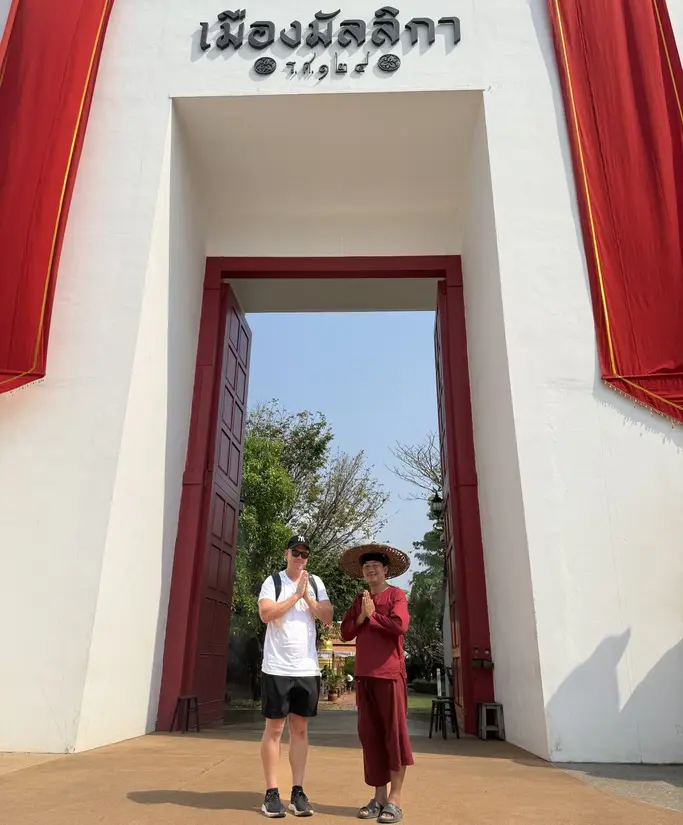
Mallika City is a replica of an ancient Siamese city, complete with floating houses, wooden stalls, beautiful gardens, and a striking red gate that welcomes visitors through the white city walls. Its most unique feature, however, is the use of the old currency system: at the entrance, you exchange your Thai baht for coins ("Satang") and can spend them as you wish.
The staff wear historical costumes and speak old-fashioned dialects, which might seem kitschy or touristy at first glance, but Kat, being Thai, thought it was pretty cool. We spent about 1,000 THB in total, on snacks, souvenirs, and a lovely lunch by the water: Pad Thai for Cam and noodle soup for Kat. It was by far the most delicious Pad Thai Cam had ever eaten – fresh ingredients and a smoky aroma from the wok!
Read more: 10 top things to do in Mallika City, Kanchanaburi
6. Explore Wat Tham Suea (Tiger Cave Temple)
A 30-minute motorbike ride from the city will take you to Wat Tham Suea, also known as the "Tiger Cave Temple," one of the most impressive temples in Kanchanaburi. The highlight is the Chin Prathan Porn (Great Buddha), an 18-meter-high seated Buddha statue covered in golden mosaics and housed in a unique shell-shaped structure. However, the climb to the temple platform isn't easy, especially if the cable car isn't running. You'll have to climb 157 steps to reach the top, but the view of the Mae Klong River and the surrounding landscape is well worth the effort!
Read more: Wat Tham Suea: Kanchanaburi's epic Tiger Cave Temple
7. Watch the train at the Tham Krasae Death Railway Bridge
The Tham Krasae railway bridge is a famous section of the route, winding along the hillside in a curve, right next to the idyllic Khwae Noi River. After watching the trains or taking a ride yourself, you can walk across the wooden railway bridge and visit the Krasae Cave, which houses a small Buddhist shrine – the perfect place to reflect on the dark history of World War II.
8. Explore the hiking trails at the Hellfire Pass Visitor Center.
Another worthwhile museum to visit in Kanchanaburi, run by the Australian government, is the Hellfire Pass Interpretive Centre. It commemorates all those who lost their lives during the construction of the "death railway" and offers free audio guides with accounts from survivors. A particular highlight is the walk along the paths carved into the rock by prisoners of war and Asian laborers. Two routes are available: a shorter, 1 km path leading to the Konyu Cutting, and a longer, 5 km path extending to the Compressor Cutting.
9. Treat yourself to a massage at Thai Thai Relax
After a few days filled with moving museum visits, strenuous temple climbs, and exciting waterfall explorations, a massage was just what we needed. On our last evening in Kanchanaburi, we discovered a chic, modern massage parlor on the outskirts of town called "Thai Thai Relax Massage." We both opted for a deep tissue massage, and although it was intense and a little painful at the time, we felt refreshed and ready for more adventures in Bangkok afterward.
10. Take a trip to the Sangkhla Buri district
If you're planning a longer stay in Kanchanaburi, we've heard great things about the nearby district of Sangkhla Buri. This hill town on the border with Myanmar is home to the Mon Bridge – the longest wooden bridge in Thailand. There you can see locals carrying goods on their heads, children in traditional clothing, and monks giving alms. The road to Sangkhla Buri is beautiful but quite challenging, so only go if you enjoy traveling off the beaten track.
Mon Bridge, Sangkhla Buri District
Tips for visiting Kanchanaburi
Read more: 50 Thailand travel tips: What you should know before your trip
Landscape of Kanchanaburi




Community
Comments 0
Start the conversation.