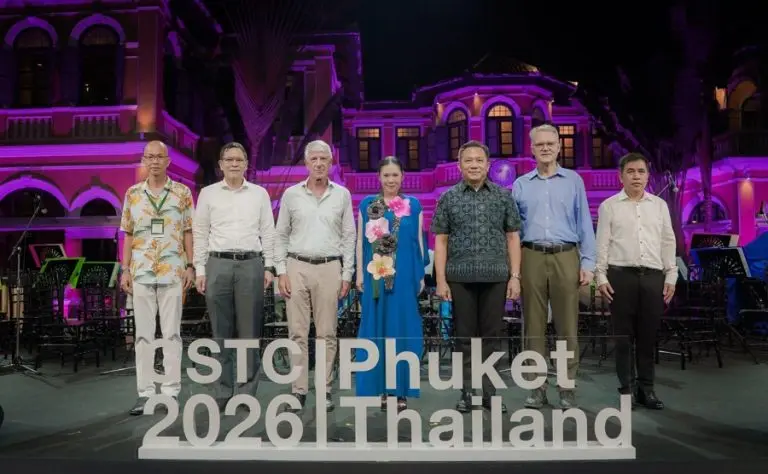
Phuket, Thailand, April 26, 2026 / TRAVELINDEX / The GSTC2026 Global Sustainable Tourism Conference took place from April 21-24 at the Royal Phuket City Hotel and Courtyard by Marriott Phuket Town in Phuket, Thailand. The event brought together tourism professionals, destination representatives, academics, and sustainability experts from around the world to discuss key challenges and practical solutions for promoting sustainable tourism.
The conference, held in one of Thailand's most renowned tourist centers, underscored the importance of sustainable travel and responsible destination management. The conference program focused on three core themes: sustainable hospitality, resilient cities and communities, and capacity utilization and visitor management. These thematic priorities provided a clear framework for the individual sessions and allowed participants to engage with relevant content from renowned speakers.
In the lead-up to the conference, various GSTC training courses were held on-site on April 19 and 20. Participants had the opportunity to deepen their knowledge through the GSTC course on sustainable tourism (in English and Thai), the course on sustainable MICE, the GSTC course on sustainable attractions, as well as two auditor training courses on the GSTC Hotel Standard and the GSTC Destination Standard. Following this pre-conference program, the 4th GSTC Academy Symposium took place on April 21, bringing together researchers, academics, and practitioners for a full day of exchange, collaboration, and discussion on key topics in sustainable tourism.
The welcome dinner for the GSTC2026 Global Sustainable Tourism Conference was held at the Blue Elephant Phuket and opened with official greetings and a tribute to Her Majesty Queen Sirikit, the Queen Mother of Thailand (1932–2025). The evening began with a traditional dance performance from southern Thailand, followed by welcoming remarks from the Tourism Authority of Thailand (TAT), the Governor of Phuket, and a greeting from GSTC Chairman Luigi Cabrini. During dinner, guests enjoyed an orchestral concert by the Yamaha Music School Phuket, presented by the Sound Gallery Group.
The first day of the conference began with welcoming speeches from Mr. Luigi Cabrini, Chairman of the GSTC; Mr. Surasak Phancharoenworakul, Minister of Tourism and Sports of Thailand; and the Governor of the Tourism Authority of Thailand (TAT), Ms. Thapanee Kiatphaibool.
“Tourism has once again become an indispensable activity, creating jobs and serving as a development tool, offering social, economic, and environmental benefits. Unfortunately, the conflicts ravaging various regions of the world, particularly the war in the Middle East, are causing human suffering and destruction and are also impacting tourism flows. Tourism promotes peace, but it also needs peace to thrive,” said Mr. Cabrini.
He outlined the GSTC's strategic goals for the next decade and envisioned the GSTC acting as a global leader and central authority for sustainable tourism, driving measurable improvements and accelerating the transition from resource-intensive to sustainable tourism. He concluded by saying, "It is an ambitious undertaking, but we are confident that we can achieve it thanks to the recognition, support, and encouragement of the tourism industry that you represent here with us today."
The opening continued with a plenary session on the global mission and current activities of the GSTC, presented by GSTC CEO Randy Durband and Dr. Mihee Kang, Chief Assurance Officer of the GSTC. The session provided participants with an overview of the GSTC's ongoing work and strategic priorities, highlighting the organization's role in promoting sustainable tourism worldwide.
The event offered a wide range of sessions on current tourism topics, including panel discussions on climate resilience, disasters and sustainable recovery, balancing growth and quality of life, sustainability education, waste management and sustainable procurement in hotels, the role of platforms for large-scale sustainable travel, and accessibility and slow travel. In addition to the main events, several workshops and an on-site consultation on the GSTC Destination Standard, which is currently under revision, were held.
“Hosting the Global Conference on Sustainable Tourism 2026 in Phuket is a significant milestone for Thailand on our path to becoming a world-leading destination for sustainable tourism. This conference underlines our strong commitment to tourism development based on the principle of ‘value over quantity’ while ensuring balanced visitor management and resource conservation.”
The GSTC 2026 brought together leading figures from politics, business, and sustainability to exchange knowledge and best practices, thereby tangibly and sustainably improving tourism standards. It also underscores Thailand's role as a proactive actor in the global sustainability alliance.
“We believe that this event not only served as a platform for international cooperation, but also as a catalyst to strengthen the capabilities of Thai tourism stakeholders, improve our destination management and create long-term, sustainable value for local communities, especially in Phuket and surrounding areas,” said Thapanee Kiatphaibool, Governor of the Tourism Authority of Thailand (TAT).
The farewell conference dinner included a Thai blessing ceremony, a traditional festive dance intended to bring blessings and prosperity to all participants, thus providing a meaningful and culturally rich conclusion to the conference.
Recordings of the conference plenary sessions and photos of the event are available on the GSTC Facebook page. Recordings of the remaining sessions will be uploaded to the GSTC YouTube channel shortly. Presentations from the various sessions will soon be available on the GSTC website.
Following the conference, participants were invited on various excursions throughout Phuket, providing them with deeper insights into the communities, cultural heritage, ecosystems, and livelihoods of the region. The excursions explored topics such as social renewal, maritime livelihoods, urban heritage, human-wildlife coexistence, and community-based conservation projects, offering participants the opportunity to experience sustainability firsthand in diverse local contexts.
Measuring the carbon footprint and other sustainable practices during the conference
As with previous GSTC conferences, the CO2 footprint of the event and the travel costs of all participants were calculated and offset by BIC Event Thailand and TCEB.
Building on the experience gained at GSTC2025 Fiji, GSTC continued its collaboration with Reforest for GSTC2026 Phuket. Reforest is an Australian social enterprise dedicated to making travel and events more sustainable for the climate, nature, and local communities. For every participant at GSTC2026 Global Conference, Reforest will plant a tree.
Sustainability was integrated into the conference through various environmental and operational measures. Styrofoam and foam were avoided, and the use of single-use plastics was minimized at all contact points. A digital approach with digital signage, programs, and communication measures helped to reduce paper and plastic waste. Reusable lanyards with a simple, non-event-specific design encouraged future reuse, and paper name badges replaced plastic sleeves.
Sustainability was also reflected in the areas of transportation, catering, and the non-profit aspects of the conference, including post-conference tours and the involvement of local service providers and communities. Electric shuttle buses were used for transfers to the airport and events, carpooling was encouraged, and venues were chosen within walking distance to reduce transportation needs.
The food and beverage offerings emphasized regional ingredients. In addition to sustainably caught fish and seafood, vegetarian dishes were also available. Water dispensers and reusable water bottles were provided. The conference supported local suppliers and communities and showcased local art and performances to promote cultural heritage.
As with all its conferences, GSTC promoted slow travel by spreading activities over several days, allowing participants to experience the destination at a more leisurely pace. Holding the conference in Phuket Town also enabled participants to engage more directly with the city's culture and heritage, while simultaneously supporting local businesses through meals and other services.




Community
Comments 0
Start the conversation.