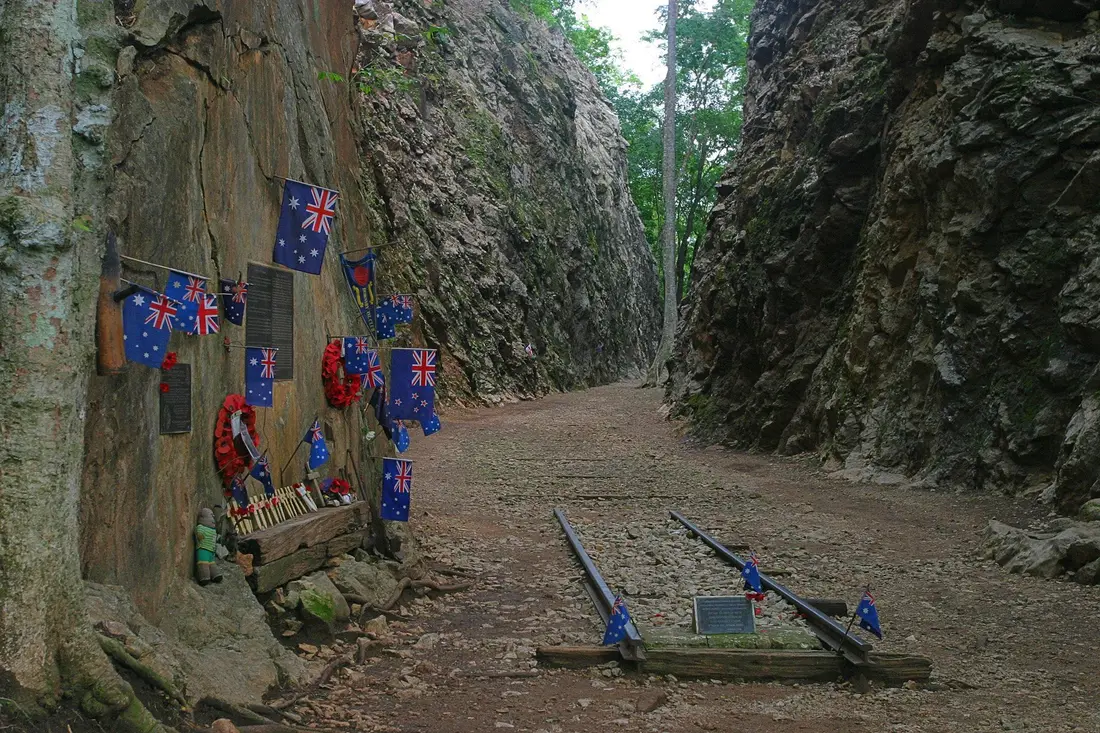
Hellfire Pass is a four-kilometer section of the Death Railway, which was intended to connect Thailand and Myanmar. The construction was carried out by Japanese prisoners of war who carved a long trench into a massive boulder to allow the train to pass. The pass is 500 meters long and 26 meters high. It was called "Hellfire Pass" by the prisoners because torches illuminated the site at night to enable them to continue working. Australian, British, Dutch, and other prisoners were forced by the Japanese to work 18-hour days. However, most of the deaths occurred among the laborers, mainly Malays, Chinese, and Tamils, whom the Japanese had lured with false promises of jobs. 100,000 forced laborers and 16,000 prisoners of war lost their lives during the construction of Hellfire Pass. Today, this section of the railway is no longer in operation. The Death Railway now only runs between Bangkok and Nam Tok. Besides this famous pass, whose story is partly told in the film "The Railway Man," you can also visit the Hellfire Pass Memorial Museum, which documents the history of the site. The museum is run by Australians under the auspices of the Australian War Graves Office. A memorial service is held at Hellfire Pass every year on November 11 (Armistice Day). A ceremony is also held annually on April 25, ANZAC Day (the national day of remembrance in Australia and New Zealand for all comrades who died in war).
Open daily from 9 am to 4 pm. Free admission.
If buses stop near Hellfire Pass and could drop you off there, I advise you to avoid public transport. Otherwise, the return trip to Kanchanaburi will be especially difficult!
How to get there
How do you get to Hellfire Pass? If buses stop nearby and you can be dropped off not too far from Hellfire Pass, I advise you to avoid public transport. Otherwise, the return trip to Kanchanaburi will be especially difficult!




Community
Comments 0
Start the conversation.