A travel guide for Chiang Rai
The embodiment of the culture of the northern Lanna
Chiang Rai was founded in 1262 by Phaya Mengrai as part of the Laotian-Thai kingdom, but only became Siamese territory in 1786.
Chiang Rai is located in the northernmost part of Thailand and captivates visitors with its impressive mountain scenery. Rivers and jungles contribute to its natural wonders, which are sure to amaze visitors.
Chiang Rai, founded in 1262 as the first capital of the Lanna Kingdom, is a historically significant city in northern Nigeria. Although Chiang Mai later became the capital, the neighboring province cannot compete with Chiang Rai as a tourist destination. Some might compare Chiang Rai to Chiang Mai because of its climate and culture. However, the province has its own distinct interpretation of northern Lanna culture and art. Chiang Rai remains one of the most popular cities in the region, especially during the cooler season from late November to February.
Chiang Rai borders Laos to the east and Myanmar to the north. The province is deeply rooted in Lanna culture and influenced by both countries. It is home to renowned artists whose museum and temple buildings have significantly contributed to making Chiang Rai a popular tourist destination. The province's ethnic diversity encompasses various hill tribes and people of Chinese descent. This multiculturalism is reflected in the distinctive style of temple architecture, cuisine, and textile art.
Chiang Rai is known for its relaxed and down-to-earth atmosphere and has retained its tranquil charm. The province offers unparalleled historical and cultural attractions that preserve the Lanna identity through an impressive collection of temples, art, and cuisine. Those who wish to enjoy life at a more leisurely pace will not be disappointed. Enchanting Chiang Rai invites you to unwind and savor every moment.
The weather in mountainous Chiang Rai is cooler year-round than in most other parts of the country. The average temperature is 24.6°C. The best time to visit is during the cooler season from November to February, when temperatures drop below 10°C at night and into the early morning hours.
Arrival
There are over 20 daily flights from Bangkok to Chiang Rai. THAI Smile (+662 118 8888) offers four daily flights between Bangkok and Chiang Rai during the peak season from November to March and three daily flights from late March to late October. Nok Air (+662 088 8955) also flies this route.
Bangkok Airways (+662 270 6699) and AirAsia also offer daily flights.
Nakhonchai Air offers 12-hour bus services between Bangkok (Mo Chit 2 Bus Station) and Chiang Rai. The fare is 725 Baht, approximately US$24. You can reach us by phone at +662 939 4999 from Monday to Saturday between 8:30 am and 5:30 pm local time, or by email at [email protected]. Sombat Tour (+662 030 4999) also offers this service with various bus types.
Green Bus offers daily connections from Chiang Mai to Chiang Rai. Call +6653 266 480 or view the timetable here.
locomotion
Unless you plan to spend a day or two in the city center, renting a car is highly recommended, as it offers greater flexibility and comfort than other modes of transport. The province is located in a mountainous region, making many of the most popular attractions in remote areas difficult to reach by other means. If you're already planning a visit to the Golden Triangle, Doi Tung, and Chiang Saen, you can conveniently pick up a rental car at the airport. Prices start at 900 baht, depending on the vehicle type.
For short distances in the city center, traditional local transport such as samlors and tuk-tuks are excellent. A tuk-tuk is a three-wheeled motorized vehicle that serves as a taxi, while a samlor is a human-powered three-wheeler. A two-hour samlor tour with stops at important temples and city landmarks costs 200 baht. It is customary to negotiate the price before using either of these modes of transport.
Motorcycling is often a good choice for solo travelers or couples. CR Big Bike Rentals on Thaiwiwat Road offers a selection of motorcycles starting from 250 baht (less than US$8) and is happy to advise you on your travel plans. Phone: +6697 935 1298. Motorbiker CR near the airport offers the same service starting from 300 baht per day (US$10). Phone: +6684 263 9396. For short trips around town, blue pickup trucks, called "songthaew" (two rows) in Thai, are also available. The fare is around 15–25 baht (less than US$1).
Things to do in Chiang Rai
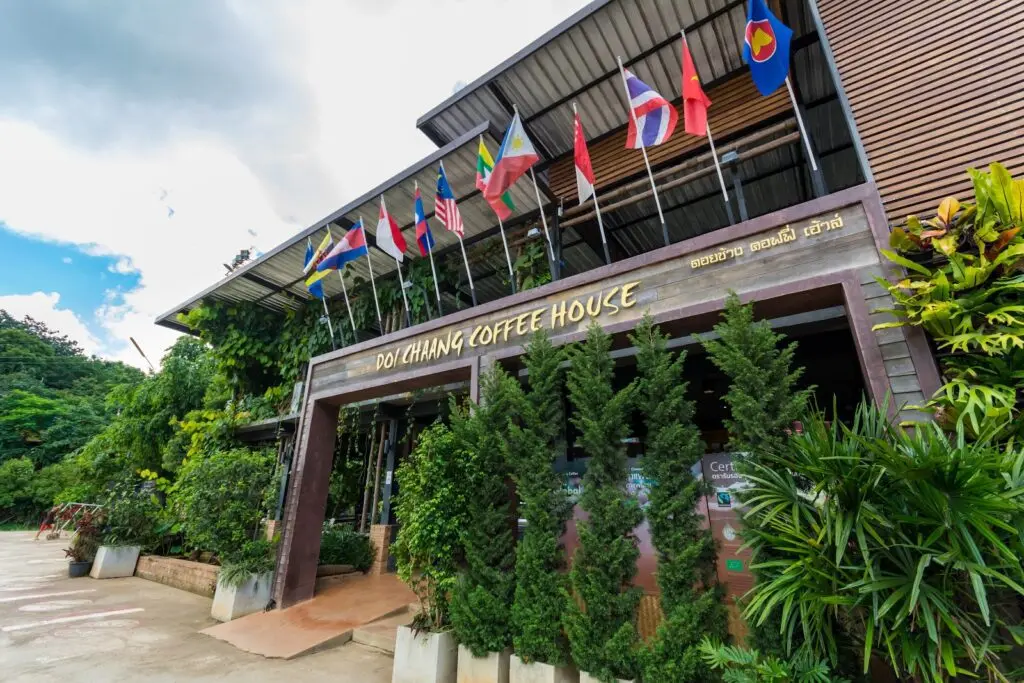
Coffee lovers know that a delicious pick-me-up awaits them at every Doi Chaang Coffee branch. In Chiang Rai, it tastes even better. Doi Chaang beans are made from high-quality Arabica specialty coffee grown in a single region, exclusively in Baan Doi Chang, Wawee subdistrict, Mae Suai district. The name Doi Chaang is synonymous with premium coffee both nationally and internationally. The village of Doi Chaang in the northern highlands of Chiang Rai was one of many communities that received royal support from the late King Bhumibol Adulyadej Rama IX. The king sought to improve the villagers' well-being and curb illegal drug cultivation by providing them with winter crops, including coffee, in 1969. Thanks to the continued support of government organizations, 40 families in the village were able to continue growing coffee in the following years, even though the Thai coffee industry was still underdeveloped and local coffee beans were not widely available. In 2002, the village farmers transitioned their agriculture to a more sustainable future and founded Doi Chaang Coffee Original Co., Ltd. the following year – the rest is history. With the initial goal of ensuring local coffee farmers a fair price for their harvest, the company grew within 15 years from a small operation with 40 hectares of coffee plants in the village to an established brand with a cultivation area almost 300 times larger. Today, Doi Chaang coffee is the pride of Chiang Rai.
Although the Wat Rong Khun monastery complex, better known to foreigners as the "White Temple," is relatively new in the Muang district, it has quickly become one of the province's most popular and frequently visited tourist attractions. The temple, whose facade is a true eye-catcher thanks to pieces of glass embedded in the plaster and walls that sparkle in the sun, was designed by the renowned artist Chalermchai Kositpipat, who opened it to visitors in 1997. The temple is unique due to its architectural and artisanal significance within Thai culture and belief, as the bridge symbolizes the transition from hell to heaven.
The original Wat Rong Khun was in a dilapidated state at the end of the 20th century, and restoration work had to be halted due to a lack of funds. Chalermchai, a Chiang Rai native and already a renowned painter, then decided to redesign the project and finance the temple's reconstruction himself. He wanted to establish the monastery complex as a center for learning and meditation for all who wished to benefit from Buddhist teachings. After its opening to the public, the temple became overwhelmingly popular with tourists and has since become one of Chiang Rai's main attractions.
The monastery is located on Phahonyothin Road, not far from Highway 1, about 15 kilometers southwest of Chiang Rai's city center. Its white color symbolizes the purity of Buddha, while the reflective glass represents his wisdom and teachings. The monastery complex is not yet complete; the original plan calls for nine buildings.
There must be good reasons why Chiang Rai is home to two such different temples, distinguished by their colors, which are among the most popular tourist attractions. If you visit the White Temple, you should definitely also see its twin, the Blue Temple. It captivates visitors with its exquisite color scheme of dark blue and gleaming gold, in stark contrast to the simple White Temple. The driving force behind the revitalization of the temple complex is Mr. Puttha Kabkaew, who assisted Chalermchai Kositpipat in the construction of the White Temple.
Eighty to one hundred years ago, Wat Rong Suea Ten in the Muang district was a deserted area on the banks of the Kok River. With few inhabitants, wildlife, including tigers, thrived there, and locals often saw them leaping across the river – hence the temple's name in Thai. As more people moved to the area, they discovered the absence of a temple nearby, as devout Buddhists typically visited temples. They decided to renovate the temple as a spiritual center for the villagers, and after eleven years of construction, the new monastery was inaugurated in January 2016. Beyond the exterior appearance of all the buildings, the interior of the vihara is particularly striking, featuring a pearly white Buddha statue and elaborate, colorful murals, where dark blue is the dominant color, accentuating the temple's overall aesthetic.
The ornately designed Blue Temple is open from 7:00 AM to 8:00 PM. Admission is free.
In terms of travel destinations, Chiang Saen is more attractive than the Muang district, as it borders Laos and Myanmar and offers a particularly diverse cultural environment. Located approximately 70 kilometers from Chiang Rai city center and about 9 kilometers from Chiang Saen town, the region was once a major hub for regional opium production. In the Golden Triangle, one can see the stretch of river that separates Thailand from its two neighbors, as well as the point where the Ruak River meets Laos and Myanmar. One can also observe the confluence of the Ruak and the mighty Mekong, a popular tourist destination with shops and restaurants along the riverbank. Across the road is Wat Phra That Doi Pu Khao temple, which offers a better panoramic view upstream of the Mekong, with Myanmar to the left and Laos to the right.
If the view from the river isn't enough for you, a river cruise is the best way to explore the Triangle in more detail. There are many different cruises to choose from. If you're short on time, the two-hour trip is recommended. It takes you downstream with stops at a local market and a fishing village, where you can experience the lives of the different nations just across the border. If you have more time, a half-day tour is a good option to see more of the three countries. A stop in Chiang Saen on the Thai side is recommended to visit the numerous ancient temples and ruins.
If you're already in the Golden Triangle, you have a wide selection of cruise operators to choose from. For example, you could book a trip directly on the riverbank. Alternatively, you can board in Chiang Saen city center. The two-hour cruise costs around 500 baht. The sunset cruise is particularly popular, although morning cruises are also available.
If you would like to book tickets in advance, please contact Tha Reua Nuea Siam on +66 089 757 1896 or Sriwan on +66 053 784 101.
A visit to the Opium Museum is a truly unsettling experience. The gloomy corridor leading into the museum's interior is as eerie as the set of a horror film. Simply walk through it to a poppy field, from which opium is harvested, and immerse yourself in the history and effects of opium.
The tour's content is carefully selected and superbly presented using multimedia. For example, you'll learn about the 5,000-year history of opium, its illegal trade, and the devastating consequences of its abuse. The museum goes even further, explaining how royal projects under the leadership of the late King Rama IV and his beloved mother helped transform the lives of a population once dependent on opium and gradually destroyed by it.
The museum, which won the PATA Gold Award in 2004, is located in Golden Triangle Park, opposite the Anantara Hotel, and is just over a 50-minute drive from Chiang Saen city center. It is open daily from 8:30 am to 4:00 pm, except Mondays. Admission is 200 baht. See the website for more information.
The Anantara Golden Triangle Elephant Camp & Resort, opposite the Opium Museum, is known for its commitment to the well-being of the elephants in its enclosure.
The resort overlooks the breathtaking Golden Triangle, where the three countries meet at the Mekong River. It is also home to the Golden Triangle Asian Elephant Foundation (GTAEF), established in 2003, which provides a sanctuary for 22 rescued elephants formerly living on the streets. The camp is designed like a traditional village and works closely with the foundation, employing elephants and entire mahout families and continuing to rescue elephants from the streets. To date, over 50 elephants have been rescued.
Here at the camp, they work closely with the mahouts to ensure the care and well-being of all the elephants. These gentle giants enjoy spacious areas to roam in while receiving appropriate nutrition and medical care. A portion of the hotel's revenue goes to the foundation.
Visit the camp and see for yourself. The Anantara Golden Triangle Elephant Camp & Resort is located at 229 Moo 1, Wiang, approximately 42.8 kilometers from Chiang Saen city center. Tel.: +66 053 784 084. Further information can be found on the website.
Located directly on the banks of the Mekong River, the small but charming Chiang Saen is an absolute must-see. The city's origins date back to the 13th century, though reliable written records from before that time have not survived. This picturesque city captivates visitors with its relaxed atmosphere and rich cultural heritage, reflected in its numerous temples, historical buildings, and ruins. Thanks to well-developed roads connecting Chiang Saen to the heart of the Golden Triangle, it's no wonder that locals and tourists alike love exploring the city by bicycle. For cycling enthusiasts, the ride along the river is an unforgettable experience, as the route is breathtaking, and Chiang Saen is significantly less crowded than Chiang Mai.
On the other side of the river, construction projects are visible in Laotian territory. The riverbank in Chiang Saen is largely untouched; only a few new hotels are being built along the quiet riverfront promenade, making the area ideal for cycling.
The old city of Chiang Saen, one of the oldest cities in northern Thailand and one of the oldest settlements in the Kingdom of Thailand, is definitely worth a visit. Although it is only a small district within Chiang Rai, another kingdom flourished here, on a flat strip of land west of the river, even before the Lanna era. Visitors can explore numerous archaeological sites and monuments that represent the legacy of this kingdom's long history. Among the main attractions is the 700-year-old Wat Chedi Luang. Those interested in archaeology and history should definitely visit the Chiang Saen National Museum, which houses a collection of ancient artifacts found in and around Chiang Saen. The museum is open from Wednesday to Sunday (excluding public holidays) from 8:30 a.m. to 4:30 p.m.
If you're not an ambitious cyclist and would prefer a leisurely ride along the waterfront and through the old town, you can rent a bicycle at the Chiang Saen Tourist Centre. Open-top bus tours are also available there between 8:30 am and 4:30 pm. Call +66 053 777 287 to check availability.
For gourmets and shopping enthusiasts, a section of the riverbank is closed to vehicles every Saturday, allowing locals and visitors to explore the Saturday market in the pedestrian zone.
In contrast to the city centers of Chiang Mai and Chiang Rai, Chiang Saen is considerably quieter. The city's Christmas and New Year's lights are less extravagant than those of hotel chains in larger cities. The pedestrian zone is no exception: open only on Saturdays, it's much simpler than its counterparts in Pai or Chiang Mai's Tha Pae. But it's precisely this simplicity that gives it its charm, and the riverfront promenade is more picturesque and romantic. Food stalls and makeshift shops line the street – it's fun to browse for something you might end up buying. And of course, don't forget to haggle for the best price. For street food lovers, there's a wide selection of grilled dishes, curries, salads, and rice and noodle dishes to whet your appetite after a long walk. Choose a restaurant or stall, take a seat on a mat or low stool, and enjoy the delicious food you've ordered while admiring the sunset over the Mekong. You can first enjoy the spectacular sunset before going shopping and having a late dinner.
The market in the pedestrian zone opens at 4 pm and lasts until midnight. This guarantees you plenty of time to shop and eat.
Don't forget to try the desserts from Pa Uan Bua Loy (+6653 743061, +6685 0323249). At her stall, she serves Bua Loy, sticky rice balls in coconut milk. This local aunt's recipe is a favorite dish, often served to Her Royal Highness Maha Chakri Sirindhorn on special occasions. She offers her famous and delicious Bua Loy daily from 5:00 PM to 9:00 PM at the Night Bazaar in five different flavors. You'll recognize her stall by the long line.
Chiang Rai is also known for its silver jewelry. In the night bazaar districts, you'll find shops selling rings, necklaces, earrings, and other items made of 92.5% pure silver. Visit the Chiang Rai Silver Night Bazaar (+6681 993 1128).
Tourists now have more options for connecting Thailand with various parts of Laos, thanks to the opening of several friendship bridges in the last five years. However, in Chiang Rai, there's no more romantic and relaxing experience than a Mekong River cruise from Huay Xai in Laos to Luang Prabang, the UNESCO World Heritage city. It promises to be another unforgettable cruise.
The Chiang Khong district, situated on the river 55 kilometers from Chiang Saen, lies opposite Huay Xai in Laos. Until the opening of the fourth Thai-Laotian Friendship Bridge in December 2013, villagers on both sides commuted daily by boat, significantly increasing tourist traffic from Thailand to Laos.
Although Chiang Khong is primarily known as a border town on the riverbank, visited for its ferries to Huay Xai in Laos, it is—much like Chiang Saen—another great place to soak up the Mekong atmosphere before crossing over. You should spend at least one night here before continuing on to Laos, with Luang Prabang as your destination.
Don't forget to bring your passport, as you will need a visa to enter Laos, which costs approximately US$35. The two-day cruise with an overnight stay and a stop in Pak Bang costs around 900 baht, or US$30. Some resorts also offer their own cruises, which are longer and include several stops at different locations between the Golden Triangle and Luang Prabang.
Slow boats depart from Huay Xai between 9:00 and 11:30 AM and take two days and one night to reach Luang Prabang. Faster boats depart at the same time. The speedboat crossing takes six hours but costs 1,450 baht or US$49.
From the Chiang Khong border crossing, tourists must take a bus across the bridge into Laos and, after completing the formalities, hire a minibus for 400 baht to Huay Xai. The journey takes about 20 minutes. From there, they can buy a ticket for a longtail boat and embark on a 30-hour cruise to Luang Prabang.
Anantara is organizing a three-day/two-day cruise through the Golden Triangle to Luang Prabang aboard the Gypsy, an exclusive cruise ship with only two deluxe cabins. Activities include visits to remote elephant camps, silk weaving workshops, and thousand-year-old caves. Contact the Anantara reservations team at +662 365 9110 or [email protected].
Selected articles about Chiang Rai
The best hiking trails in all of Thailand
When you think of Thailand, golden temples and tropical beaches might come to mind. But beyond that, numerous hiking trails await...
A guide to traveling in Thailand during the cooler months
From November to February, Thailand experiences its cooler season – a time with blue skies and fresh mornings that appeals to travelers...
Cycling in Thailand: The best relaxed cycling routes in Thailand for scenic adventures
You are looking for a different way to experience Thailand – one that allows you to travel at your own pace and off the beaten track...
Do you need travel information?
Discover everything you need to know before your trip – from visa requirements and entry guidelines to essential travel tips and frequently asked questions.




Community
Comments 0
Start the conversation.