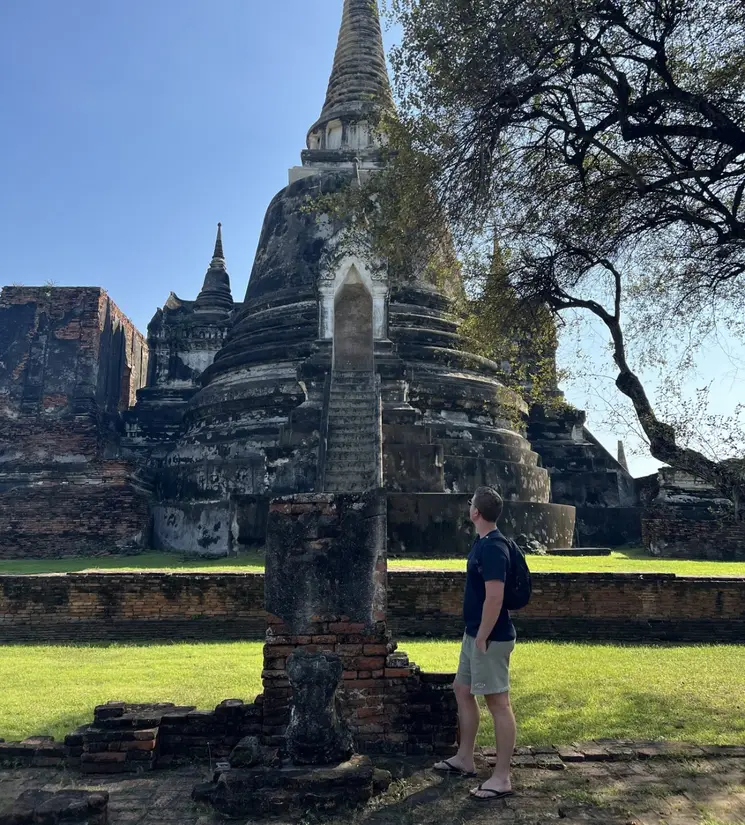
As we discovered on our day trip from Bangkok, Ayutthaya has much more to offer than one might initially expect. The ancient capital is famous for its temple ruins – with brick prangs, Buddha heads entwined with tree roots, and bell-shaped chedis scattered throughout the UNESCO World Heritage Park. However, what impressed us most was the city's riverside location, the delicious food, and the fact that we traveled extensively by train and tuk-tuk.
We visited Ayutthaya with Cam's parents, and although temple visits were the main focus, Kat discovered some fantastic local food that enriched our trip: boat noodles and giant river prawns. We enjoyed these two dishes for breakfast and lunch, which gave us the energy we needed to explore the many different ruins on the historic island. The park is vast and definitely not something you can cross in an hour, so a tuk-tuk driver is highly recommended. This way, we didn't have to walk or cycle in the afternoon heat and could easily reach the temples.
A day trip from Bangkok to Ayutthaya is one of those experiences that requires hardly any planning. You can simply do it like we did: hop on the local train early in the morning, hire a tuk-tuk driver at the station, visit a few temples, have lunch by the river, and head back to Bangkok before nightfall. Since Ayutthaya is only 80 kilometers away, a day trip there is perfectly doable and definitely worthwhile – especially for history buffs.
Due to its history, the ruins of Ayutthaya are no longer in perfect condition. The kingdom existed for over four centuries and was a political power and trading center in its time. However, the city was ultimately destroyed in 1767 during the Burmese invasion. Some Buddha statues were beheaded, and many temples were burned. While the ruins are not perfectly preserved, they still possess a fragmented, unadorned beauty.
Getting to Ayutthaya by train
There are several ways to travel to Ayutthaya, but in our opinion, the train is the best option – it's comfortable and the train journey is simply unbeatable. We opted for the regional train, also known as the "regular train," from the historic Hua Lamphong station. These trains are third class and considerably slower than other services (the journey can take up to two hours with stops), but they are cheaper and much more charming.
The carriages of the regional train are simply furnished and filled with locals. With the window open, you can watch the passing scenery – from skyscrapers to traditional alleyways (“sois”) and canals, all the way to the flat landscape. Arriving at Ayutthaya station, you'll find yourself just outside the historic island, which isn't really accessible on foot. However, numerous tuk-tuk drivers are waiting to take you to the historic park.
Another option is to travel from Krung Thep Aphiwat station. This modern station now handles most of Bangkok's long-distance trains, so you can take the express train if a quick arrival is particularly important to you. The journey to Ayutthaya is more direct and takes between 60 and 75 minutes. The carriages are even air-conditioned. We recommend boarding the train between 7:30 and 8:30 a.m. – early enough to avoid the biggest crowds and the worst of the heat, allowing you to enjoy a full day in Ayutthaya.
Hua Lamphong Station
Ayutthaya Itinerary: The most beautiful temples and restaurants
The best way to plan your day trip to Ayutthaya is to accept that it's impossible to see everything. The city is home to dozens of ruins and temples, often spread far apart. It would take several days to see everything, and just as many to discover the numerous hidden gems. Ideally, you should choose four or five main attractions and plan your day so you don't get "temple fatigue"—which, by the way, can definitely happen.
10:00 AM: Boat noodles at a local restaurant
Ask your tuk-tuk driver to take you straight to a local restaurant serving boat noodles—you'll be hungry after the train ride, and it's a great way to start the day. Each bowl is bursting with flavor, containing rice noodles, pork or beef, meatballs, liver, and water spinach. The broth is thickened with pork or beef blood and then garnished with garlic, pork rinds, and Thai basil. Boat noodles are served in small bowls, so it's customary to order more than one. For us "farangs" (foreigners), that simply meant two bowls, but for Kat, it meant four or five bowls drenched in copious amounts of chili.
11:00 AM: Wat Phanan Choeng Worawihan
The absolute highlight of Wat Phanan Choeng Worawihan is the enormous, 19-meter-high Buddha statue covered in gold leaf in the main hall. Its size is impressive, but what touches you even more is the peaceful atmosphere of the temple. The hall feels more contemplative than touristy, and you see locals earning merit and praying – including Kat, who was praying before the Buddha and lighting candles and incense.
Wat Phanan Choeng Worawihan
12:00: Wat Yai Chai Mongkhon
Our favorite temple in all of Ayutthaya was Wat Yai Chai Mongkhon. It houses a bell-shaped chedi, accessible via a brick staircase. While the view from the top is beautiful, what truly sets this temple apart are the rows of stone Buddha statues draped in orange cloths – a unique photo opportunity. The temple also boasts a reclining Buddha, which, while not as famous as the one at Wat Pho in Bangkok, is still well worth a visit. For these reasons, Wat Yai Chai Mongkhon made it onto our list of the 10 best temples in Thailand – feel free to read the article below.
Read more: The 10 most beautiful temples in Thailand: Golden Buddhas and ancient ruins
1:00 PM: Wat Mahathat
Wat Mahathat is one of the most popular temples in Ayutthaya – a sprawling complex filled with ancient ruins, crumbling towers, brick foundations, and the famous Buddha head entwined by tree roots. The Buddha head's history dates back to the Burmese invasion of 1767, when statues were beheaded. After the site was abandoned, the roots of a Bodhi tree slowly grew around the stone, holding it in place like a natural shrine. During our visit, we saw people sitting before the Buddha, admiring it from a distance – a common practice in Thailand, where one always adopts a lower posture than the Buddha out of respect.
Buddha head in the roots of a Bodhi tree
2:00 PM: Giant river prawns for lunch
In the early afternoon, it gets very hot in Ayutthaya – the perfect time for lunch by the river. Fantastic seafood restaurants line the riverbanks, including Baan Mai Rim Num and Grand Chaopraya. Both offer the giant river prawn – grilled and served with a spicy seafood sauce. Kat ordered this dish during our lunch break, and we couldn't believe how enormous it was. One reason Thais love it so much is the buttery fat inside the prawn's head.
3:00 PM: Wat Ratchaburana
Another temple in Ayutthaya worth mentioning is Wat Ratchaburana. It boasts a massive, Khmer-style central prang with a secret underground crypt that you can descend to admire ancient murals. However, if you enjoy photography (as we did), the temple's highlight is the ruin of the ordination hall (ubusot) with its brick walls and beautifully weathered, hollowed-out windows. We thoroughly enjoyed photographing the windows, with the light perfectly illuminating the central prang in the background.
4:00 PM: Wat Phra Si Sanphet
Wat Phra Si Sanphet served more as a royal retreat than a public monastery and was the site of numerous royal ceremonies, generally representing state power. Architecturally, the temple is known for its three bell-shaped chedis – partially ruined, but still impressively beautiful. After this temple visit, it's probably time to wind down the day. So, let your tuk-tuk driver take you back to the train station to begin your journey back into the city, where more Bangkok adventures await.
Frequently asked questions about visiting Ayutthaya
Is Ayutthaya worth visiting from Bangkok?
In our opinion, Ayutthaya is absolutely worth a visit. It's easily accessible from Bangkok by train in just over an hour. However, because the city is so close, large tour groups flock to the temples. We expected a lot of visitors, so it didn't bother us, but for others, this might be a deal-breaker. In that case, we recommend Sukhothai instead – just over an hour's flight away. While flying isn't the cheapest way to travel in Thailand, it gives you the opportunity to discover impressive sites like Wat Si Chum and Wat Si Sawai.
Read more: Ayutthaya vs. Sukhothai: Day trip or adventure in the north?
When is the best time to travel?
We were there in December, during the cool, dry season, and it was still quite hot. The tuk-tuk did offer some shade and a pleasant breeze as we traveled between the temples. April and May are the hottest months, so hiking or cycling can be quite strenuous. June to October is the rainy season, but with the right attitude, it's still a wonderful time to visit. Pack a poncho and an umbrella, and you'll experience a less crowded Ayutthaya and benefit from cheaper hotel prices if you're staying overnight.
Read more: 50 Thailand travel tips: What you should know before your trip
What is the best way to get around Ayutthaya?
The ruins of Ayutthaya are extensive, making a stroll among them nearly impossible. Therefore, we recommend hiring a tuk-tuk driver for the day. This can easily be arranged right after arriving at the train station. Our driver recommended several temples, showed us some local specialties, and—most importantly—waited for us at each temple. Cycling is a popular alternative, but it's better suited for a multi-night stay. Another option is to book a guided tour from Bangkok. This offers several advantages: transportation, a tour guide, and lunch are all included in one package.




Community
Comments 0
Start the conversation.