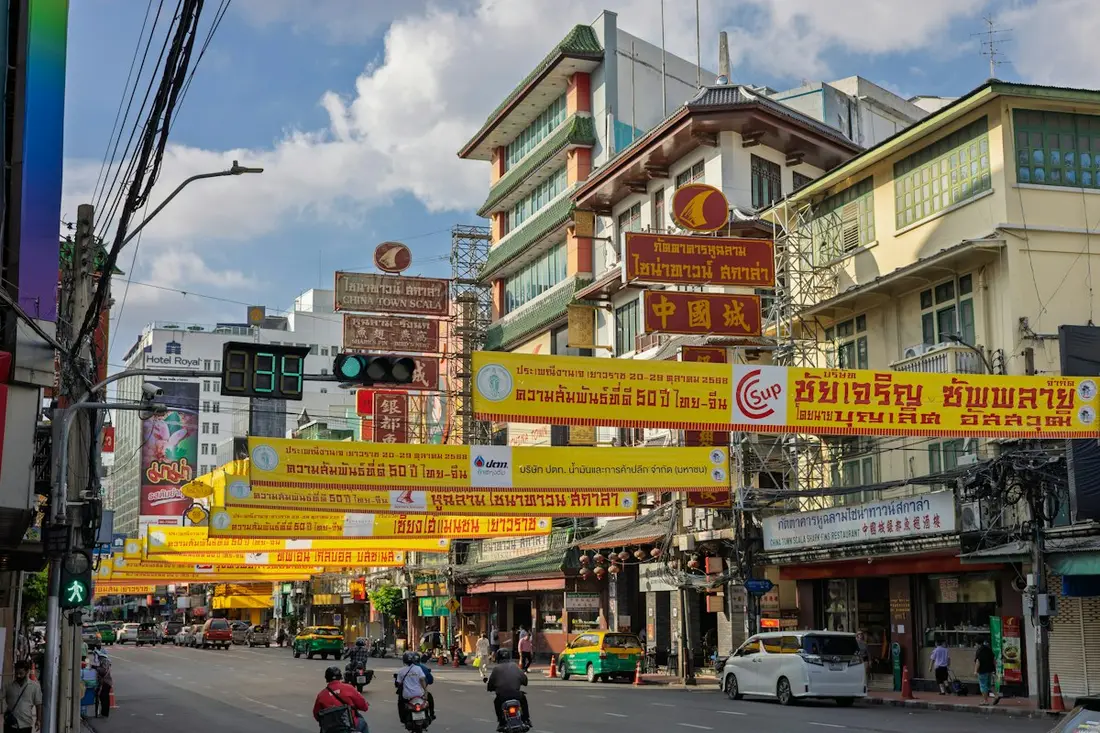
What language is spoken in Thailand? The short answer
The language spoken in Thailand is Thai (ภาษาไทย, also called Central Thai or Siamese), the only official language, spoken or understood by about 88% of the 70 million inhabitants. English is Thailand's unofficial second language and is widely understood in Bangkok, Chiang Mai, Phuket, and the islands, so it's possible to travel without speaking a word of Thai. Thai is a tonal language with its own script of 44 consonants, and only about a third of Thais speak Central Thai as their first language.
The rest grow up with regional variations like Isan Thai and learn Standard Thai at school. This guide covers the language, the dialects, where English works and where it doesn't, and ten key phrases with their respective Thai script so you can recognize them on signs and menus.
Key Facts (2026)
The official language is Thai (Central Thai), which is understood by about 88% of the population.
Thai is the language of schools, television, and government throughout the country. Only about a third of Thais speak it as their first language; the rest learn it along with a regional variant.
English is the unofficial second language and is widely spoken in tourist areas.
Hotels, tour operators, dive schools, airports, and most restaurants in Bangkok, Chiang Mai, Phuket, and the islands operate in English, with bilingual menus and BTS/MRT signage. This changes quickly in local markets, small towns, and with songthaew drivers.
The three most widely spoken languages are Central Thai, Isan and Kham Mueang (Northern Thai).
Isan, a language closely related to Lao, is spoken by about a third of the population in northeastern Thailand. Kham Mueang is widespread in the Chiang Mai area, and Pak Tai (South Thai) is spoken on the peninsula and islands. In total, there are over 70 living languages in Thailand.
Five notes, 44 consonants, no spaces between words
Tones are the most difficult part of Thai. The grammar is simple; there are no conjugations, tenses, or plural forms. Thais are very forgiving of foreigners' tonal errors, and context helps with understanding.
Hello, is Sawasdee Khrap (men) / Sawasdee Kha (women)
สวัสดีครับ / สวัสดีค่ะ, often with a slight wai. The politeness particle khrap/kha appears at the end of almost every sentence and is the easiest way to be well received.
Thai is the official language of Thailand.
Thai (ภาษาไทย, Phasa Thai) belongs to the Tai-Kadai language family and is related to Lao (largely mutually intelligible). Despite centuries of borrowing from all three languages, as well as a significant amount of Sanskrit and Pali vocabulary introduced with Buddhism, it is not related to Chinese, Malay, or Khmer. The Thai script (อักษรไทย) is derived from Old Khmer and comprises 44 consonants, over 15 vowels, no spaces between words, and—fortunately for visitors—Arabic numerals, which are used alongside Thai numerals in everyday life. The script is ubiquitous, appearing on everything from temple gates to receipts. Recognizing just a few shapes, such as the repeat sign ๆ or the Baht sign ฿, makes the signage easier to understand.
What makes the Thai language so difficult are its tones. There are five (mid, low, falling, high, rising), and the same syllable can have completely different meanings depending on the tone. A typical example is ไม้ใหม่ไม่ไหม้ใช่ไหม, six words, five of which are roughly romanized with "mai," which, with the correct tones, means something like "New wood doesn't burn, does it?" In practice, however, this isn't always easy, as Thais are very forgiving of foreigners' incorrect tones, and context plays a crucial role.
One structural feature you'll hear constantly is the use of politeness particles. Men end sentences with ครับ (khrap), women with ค่ะ (kha), and they add something to almost everything to make it polite. For example: สวัสดีครับ/ค่ะ (sawasdee khrap/kha, hello), ขอบคุณครับ/ค่ะ (khop khun khrap/kha, thank you). Using them is the easiest way to be instantly better received.
Other languages spoken in Thailand, from Isan to northern and southern Thailand
Thailand has over 70 living languages, and the major regional dialects are also of interest to visitors. Isan (ภาษาอีสาน), spoken by about a third of the population in the northeast, is more closely related to Lao than to Central Thai. It can be heard everywhere in Bangkok from taxi drivers and street vendors, as many of the city's workers come from the northeast. Kham Mueang (คำเมือง, Northern Thai) has survived in the Chiang Mai area and uses its own Lanna script on temple signs. Pak Tai (ปักษ์ใต้, Southern Thai) is the faster, more concise variant of Thai spoken on the peninsula and islands.
Everyone educated in Thailand speaks Standard Central Thai (it's the language of schools, television, and government offices), so dialects are more of an enrichment than a barrier. You'll also encounter larger communities that speak Malay (in the far south), Chinese dialects like Teochew (in Bangkok's Chinatown), Karen and hill tribe languages (in the northern mountains), and Khmer (along the Cambodian border).
Is English spoken in Thailand? Where does it work and where doesn't it?
English is widely understood in tourist areas of Thailand. Hotels, hostels, tour operators, dive schools, airport staff, and most restaurants in Bangkok, Chiang Mai, Phuket, and the islands speak fluent English. Menus are bilingual, and announcements and signage on the BTS/MRT are entirely in English. While Thailand ranks relatively low in the EF English Proficiency Index nationwide, the tourism industry, which accounts for approximately 12% of the economy, is the most important English-speaking target group.
In local markets, with songthaew and bus drivers, in small Thai towns, and at street food stalls off the beaten track, English is often in short supply. The solutions are simple: Google Translate translates menus with your camera, Grab makes directions unnecessary, and a smile, a finger gesture, and the question "Tao Rai?" (How much is this?) are enough to complete most market transactions. Thais are extremely helpful, and a lack of English is common, while helpfulness is rare.
10 Thai sayings worth learning
สวัสดี – Sawasdee khrap/kha – hello
สวัสดีครับ (male) / สวัสดีค่ะ (female). The universal greeting (sah-wah-DEE krap/kah), often paired with a slight wai (palms together, small bow). For each subsequent sentence, use khrap if you are male and kha if you are female.
ขอบคุณ – Khop khun khrap/kha – Thank you
ขอบคุณครับ/ค่ะ (kop-KOON krap/kah). The most used phrase on every trip. ขอบคุณมาก (khop khun mak) = thank you very much.
ไม่เป็นไร – Mai pen rai – don’t worry / it’s okay
(my-pen-RYE). The national philosophy in three syllables. Use it to excuse apologies, mishaps, and minor messes.
เท่าไหร่ – Tao Rai? - how much?
(Rye). Market essential. The figures come back quickly, but the sellers type them into a calculator if you seem a bit perplexed.
อร่อย – Aroi – delicious · ไม่เผ็ด – Mai phet – not spicy
อร่อยมาก! (Aroi Mak, very tasty) pleases every cook. ไม่เผ็ด (my-PET) is self-defense when ordering, and เผ็ดนิดหน่อย (phet nit noi) = something spicy.
ห้องน้ำอยู่ที่ไหน – Hong nam yu tee nai? — Where is the bathroom?
(hong-NAHM yoo tee-NYE). Or simply? (hong nam?) with a questioning look. It is generally understood.
ไม่เอา – Mai ao khrap/kha – no thanks (I don’t want it)
(My-OW). The polite and effective way to decline pushy salespeople, tuk-tuk offers, and suit shops. Far better than silence.
ใช่ / ไม่ใช่ – Chai / Mai chai – yes / no
(Chai / My-Chai). Literally "right / not right", the everyday yes and no.
ไป... — Pai... — go to...
Tell a taxi driver "ไปสุขุมวิท" (pai Sukhumvit), and you'll get going. Combine it with a marker on your phone's map for more precise directions.
โชคดี – Chok dee – good luck / cheers
(chok-DEE). It serves both as a toast with Chang beer and as a heartfelt farewell. End every pleasant encounter with it.
Are you ready to use these formulations? Continue planning.
Frequently Asked Questions
Frequently asked questions about: What language is spoken in Thailand?
Thai (Central Thai/Siamese) is the official language and is understood by about 88% of the population. Only about a third speak it as their first language. In large parts of the region, such as Isan (northeast, closely related to Lao), Kham Mueang (north), or Pak Tai (south), Standard Thai is taught in schools.
Yes, in tourist areas. Hotels, restaurants, tour operators, and transport hubs in Bangkok, Chiang Mai, Phuket, and on the islands generally understand English well, thanks to bilingual signage on trains and at airports. English skills are limited in local markets, small towns, and among taxi/songthaew drivers, but a translation app and a few Thai phrases can easily overcome the language barrier.
สวัสดี ('sawasdee'), with the polite particle, so สวัสดีครับ (sawasdee khrap) if you are male, สวัสดีค่ะ (sawasdee kha) if you are female (sah-wah-DEE krap/kah). It is often accompanied by the wai, pressing the palms together with a slight bow to the chest. Returning a smile with a smile is always well received.
Basic Thai language skills are easier than you might think. The grammar is simple (no conjugations, tenses, or plural forms). The five tones and the script with its 44 consonants are more challenging. However, you don't necessarily need either for travel, as ten common phrases plus the polite particle "khrap"/"kha" are sufficient for most social interactions.
These are closely related Tai-Kadai languages with a high degree of mutual intelligibility. Thai and Lao speakers can generally understand each other, and Isan (spoken by about a third of Thais in the northeast) is a Lao variety written in the Thai script. Standard Thai and Lao use different writing systems and differ in vocabulary and tonal patterns.
Central Thai (the official language, understood by about 88% of the population), Isan (the Lao-related language of the northeast, spoken by about a third of Thais), and Kham Mueang, the northern Thai of Chiang Mai, are the most widely spoken languages. Southern Thai, Malay, and Chinese dialects such as Teochew, Khmer, and Karen follow. English is the most commonly spoken foreign language.
No, Thai is the only official language. English is the unofficial second language, taught in all schools, used in tourism and business, and found on airport, BTS/MRT, and street signs. Language proficiency is high in hotels and tourist areas, but rather patchy outside of cities. Therefore, it's advisable to have a translation app handy when traveling outside of cities.
Where to stay in Thailand
Compare prices on different trusted booking sites for the destinations listed in this travel guide.
Compare prices on Booking.com
We may receive a commission for bookings made through these links – this will not incur any additional costs for you. Learn more.
You might also like this
Best time to travel to Thailand
The best time to travel is from November to February; the rest of the year is best on the east coast.
Thailand on a budget
Thailand for less money, without sacrificing the best
Is Thailand safe?
What actually poses risks, what is only mentioned in the news, and what do four government advisories say – destination by destination?
Thailand Visa and Entry Requirements
Who is allowed to enter visa-free, what entry controls are in place, what is the TDAC, and how can you extend your stay?
Ethical elephant sanctuaries in Chiang Mai
No riding, no shows, and the protected areas where you watch rather than wash.
I lived in Bangkok for four years and traveled throughout the country from there. The guidebooks reflect my personal opinion and are written as I would explain things to a friend planning a trip.
Ready to create your travel itinerary?
Use our free trip planner to save places, organize days, and share your trip.




Community
Comments 0
Start the conversation.