Why should you go there and how do you do it right?
The giant swing is a popular photo opportunity, but the real reason to pass through the gates lies in what lies beyond. Wat Suthat is one of Bangkok's ten first-class royal temples. Begun in 1807 by Rama I and completed in 1847 under Rama III, its wihan houses Phra Si Sakyamuni, an eight-meter-high bronze Buddha statue cast in Sukhothai in the 14th century and shipped to the new capital. The walls are painted from floor to ceiling, and the wihan's magnificent carved doors were crafted by King Rama II himself; the originals are now in the National Museum.
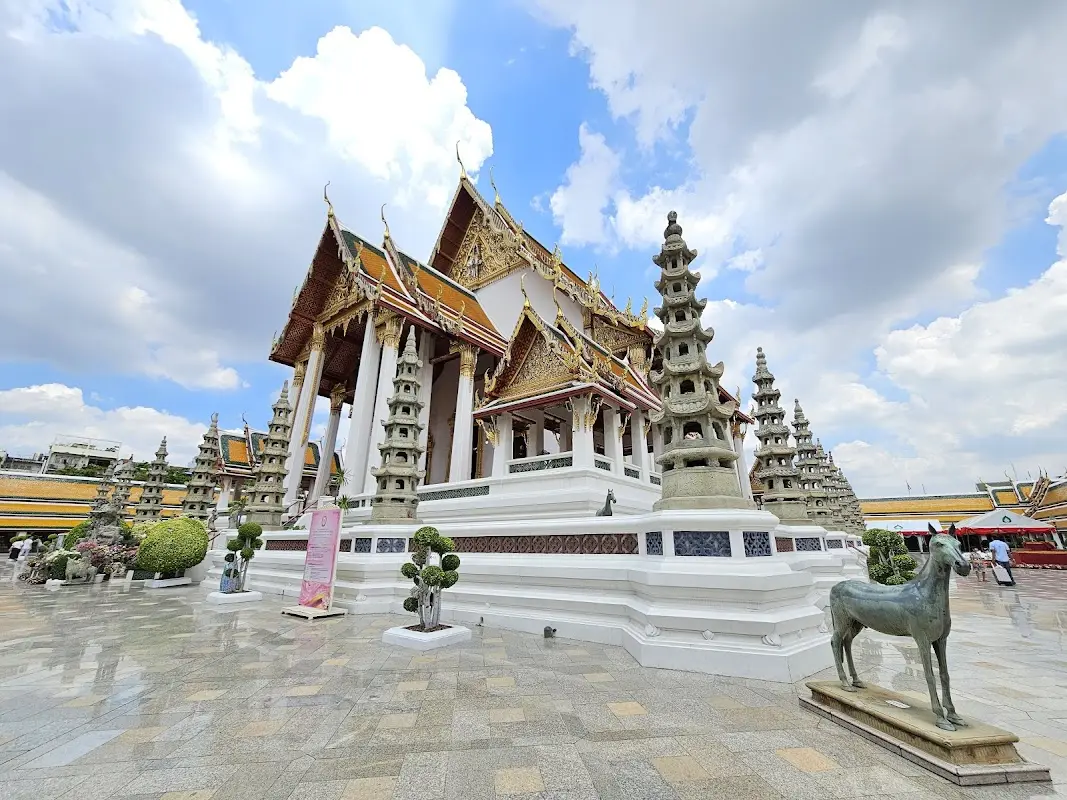
What surprises most people is the tranquility. Located in the heart of the old city, the cloisters are spacious, shady, and peaceful, lined with rows of seated Buddha statues. Look out for the Chinese stone figures in the courtyards, which arrived as ballast on rice ships in Bangkok's early days, and the 28 small Chinese pagodas surrounding the main hall. Thai visitors come to pray during the week, so you're more likely to be sharing the place with worshippers than with tour groups. It's quietest on weekday afternoons.
Entry costs 100 baht for foreign visitors and is free for Thai citizens. The temple complex opens at 8:30 am and remains open until the evening. Google Maps indicates a closing time of 8:00 pm, while some guidebooks mention a later closing time. A visit is therefore best at the end of a day at the temple. Please cover your shoulders and knees and remove your shoes inside.
Sam Yot MRT station is about a ten-minute walk away, along Bamrung Mueang Road, where shops sell monks' supplies and Buddha statues. The Grand Palace is about a kilometer to the west. The giant swing is directly opposite, so you can see both at the same time.




Community
Comments 0
Start the conversation.