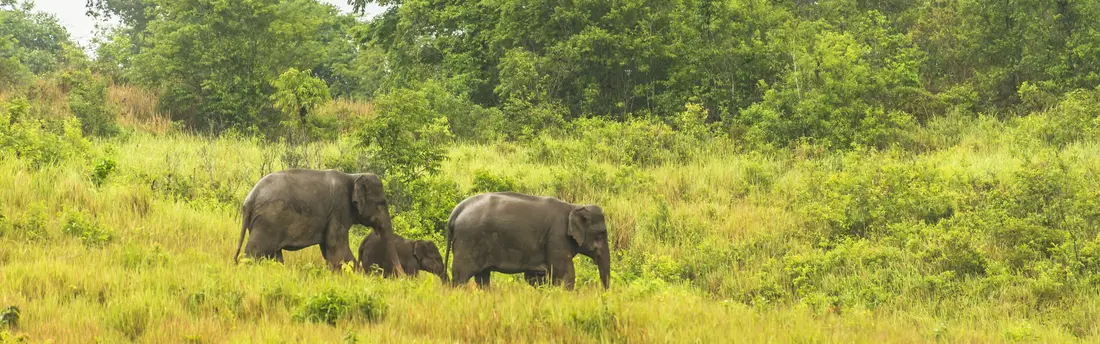
Located just three hours from Bangkok, Khao Yai National Park is a lush paradise that is perfect for a weekend getaway for expats and adventure seekers alike.
After my visit, I compiled this ultimate travel guide, combining my personal experiences with essential tips for your trip – from the best time to travel and the optimal length of stay to restaurants and accommodations.
The 3 best activities in Khao Yai National Park
1. Jungle hiking: Ideal for wilderness seekers
A hike in Khao Yai National Park offers a truly relaxing escape from the hectic city life. Surrounded by dense tropical forests, you can admire unique plant species and listen to the calls of the wildlife.
The park offers seven hiking trails of varying difficulty. The shorter trails, numbers 1, 2, and 7, are beginner-friendly, take approximately 1–2 hours, and feature well-maintained paths.
Trails 3 through 6 are particularly attractive to adventurers due to their unpaved paths and better wildlife viewing opportunities. Ranger accompaniment is mandatory on these trails. However, the rangers may speak little or no English.
That's why we were so glad we had booked Tenny, our guide, in advance. As a translator, she helped us understand the ranger's introduction and instructions, and showed us exactly where we could observe gibbons, hornbills, and other animals. She also captured many fascinating moments for us.
2. Waterfalls: Best visited during the rainy season
A visit to Khao Yai isn't complete without seeing its famous waterfalls. The two most well-known are the largest waterfall, Haew Narok, and Haew Suwat, which was made famous by a legendary scene in the film "The Beach".
The waterfalls can be experienced in their most spectacular form during the rainy season (June to October), while during the dry season (November to May) they are just a trickle.
Just so you know: Swimming is not allowed at any of the waterfalls, so please enjoy the view from the designated viewpoints.
3. Encounters with wild animals: A gamble
Khao Yai is home to thousands of wild animals and a paradise for animal lovers. While spotting wild elephants is the main attraction, sightings are rare. More common are muntjacs, macaques, gibbons, civets, porcupines, and various bird species such as hornbills.
To observe wildlife, you could combine this with an early morning hike or take part in a one-hour night safari, as wildlife is typically active during the cooler hours.
How many days are enough for Khao Yai National Park?
A day trip may suffice for a short visit to Khao Yai National Park, but 2-3 days are ideal for a more intensive experience that includes hiking and wildlife viewing.
Day trips to Khao Yai National Park are very popular online, especially from/to Bangkok. They may seem tempting, but with a long round trip of 6-7 hours, you would hardly see anything of it.
With two days, you can visit the main sights, go on longer hikes, and even participate in guided night activities such as safaris or bat watching. A third day allows for a more relaxed pace and offers better chances of spotting wildlife.
Our two-day trip through Khao Yai National Park
During our two-day tour, we explored trails 3 and 4, visited the majestic Haew Norak and Haew Suwat waterfalls, and tried our hand at bat watching at dusk. Here are the details of our adventure:
Day 1: Viewpoint at kilometer 30, hike on trail 3 and Haew-Suwat waterfall
Our first stop, the KM30 viewpoint, offers a panoramic view of the mountains below and is ideal for capturing breathtaking vistas.
Before reaching this stop, we traveled for almost an hour from the park entrance on winding mountain roads. If you are prone to motion sickness, a little preparation can be helpful.
After a short break, we drove to the visitor center to get kitted out for our hike on trail 3. Our ranger kindly gave us leech socks (essential! We saw leeches during the hike). Then we drove to the trailhead at kilometer 33.
Our 3-hour hike could be divided into two sections: one and a half hours through dense jungle, followed by another half hour in a grassy landscape.
Deep in the lush forest, the ranger explained the different plants to us (their scent and even taste), taught us how to identify animal tracks and droppings, and familiarized us with the sounds of the diverse wildlife. The most magical moment? A flock of hornbills circling overhead while a curious monkey searched for food nearby.
The open grasslands in August, with their lush green and white blossoms, offered picturesque photo opportunities. Climbing to the observation tower, armed with binoculars, and searching for animal tracks gave us an exciting sense of connection!
After a simple lunch at the tourist center, we explored the Haew Suwat nature trail, which leads to the famous waterfall.
The descent from the parking lot to the base of the waterfall took about 40 minutes. The path was mostly well-maintained, with only a steep set of stairs at the very end. This descent is not recommended for people with limited mobility – in this case, the viewing platform is a better option.
At dusk, we visited the Khao Luk Chang bat cave hoping to see thousands of bats taking flight. It is said that the bat colonies usually emerge between 6:00 and 6:30 pm.
Unfortunately, the overcast sky delayed their appearance, and we weren't able to observe some of them until around 7 p.m. According to local information, sunny days are best for witnessing this spectacular event, with the chances being highest during the dry season (November to May).
For those seeking nighttime activities in Khao Yai, a night safari during the rainy season offers a particularly wonderful experience. Even if you don't spot any animals, the drive through the park in an open 4x4 is an unforgettable adventure!
Day 2: Hiking Trail 4 and the Grand Haew Narok Waterfall
After checking out of our hotel at 7:30 am, we went directly to the park's visitor center to meet our ranger and prepare our equipment.
Hiking trail 4 is shorter than hiking trail 3, but considerably more challenging. With its many ascents and descents, denser vegetation, and paths that can be slippery after rain, the hike takes about 2 hours.
Highlights included crossing a stream on a fallen tree trunk (a thrilling balancing act!) and accidentally discovering a huge anthill – both nerve-wracking and fascinating at the same time.
Our last stop was the park's highest and most spectacular waterfall, Haew Narok. This three-tiered waterfall plunges an incredible 150 meters, making it even more impressive than Haew Suwat Waterfall.
The picturesque, kilometer-long path to the waterfall winds through the tranquil forest. But the last 200 steep steps were a real challenge!
Read more about Khao Yai vs. Khao Sok.
Do I need a guidebook for Khao Yai National Park?
As a local expat with a car and basic knowledge of Thai, you can explore the park on your own. Only for the challenging hiking trails 3 to 6 is booking a ranger mandatory.
However, foreign travelers are advised to book a tour with an English-speaking guide and private transfer in advance. Without your own transportation, exploring the park is quite difficult due to its size.
Furthermore, the local rangers spoke very little English. Without a guide to explain important details, one might miss valuable insights into the flora and fauna. This also explains the frequent negative feedback regarding hiking experiences.
Best time to visit Khao Yai National Park
As a natural paradise, the ideal time to visit Khao Yai depends on what you want to experience. Each season has its own charm, so it's mainly a matter of aligning your preferences with the park's seasonal highlights.
All activities are possible during the dry season. Thanks to the guaranteed sunny days, the hiking trails are less muddy.
The weather is also pleasantly cool, as the high-altitude terrain and dense forests of Khao Yai keep temperatures moderate even during Thailand's hotter months (March to May); daytime highs rarely exceed 30°C.
However, the grasslands take on a golden hue, and the waterfalls, while still picturesque, are less powerful.
During the rainy months, the park is a lush green, offering an experience reminiscent of the "Discovery Channel" films. Since the rain showers are usually brief, occurring late in the evening or early in the morning, they hardly affect daytime activities.
You can also enjoy a less crowded experience. During my visit in August, we were the only group on the hiking trail, which gave me an exclusive and intense feeling of seclusion.
Be prepared for occasional closures of hiking trails, especially on challenging routes such as trails 5 and 6, as these can become unsafe in heavy rain.
Read more about the best time to travel to Thailand.
Since Khao Yai has no airport, Bangkok serves as a popular gateway to Khao Yai National Park. The journey from Bangkok to Pak Chong, the nearest town to the park, typically takes about 2.5 to 3 hours.
Private door-to-door transfers are undoubtedly a convenient and flexible option. However, if you choose to travel by bus or train, you would also need to arrange a private transfer to the park.
Get more inspiration for planning a trip to Thailand.
Accommodation: Inside or outside the park?
A stay in the park is not recommended unless you are comfortable without air conditioning and with the minimal comfort of the campsites and guesthouses in Lum Ta Kong. Furthermore, due to the limited number of rooms, you must book at least two months in advance; payments can only be made through Krung Thai Bank.
Those seeking more comfort should consider hotels outside the park. There, you'll often find a wider selection with better amenities and a more relaxed atmosphere. After a day of hiking and exploring, there's nothing better than returning to a comfortable room and enjoying a delicious meal. The Lacol Khao Yai and the InterContinental Khao Yai Resort are among the top choices.
What to eat in Khao Yai National Park
The food options in the park are quite limited; there's only one restaurant in the tourist center. There you'll find several food stalls offering simple Thai fast food dishes like Pai Thai (fried noodles), Pad Krapow (meat with Thai basil), and fried fish or chicken. The food is inexpensive, but don't expect fine service!
Outside the park there are more dining options with better service, ranging from local Thai cuisine to international dishes.
On our second day in the national park, we treated ourselves to a Michelin-starred meal at Penlaos, not far from the park entrance. We particularly enjoyed the sticky rice, Som Tam (green papaya salad), Gai Yang (grilled chicken), and Isan sausage (pork and rice sausage), as well as the homemade ice cream.
What you should pack for a visit to Khao Yai National Park
Sunscreen, insect repellent and a good pair of hiking boots are also essential.
If you are traveling during the rainy season, remember to wear high socks to protect against leeches and bring a raincoat for sudden downpours.
Explore Khao Yai with us
Thailand Highlights has been organizing private tours for thousands of holidaymakers for years. Simply tell us what you hope to achieve on your Thailand trip, where you want to travel, and what you'd like to experience. We'll tailor your entire trip to your individual wishes.

Community
Comments 0
Start the conversation.