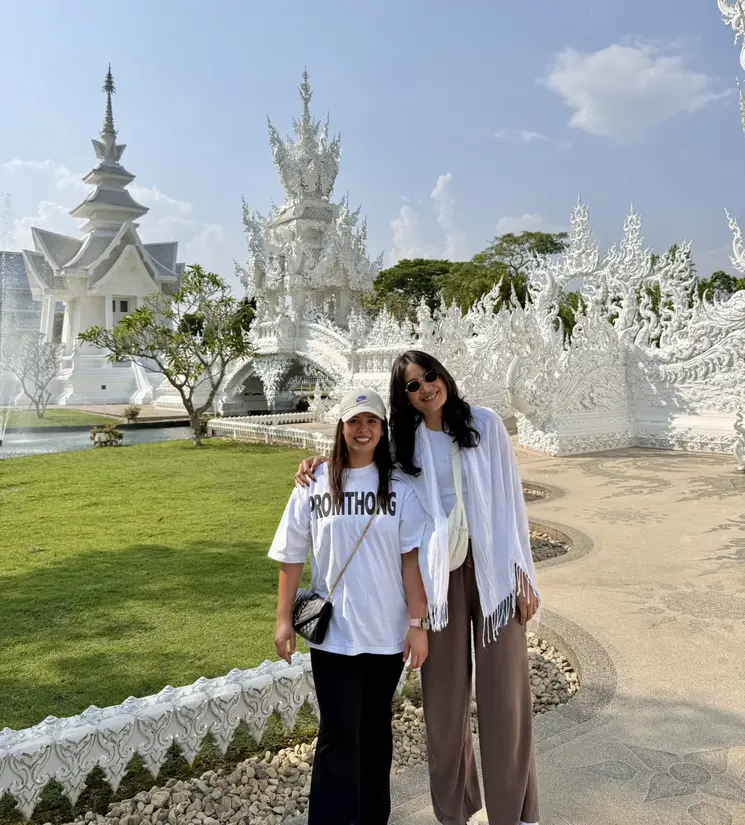
The White Temple of Chiang Rai, also known as Wat Rong Khun, is undoubtedly one of the most impressive temples we saw in Thailand. The attention to detail is extraordinary: thousands of mirrored tiles and flame-like patterns glitter in the sun. It's not every day you see a Thai temple painted entirely white – a color chosen by the local artist Chalermchai Kositpipat to symbolize the purity and goodness of Buddha.
Wat Rong Khun is open daily from 8:00 AM to 5:00 PM. Entrance costs 200 THB for foreigners (free for Thais). Since the White Temple is located south of the city on Highway 1, we visited it at the end of our tour from Chiang Mai. We were overwhelmed by the sight, and it was the perfect introduction to Chiang Rai.
A temple that shines in the sun
The story behind the White Temple of Chiang Rai
The man responsible for the current version of Wat Rong Khun is Chalermchai Kositpipat, a local artist who began an ambitious reconstruction project in 1997. He invested his own money in the design and financed the project entirely through small donations to maintain full artistic control. Chalermchai transformed a dilapidated temple into an extraordinary art installation that blends sacred imagery with pop culture.
As we entered the grounds, we were surprised by the sheer size of the temple complex: besides the White Temple, there is much more to discover and plenty of room for future expansion. This is part of Chalermchai's grand plan to construct nine unique buildings here over the next few decades. There's even a cardboard cutout of him right next to the ticket booth.
Incredible details of Wat Rong Khun
What to see in the White Temple
The Bridge of Rebirth
On the Bridge of Rebirth, hundreds of hands reach desperately downwards as if drowning. Even some skulls are raised, making the scene even more haunting. We found the symbolism here extremely powerful: the hands represent hell and the cycle of suffering caused by greed, temptation, and desire.
Buddhist philosophy revolves around understanding, letting go of, and ultimately overcoming desires. If you find yourself on a spiritual journey through Thailand, you will surely appreciate this wisdom. Crossing the Bridge of Rebirth allows you to leave all vices behind and reach a state of enlightenment in the inner hall. While the photo opportunities are fantastic, the symbolism of the artworks is truly captivating.
The Gate of Heaven
The next section, beyond the Bridge of Rebirth, is called Heaven's Gate. Two imposing statues guard the path to the inner hall. They determine whether one enters heaven or not. Many visitors often gather here, as it offers a beautiful view of the path to the main temple. However, those who take too many photos risk triggering the security alarm and being asked to move on.
The main hall (Ubosot)
The holiest place in a Thai temple is called the "Ubosot," or ordination hall, but the one in the White Temple in Chiang Rai is unique. Its walls are adorned with murals of Neo from The Matrix, Spiderman, and even atomic explosions. This may seem strange at first, but the spiritual meaning is profound: the artist used these symbols to represent Samsara, the cycle of suffering and rebirth in which humanity is trapped.
It also illustrates how the modern world—with its entertainment and technology—distracts us from finding inner peace. The murals are placed close to the floor and symbolize the lower earthly realms. However, looking upwards and towards the back of the hall, one sees a golden Buddha statue and a wax figure of a meditating monk.
The golden toilets
At first glance, the golden toilets at Wat Rong Khun could easily be mistaken for a temple or palace – they are so opulent. But the artist Chalermchai Kositpipat wanted to make a point with this structure. The gold leaf and the elaborate design symbolize wealth, greed, and basic bodily needs. It represents the idea that money and material possessions are ultimately worthless.
Tickets, dress code & opening hours
Entrance to the White Temple costs 200 THB for foreigners and can only be paid in cash. Children enter free. We recommend dressing in white, for example, with a white top or a white bag. Kat did this and had a lot of fun choosing her outfits with her friends. As in all Thai temples, there is a strict dress code: knees and shoulders must be covered.
You should definitely bring sunglasses, as the reflection in the white lenses is very strong. Photography is permitted in the gardens and on the paths, but not in the main hall. To avoid the biggest crowds, it is recommended to arrive either at 8:00 a.m., right after the temple opens, or shortly after 4:00 p.m. We were there at 3:00 p.m. and found the crowds, especially at Heaven's Gate, somewhat disruptive.
How to get to the White Temple
From Chiang Rai
From Chiang Rai, you can reach the White Temple in just 15 minutes – whether by scooter, rental car, or taxi. However, the most entertaining and authentic way to get there is probably by bus or songthaew. At Chiang Rai 1 bus station, you can board the orange or blue shuttle bus or hail a songthaew heading south on Highway 1.
Read more: 10 unique activities in Chiang Rai: A guide by locals
From Chiang Mai
In Chiang Mai, it's easy to rent a motorbike or car. However, be aware that the drive to Chiang Rai is quite long (over 3 hours) and Route 118 has many construction sites. The route isn't as scenic as you might expect, and the construction requires concentration and careful driving, which can be tiring. The best alternative to driving yourself is to take the GreenBus from Terminal 3 in Chiang Mai or book a guided day tour that includes the White, Blue, and Red Temples, as well as the Karen tribes.
Read more: 10 top things to do in Chiang Mai: Discover hidden treasures
Other temples to visit in Chiang Rai
The Black House (Baan Dam Museum)
The Blue Temple (Wat Rong Suea Ten)
Community
Comments 0
Start the conversation.