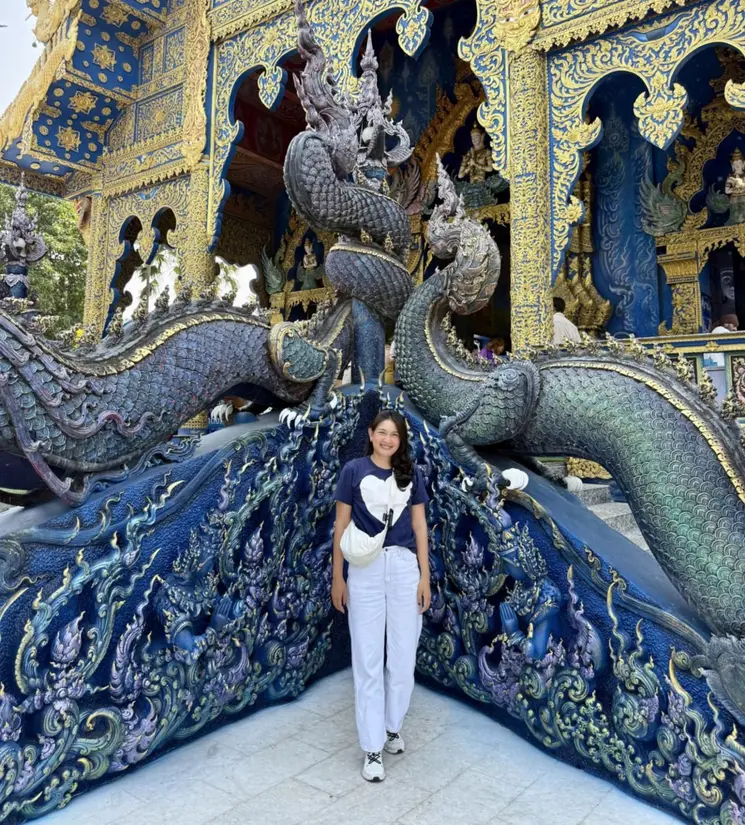
The Blue Temple, also known as Wat Rong Suea Ten, is another artistic masterpiece by Chiang Rai, captivating visitors with its sapphire blue and gold details. Inside, you'll find a stunning porcelain Buddha statue, and the wall and ceiling paintings lend it a cosmic and almost psychedelic atmosphere. It's just a short drive from the city center, and best of all, admission is free.
The Blue Temple, opened in 2016, was designed by the local artist Phutta Kabkaew (known as Sala Nok), a student of Chalermchai Kositpipat, the creator of the White Temple. The temple's name means "House of the Dancing Tiger" and refers to the location of the site, where a stream (rong) was once said to be inhabited by wild tigers (suea). According to legend, the tigers (ten) would leap over the water as if dancing.
What to see and do in the Blue Temple
On our road trip to Chiang Rai, we visited the Blue Temple and found it just as fascinating as the White Temple. The main difference between the two (apart from color and symbolism) lies in their size. The Blue Temple is significantly smaller, but we loved its cozy atmosphere, nestled in the city along the Kok River. We also stopped for lunch at the nearby Chivit Thamma Da restaurant, which was the perfect end to a wonderful morning.
Admire the Naga snakes at the entrance.
Upon entering the temple grounds, one's gaze is immediately drawn to the two enormous Naga serpents flanking the staircase to the main hall. These mythical creatures are adorned with magnificent colors and incredible detail: sapphire-blue scales, purple bellies, red mouths, and pearly-white, sharp teeth. Their tails wind their way up to the Ubosot (ordination hall) – a building decorated with some of the most spectacular gold patterns one has ever seen.
Enter the main prayer hall
On the walls and ceiling, you'll find fascinating murals depicting key moments in the life of Buddha – from his birth to his attainment of Nirvana. These traditional Buddhist stories are creatively retold in the Blue Temple, using neon blue and deep purple hues and swirling cosmic patterns. And, of course, you can observe local Thais peacefully praying beneath the magnificent porcelain Buddha statue.
Admire the porcelain Buddha statue.
The main Buddha statue is officially named Phra Buddha Ratchamongkol Bodi Trilokanat and is even more impressive in person than in the photos. The porcelain-white statue stands in the center of the hall, its radiant color contrasting beautifully with the sapphire blue background. Thanks to the LED lighting and the daylight streaming through the windows, it almost seems to glow.
See the standing Buddha in the background.
Behind the main hall lies a jewel of the Blue Temple: another white Buddha statue, this time outdoors in front of a royal blue and gold wall. A staircase leads up to it, once again flanked by mythical Naga serpents. Buddha's left hand is gently raised, as if to offer protection or blessings to those arriving.
Try the blue coconut ice cream
Opposite the main hall are several food stalls selling snacks and drinks, including one with blue coconut ice cream. The ice cream is colored blue naturally using butterfly pea flowers. Kat couldn't resist and ordered an ice cream in the morning to take perfect Instagram photos in front of the blue facade.
Lunch at Chivit Thamma Da
To round off your morning visit to the Blue Temple, a short stroll around the corner to Chivit Thamma Da is highly recommended. This café and bistro, situated on the banks of the Kok River, boasts a charming vintage English-style ambiance and a lovely garden. We enjoyed a fantastic lunch there – the perfect place to escape the heat and the crowds that were slowly gathering at the Blue Temple. Cam opted for a burger, while Kat and her friends enjoyed smoothies and Thai food.
Visitor information for the Blue Temple
Opening hours
The Blue Temple opens daily at 7:00 a.m., which is quite early for a Thai temple. However, this allows you to avoid the biggest crowds in the morning. It also doesn't close until 8:00 p.m. Therefore, you can also visit it in the evening when it is illuminated, the main hall exudes a particularly magical atmosphere, and the monks come to pray, chant, and collect alms.
Entrance fee & dress code
Entry to the Blue Temple is free for both foreigners and Thais. As in all temples in Thailand, knees and shoulders are expected to be covered. You can also wear clothing in the temple's colors, which Kat enthusiastically did. Shoes must be removed before entering the main hall, as it is carpeted in blue.
Arrival
From the city center, the Blue Temple can be reached in just 10 minutes by taxi, Grab, or scooter. There is ample parking directly in front of the temple gate. A tuk-tuk ride is a bit more expensive, but an unforgettable experience anywhere in Thailand. Alternatively, you can travel by songthaew: at Chiang Rai 1 bus station, you can ride with locals for a maximum of 20–40 THB per person.
Final thoughts on the Blue Temple
In our opinion, the Blue Temple is just as worth seeing as the White Temple. Both could easily be included in a temple tour, and perhaps the Black House (Baan Dam Museum) could also be visited. The temples of Chiang Rai are unique in Thailand (and worldwide) – they were designed with such attention to detail and such imagination that it's almost unbelievable.
Community
Comments 0
Start the conversation.