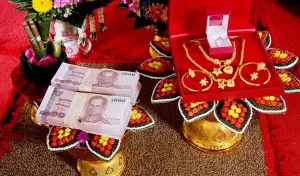
Paying a dowry is an important cultural tradition in Thailand, still practiced today. Typically, the groom pays the bride's family a dowry to thank them for raising her and to demonstrate his ability to provide financial stability as her husband.
In the Thai language, this dowry is called Sin Sod, and anyone planning a wedding in Thailand with a Thai bride should understand this important part of the culture.
Although this may seem strange or even backward to some uninformed foreigners, it is a mistake to take this tradition lightly when getting married in Thailand. Unless the bride's family explicitly waives the dowry, paying a dowry in some form is obligatory when marrying a Thai bride, especially in a traditional Thai marriage.
First-class services from Siam Legal International, Thailand's largest network for legal services.
Why does Thailand have a dowry system?
As mentioned previously, dowry is an ancient tradition in Thai culture, intended to project a positive image of the couple and strengthen the bond between the two families. However, nowadays, dowry payments are largely ceremonial and symbolic.
In fact, the majority, if not the entire dowry or an equivalent amount, is usually returned to the couple to secure their livelihood in their retirement. The payment of a dowry is therefore not a financial or legal matter, but rather a cultural custom. The dowry plays no role in the civil marriage ceremony and is not legally required; it only comes into play during the ceremony itself.
However, it is not advisable to ignore this tradition or to only superficially respect it, as this could offend the bride's family and lead to tension. Since very little money usually changes hands, there is no reason not to consider this cultural custom a unique part of a traditional Thai wedding.
How high should a Thai dowry be?
Paying too small a dowry in Thailand can be just as offensive, if not more so, than paying no dowry at all, as this can be interpreted as a criticism of the bride's and her family's worth. Any groom who wishes to pay a dowry should therefore ensure that the amount is appropriate, if not higher.
There is no fixed rule for the amount of the dowry. Rather, the amount of the dowry depends on a variety of factors, including the characteristics of the Thai bride:
In very traditional families, the bride's virginity can also affect the dowry, although this is not so common nowadays.
The typical dowry for a middle-class bride with a good upbringing and education ranges from 100,000 to 300,000 baht, though this amount is steadily increasing due to inflation. Grooms usually have to pay more for brides with higher social status or education, around 500,000 to 1 million baht. In high-profile marriages involving billionaire families, dowries can reach as high as 1 billion baht!
Conversely, the groom is expected to pay less or nothing at all if the bride is a Mae Mai. Mae Mai literally means "widow," but can also refer to a divorced woman or someone who has been in a long-term relationship. In Thai culture, these women are not well-regarded when remarrying. Unfortunately, they are sometimes stigmatized as "spoiled" or "ruined" because they are no longer virgins or have children from a previous marriage.
Is a dowry required for a Thai bride?
Ultimately, the groom decides on the size of the dowry. However, if the amount falls short of expectations, the bride's family might feel insulted and likely hold a grudge for a long time. Conversely, a larger dowry, while demonstrating strong commitment, could also portray the groom as generous but easily exploited.
Ultimately, the amount of the Thai dowry should be discussed with all parties involved before a decision is made.
How to pay a Thai dowry
As the couple prepares for the wedding, the topic of dowry will come up, and the bride's family will have a sum in mind that they consider appropriate. The groom can negotiate this amount if he wishes, but excessive haggling will likely be perceived as insulting.
In a traditional Thai wedding, additional ceremonies take place before the actual marriage ceremony. One of these preparatory ceremonies is the exchange of the dowry. This can consist of anything of value, but traditionally it is cash or 24-karat gold jewelry. Gold has great cultural significance in Thailand and serves as a common store of value and medium of exchange across all social classes.
Another reason why a large portion of the dowry is paid in gold is that it is prominently displayed during the wedding ceremony to demonstrate financial stability and prosperity. This is not fundamentally different from the extravagant or even ostentatious wedding ceremonies in the West; it simply takes a different form.
Do you have any further questions about Sin Sod or do you need legal advice regarding marriage in Thailand?
If you are planning to marry a Thai bride and would like to learn more about dowry or other aspects of wedding preparations, contact Siam Legal. We will help you navigate this tradition and support you with other aspects of your marriage, such as the civil ceremony, planning and organizing your ceremony, and prenuptial agreements.
Frequently asked questions about dowry in Thailand
Here are some of the most frequently asked questions we at Siam Legal receive regarding dowry in Thailand.
Do I have to pay a dowry in Thailand?
Legally speaking, no. There are no laws in Thailand that mandate the payment of a dowry. However, refusing to comply with the bride's family's request will almost certainly lead to hostility and later marital problems.
Keep in mind that nowadays most, if not all, of the dowry is returned to the couple. Furthermore, it's customary in Thailand for wedding guests to bring monetary gifts to help the couple get started in their life together. A traditional Thai wedding is therefore not as expensive as it might seem. For this reason, it's generally advisable to pay the dowry if requested and if it's a reasonable amount.
Why do Thais demand Sin Sod for Thai brides?
As mentioned earlier, the Sin Sod serves to thank the family for raising the bride well and to demonstrate financial stability. However, a primary reason for the dowry is to save face or even to boast to friends, family, and neighbors. For this reason, dowries in Thailand almost always consist of gold jewelry.
The dowry, including the gold, is presented visibly to all during the wedding ceremony. A generous dowry (Sin Sod) signals that the bride is marrying a reliable, wealthy, and generous groom and enhances her social standing. Conversely, a small dowry suggests a bride of "lesser quality" and a family of limited means, something families in every culture wish to avoid.
Every society has its own ways of displaying wealth and demonstrating stability, and this is one of them in Thailand. In fact, it's not uncommon for couples marrying in Thailand to buy or even rent counterfeit money and fake gold jewelry to present during the wedding ceremony. This isn't meant to deceive guests, but is simply a way to uphold traditions while avoiding an outdated financial aspect of marriage.
Will I get my dowry back if I divorce my Thai wife?
Generally not. The dowry is considered a gift, and if the Thai family keeps it and you divorce the bride, they are not obligated to return it to you. It is not considered "marital property" and is not taken into account in divorce proceedings.
Do all Thais require a dowry?
No, nowadays this custom has fallen out of fashion, and most younger Thais reject this tradition as outdated. Urban and educated Thais, in particular, tend to either ignore this tradition or perform it only out of tradition, without investing significant sums of money.
However, it is important that you discuss this matter with both your future Thai bride and her family to ensure that everyone involved is of the same opinion regarding the dowry and its handling.
Is dowry fraud in Thailand?
It depends on the individual case. While Sin Sod is a legitimate tradition with a long history, it does happen in Thailand that foreign women fall victim to romance scams involving dowry demands. Although this is not the norm, there are many cases of brides from rural and economically disadvantaged areas seeking foreign husbands to enrich themselves financially.
One of the many methods they use to exploit their victims is to demand exorbitant dowries. They claim the family requires it or that it is a strict Thai tradition. Later, they plan to divorce their foreign husbands and keep most of their assets, including the dowry.
In short, a Thai dowry is not a scam by definition, but it is a tool that is sometimes used by fraudsters.




Community
Comments 0
Start the conversation.