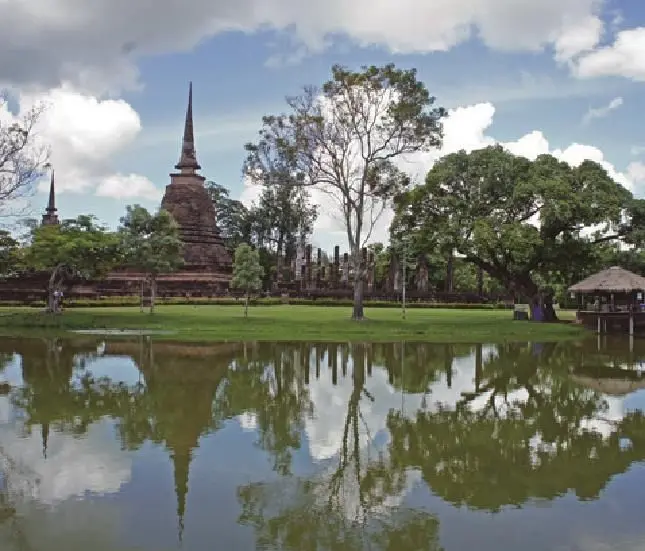
Sukhothai (สุโขทัย) is a province in northern Thailand, with its capital in Sukhothai. It is located on the central plains of Thailand, 427 kilometers north of Bangkok.
Sukhothai is considered the cradle of Thai culture, with its writing system, art, culture, and laws all originating during the Sukhothai era. The greatest contribution was made by Ramkhamhaeng the Great, the third king of the Sukhothai dynasty, who modified the Pali and Khmer scripts prevalent in the Sukhothai region, creating the Thai alphabet in 1283.
Sukhothai boasts numerous historical sites, but many palaces and temples were destroyed during the Ayutthaya Kingdom wars and, due to long-term neglect, were reduced to ruins. In 1979, with the assistance of UNESCO, Thailand began restoring these magnificent temples and monuments. Sukhothai Historical Park is a UNESCO World Heritage Site. The ancient capital is 1400 meters long from east to west and 1810 meters long from north to south, with four city gates, surrounded by inner, middle, and outer walls and a moat. The ancient capital is 12 kilometers from the new city, and most of the ruins are concentrated in the old city of Sukhothai. Besides Sukhothai Historical Park, the Si Sachanalai Historical Park, 55 kilometers north of the new city, also offers visits to many temples built during the Sukhothai Kingdom period.
Traffic in Sukhothai
Chiang Mai to Sukhothai
There are buses from Chiang Mai bus station to Sukhothai, the journey takes about 5 hours and costs approximately 218 baht. Try to take the buses departing at 7:00 or 8:00 AM. When you arrive in Sukhothai, get off at the Old City stop, Mueng Gao (where Sukhothai Old City is located), as this is closer to Sukhothai Historical Park.
Sukhothai internal transportation
Public transportation in Sukhothai mainly consists of tuk-tuks and songthaews. You can also rent bicycles or motorbikes. There are many bicycle rental shops in the Old City; the cost is about 30 baht per day. The process is simple, and try not to leave your passport or ID card as collateral.
Sukhothai Accommodation
Sukhothai is divided into a new city and an old city. Jarodvithi Thong Road in the new city is where hotels are concentrated and is close to the river, offering a beautiful environment. The new city has many good restaurants and shopping is more convenient than in the old city, but it is farther from Sukhothai Historical Park.
Most hotels in the old city are concentrated in Ban Kluai, which is conveniently located with many nearby temples and easy access to historical parks. Most tourists visiting Sukhothai stay here.
Recommended hotels
Sukhothai Heritage Resort ★★★★
This stylish four-star resort hotel is located next to Sukhothai Historical Park and features two outdoor swimming pools, a terrace, free Wi-Fi, and free private parking. The hotel's outdoor restaurant and bar serve Thai cuisine, cocktails, and other hot and cold drinks, as well as Thai massage services.
999 M.2, T. Klongkajong, Sawankaloke, Sukhothai 66 55 647564 www.sukhothaiheritage.com From 2800 THB/night (for reference only)
Ruean Thai Hotel ★★★
Hotel Luang is conveniently located near Sukhothai Bus Station and features an outdoor swimming pool and a restaurant. Free Wi-Fi is available throughout the hotel. Rooms are comfortable and convenient, and the restaurant offers local and international cuisine. Sukhothai Airport is approximately a 30-minute drive away.
181/20 Soi Pracharuammit, Jarodvithithong Rd., Sukhothai 66 55 612444 www.rueanthaihotel.com Sukhothai has relatively few hotels, so there is no distinction between star-rated and budget hotels.
Sukhothai attractions
The peak tourist season in Sukhothai is from November to February of the following year, with an average temperature of 25°C, pleasant weather, and mild sunshine. It's best to avoid visiting Sukhothai in March and April, as the sun is very strong during this time. When exploring the old city, avoid prolonged exposure to the sun.
Special tour
Explore the ancient capital by bicycle
Cycling is the best way to explore Sukhothai. Under the bright sunshine, you can wander through ancient temples and shady groves, feeling the power of history and experiencing its vicissitudes and tranquility.
Famous attractions
Sukothai Historical Park
สุโขทัย
Sukhothai Historical Park is the essence of the Sukhothai Kingdom's historical sites. The Ramkhamhaeng Museum, located at the entrance to the old city, is the best starting point for visiting the park. In addition to a detailed record of Sukhothai history, the museum houses many artifacts and sculptures unearthed from the Sukhothai period, including the highly acclaimed Songkalok ceramics.
Sukhothai Historical Park boasts a vast number of temples, pagodas, and palaces, with magnificent architecture and breathtaking design. As the Thai people are devout Buddhists, Buddha statues are found throughout the park. The temple architecture is heavily influenced by Indian and Sri Lankan styles, and even the ruins retain their solemnity. The most spectacular is Wat Mahathat, the largest temple in Sukhothai, measuring 200 meters on each side. Wat Mahathat contains 198 pagodas of varying sizes and a colossal seated statue of Buddha. Wat Sichang, Wat Chophangthhong, and Wat Saphan Singh are also worth visiting.
Sukhothai Historical Park is quite large, so a thorough visit requires at least half a day. The easiest way is to rent a bicycle at the entrance to the old city and leisurely explore its various attractions.
■ Sukhothai Historical Park Visitor Guide
Sukhothai Inscriptions: The Sukhothai Inscriptions were carved during the Sukhothai Dynasty in the 13th century and are the most...
The inscriptions carved in Thai script in the early days have high historical and literary value and are regarded as a model of Old Thai language.
Fifteen Sukhothai stelae were discovered in the historical park. The inscriptions are carved in Old Thai, but also contain some Sanskrit, Pali, and Khmer. The inscriptions primarily recount the life and achievements of King Ramkhamhaeng and express his best wishes for the prosperity of Sukhothai. The inscriptions are divided into three parts: the first part is Ramkhamhaeng's first-person account of his life. The second part, written in the third person, describes the development of Sukhothai during Ramkhamhaeng's reign, the creation of the Thai script, the customs, religious beliefs, and living conditions of various ethnic groups in Thailand, and significant events of the time, such as the dispatch of envoys to China in 1292. The third part records the territory of Sukhothai and praises Ramkhamhaeng's achievements. The Sukhothai stelae are the earliest recorded historical and literary works in Thailand, rich in content, concise and rhyming, with many quotes becoming popular sayings.
To date, over 200 stone tablets have been discovered in Thailand, mostly inscribed in Sanskrit, Pali, Mon, and Khmer. The earliest inscription dates back to 657 AD. These early inscriptions largely record the backgrounds and achievements of various Thai kings and princes, historical events, customs of the Thai people and neighboring ethnic groups, and fragments of Buddhist scriptures. These stone tablets are invaluable historical relics for the study of Thai history.
Wat Sri Chum (วัดศรีชุม): Upon entering Wat Sri Chum, you will see a huge...
A seated Buddha gazes out from a narrow doorway. Similar to the "Agana Buddha" mentioned on the Langkawi Stele, this Buddha points to the ground with its right hand in a demon-suppressing posture, standing 15 meters tall with knees 11.3 meters wide. The statue has been restored, removing its weathered appearance and revealing a beautiful exterior. Xichang Temple measures 32 meters long and wide, 15 meters high, and has walls 3 meters thick. Unlike typical temples, Xichang Temple features a passageway leading to the roof, accessible only from the left and right. Another treasure of Xichang Temple is hidden on either side of this passageway: over 50 stone slab paintings on the ceiling depicting Jataka tales and the stories of the Buddha's ten incarnations.
There's a very interesting story about Wat Saket. Once, when the Khmer army attacked Sukhothai, two Sukhothai soldiers hid behind the giant Buddha statue. When the Khmer army stormed Wat Saket, they heard the two soldiers talking and, thinking it was the Buddha statue speaking, they immediately withdrew. Therefore, the giant Buddha statue at Wat Saket is also known as the "Talking Buddha" by the Thai people.
Wat Trapang Thong Lang: In Thai, "Trapang" means "Trapang".
(Trapang) means "pond" and "Thong" means "gold," so Wat Trapang Thong means "Golden Pond Temple." The main hall of this temple was only completed more than 30 years ago, and the pagoda is in the Sri Lankan style. The highlight of the visit is the Buddha's footprint enshrined in the pavilion.
Wat Mahathat (วัดมหาธาตุ): Wat Mahathat dates back to the Sukhothai period.
The largest and most important temple, built in the 13th century, is the largest temple in the ancient city. Located in the center of the city, it is surrounded by moats and covers an area of 0.4 square kilometers. The temple once had more than 200 stupas, most of which are now just ruins.
The best-preserved structures include the main pagoda, which is in the Thai style, surrounded by three smaller pagodas in the Sri Lankan style and four smaller pagodas in the Khmer style. In addition, there is the main monastery and the stupa containing the ashes of King Li Thai.
Wat Mahathat is the main venue for the Loy Krathong festival celebrations, which also feature spectacular Sukhothai dance performances.
Wat Saphan Hin, วัดสะพานหิน
Wat Saphan Singh, also known as Wat Phra That Doi Suthep, features a long stone bridge and steps, approximately 200 meters long. Although still passable, it has collapsed and is now a terrifying sight to walk on. According to a stone inscription left by Ramkhamheng, Wat Saphan Singh was the residence of a high-ranking monk and also the place where Ramkhamheng surveyed the terrain and searched for water sources for the entire city. On important festivals, Ramkhamheng would ride an elephant to worship here. The 12.5-meter-high Atallo Buddha is a standing Buddha, towering high in Wat Saphan Singh, its right hand outstretched, silently protecting the entire city. Following the Buddha's hand, we can see this beautiful and fertile land and imagine the strategic brilliance of Ramkhamheng in his prime.
Si Satchanalai-Chaliang Historical Park
อุทยานประวัติศาสตร์ศรีสัชนาลัย
Located near Sukhothai, the Si Sachanalai Historical Park is another ancient city worth visiting. Situated about 50 kilometers north of Sukhothai Historical Park on the banks of the Uung River, it covers an area of 45 square kilometers and is the sister ancient city ruins of Sukhothai Historical Park. It has also been listed as a UNESCO World Heritage Site.
Nestled amidst lush green hills and meadows, Sisachanarai Historical Park is less crowded, making it ideal for leisurely exploration by bicycle or elephant rides. Within the old city of Sisachanarai lies Wat Chang Lom, whose Thai name means "Temple Surrounded by Elephants." The main stupa of the ancient temple is a Sri Lankan stupa, surrounded by 39 elephant sculptures; however, after more than 700 years, most of the stone elephants are now severely damaged.
66 22 505500 Si Satchanalai District, Sukhothai
Sukhothai Historical Park is a large scenic area and the most worthwhile attraction in Sukhothai. It is recommended to spend half a day to a full day to explore it thoroughly.
Sukhothai cuisine
The new and old cities of Sukhothai are 12 kilometers apart. The historical park in the old city (Mueang Kao) is a hub for tourist attractions. Sukhothai's food scene is largely comprised of roadside stalls and food streets in markets, much like Pai and Chiang Mai, with a very relaxed and friendly atmosphere. Sukhothai's most famous dish is its signature rice noodles, and other snacks such as Thai seafood soup, fried rice, fried noodles, and pudding are also delicious.
Restaurant Recommendations
Pai Sukhothai
This restaurant offers Thai cuisine, where you can sample Sukhothai's signature rice noodles. It boasts a wide variety of dishes, excellent service, and long opening hours. 3 Pravetnakorn rd, Sukhothai, Thailand
S&N Coffee House
Offers coffee, pizza, and Thai cuisine. 50-52 Singhawat Road | Thani, Sukhothai, Thailand 66 86 6053201
Pimmy's House
Offers desserts, Western food, coffee, and Thai cuisine. 45 Singhawat Street | Thani, Sukhothai 64000, Thailand 66 83 3304949
Dream Cafe
Located in Sukhothai's new city, this coffee shop offers American and Thai cuisine. The owner is an antique collector, so the shop is decorated with many antiques, creating an artistic atmosphere. 86/1 Singhawat Road, Sukhothai 64000, Thailand 66 55 612081
Phuket (ภูเก็ต) is located in southern Thailand, next to the Malay Peninsula, 862 kilometers from Bangkok. A bridge connects Phuket Province and Phang Nga Province to the north, and it faces Krabi across Krabi Bay to the east. Phuket Island is approximately 21 kilometers long from east to west and is shaped like an irregular pearl.
Phuket is a paradise in southern Thailand and the country's largest island. Surrounded by the warm waters of the Andaman Sea, it boasts beautiful beaches, uniquely shaped islands, stalactite caves, and natural grottoes. Coupled with the crystal-clear blue waters along its coast and the breathtaking underwater world, these abundant natural conditions have earned Phuket the title of "tropical paradise."
The word "Phuket" originates from Malay and means "hill." Phuket is often called the "Pearl of Thailand," and the brilliance of this pearl comes from its 500-year-old tin mining industry, which brings substantial revenue to the island. Thailand is the world's third-largest exporter of tin, with the vast majority of its production coming from Phuket's waterways and inland areas. Besides tin mining, many islanders rely on rubber plantations, while others cultivate coconuts, rice, and fruit, or fish at sea for their livelihood.
The stunning scenery of Phuket and Phang Nga Bay attracts worldwide attention and is favored by many travelers. Khao Phra Thaeo National Park, with its pristine forests, is also a great option. Cape Thepong, also known as Promthep Cape, located at the southernmost tip of Phuket, is an excellent spot to watch the sunset. Other noteworthy attractions include the Phuket Aquarium, pearl farms, Thai villages, orchid gardens, and the Women Warriors Memorial. The island's golf courses are not only picturesque but also boast professional-level facilities, attracting top golfers from around the world.
Phuket's most prized asset is its more than ten beautiful beaches along the Sittaman coast, such as Patong Beach, Karon Beach, Kata Beach (Hat Karon & Hat Kata), Surin Beach, and Mai Khao Beach. These beaches boast fine white sand, crystal-clear waters, and brilliant sunshine, while colorful parasols dot the water, creating a play of light and shadow that makes happiness feel within reach.




Community
Comments 0
Start the conversation.