What Chiang Mai is like and how to plan your visit
Chiang Mai is Thailand's tranquil, culturally rich north. A 700-year-old square surrounded by a moat houses around thirty temples, a sacred mountain rises just outside the city to the west, and with 900–2,500 baht per day, the city offers the lowest cost of living in the country. Three to four days is ideal. From November to February, I recommend staying in the Old City or Nimman, and avoid the forest fire season from mid-February to April. This guide provides information on a city map, neighborhoods, exact prices, the most important temples and culinary highlights, information on ethical elephant husbandry, and a monthly weather and air quality chart to help you plan your trip. For a detailed overview, refer to days 3 and 4 of the 7-day Thailand itinerary.
Where to stay in Chiang Mai
Search for hotels in Chiang Mai for your desired travel dates or narrow your search to the areas recommended in this travel guide. Filter for hotels with free cancellation if you'd like to book a room and decide later.
Open Booking.com with your travel dates · also on Expedia · Trip.com
My recommendations in every price category in Chiang Mai
Key Facts (2026)
During the period from November to February, and never from mid-February to April.
Cool mornings with temperatures between 15 and 20 °C, clear skies, and the lanterns of Yi Peng in November. During the burning season (mid-February to April), the Air Quality Index (AQI) rises above 150 on most days, and the peak in March 2026 was among the worst in the world. From June to October, the landscape is green, with occasional rain and temperatures 20–40% lower.
Give him three to four days.
The temples of the old city and an evening at the market, Doi Suthep at dawn with the monks' trail, an afternoon with elephants, or a cooking class and a day trip if you have any money left over. Digital nomads can live for months on the same budget.
Stay overnight in the old town near the Tha Phae Gate or in Nimman.
Within the castle moat are thirty temples, massage parlors, and the Sunday pedestrian zone. Nimman, the district with cafes, coworking spaces, and bars, is ten minutes west. Riverside is the quiet, elegant alternative.
A ride in a red songthaew costs 30–40 baht, with Grab 60–150 baht and with a scooter 150–250 baht per day.
Hail a red van, state your destination, and get in the back when the driver nods. Within the city, a ride costs a flat rate of 30–40 baht. At the airport taxi stand, the fixed price is 160 baht, and the old town is a ten-minute walk away. You need a driver's license for scooters, and there are checks.
Budget: 700–1,550 Baht per day for backpackers, 2,550–5,400 Baht for mid-range travelers
Khao Soi costs 50–80 baht, a one-hour massage 250–500 baht, temple fees (if charged) 20–40 baht, a half-day cooking class 1,000–1,500 baht. Long-term nomads spend a total of 25,000–40,000 baht per month.
From Bangkok you can fly for 1 hour 15 minutes for 900–1,500 Baht or take the night train at 18:40 (941–1,041 Baht per sleeper berth).
Special train No. 9 departs Bangkok at 6:40 PM and arrives at 7:15 AM. It replaces a hotel night, and lower berths are booked weeks in advance during peak season. Book early. The Bangkok-Chiang Mai travel guide compares all options.
Chiang Mai Airport (CNX) → Old City / Nimman
Arrival from the airport
Chiang Mai Airport is just ten minutes from the Old City. A taxi from the arrivals hall costs 160 baht, Grab offers rides from the parking lot for 100–200 baht, and a pre-booked car through 12Go (from around 450 baht, usually 750–1,000 baht) is the fixed-price option for late arrivals. Prefer to take the night train? Red songthaews and Grab wait at the station; the ride to the city moat costs 60–120 baht.
Sponsored link. We may receive a small commission if you book – this will not incur any additional costs for you. Learn more.
How Chiang Mai is laid out – a square, a strip, a river and a mountain
Chiang Mai is the easiest city in Thailand to remember. The old city is a 1.5-kilometer-long square enclosed by a wall and a moat. The Tha Phae Gate (the central landmark) is located in the middle of the eastern side. Within the square are temples, guesthouses, and massage parlors—all within easy walking distance. East of the gate, a ten-minute walk downhill through the night bazaar district leads to the Ping River and its riverside restaurants. To the west of the square runs Nimmanhaemin Road, or Nimman for short, towards the university. Here you'll find specialty coffee shops, coworking spaces, boutiques, and the Maya shopping mall. Beyond Nimman, the city finally ends at Doi Suthep, the 1,600-meter-high mountain with its temple, which appears at the end of every road heading west.
Getting around is just as easy. Within the castle moat, you walk. Between districts, you hail a red songthaew, the shared taxi that forms the city's bus system. You flag one down, tell the driver your destination through the window, and if the driver nods, you hop in the back and pay 30–40 baht when you get off. Grab fills in the gaps for 60–150 baht, tuk-tuks cost twice as much for the open-air ride, and with a scooter (150–250 baht per day, driver's license required, checkpoints in place), the entire valley, including Doi Suthep, becomes your own little neighborhood.
The short version is: Stay overnight in the moat or in Nimman, walk through the marketplace, take a songthaew for everything else, and let the mountain experience its own early morning.
Getting around Chiang Mai: All fares on one sheet (2026)
There is no subway and no taxi culture – songthaews and Grab cover everything a visitor might do.
Districts of Chiang Mai and where to best stay
The Old Town – the standard for first-time visitors
Within the castle moat, everything you need for a short visit is easily accessible on foot: the four major temples, massage parlors, the Sunday pedestrian zone right outside, and the Tha Phae Gate as a landmark. Accommodation ranges from hostels starting at 300 baht to teak boutique hotels like Tamarind Village and The Inside House. The alleys quiet down after 11:00 PM. It's recommended to stay in the eastern part of the complex, where you'll find the gate, restaurants, and morning coffee.
Nimman – Cafes, coworking spaces and the bar scene
Thailand's digital nomad capital in miniature: Here you'll find coffee roasters with single-origin coffee, coworking spaces, the boutiques of One Nimman, and the Maya shopping mall. The city's trendiest restaurants and bars line the numbered alleyways (sois). Just a ten-minute songthaew ride from the temples, it's the ideal base for a stay of more than a week – perfect for those who prefer to start their mornings with a flat white rather than a visit to a wat (temple).
Riverside – quiet, green, for adults
East of the night bazaar, along the Ping River, are riverside terraces (the Riverside and the Good View have been defining features of the area for decades), boutique hotels with gardens, and the Warorot Market, the city's main daytime market, just a short walk north. Quieter nights, a nicer breakfast, and a songthaew ride to all other destinations.
Santitham – the affordable local bag
North of the castle moat, between the old town and Nimman, you'll find guesthouses and apartments at reasonable prices, Chang Phuak Street with its many late-night restaurants, and the "North Gate" jazz bar at the end of the street. The area itself has no major tourist attractions, but it's easily accessible from all of them within ten minutes.
Highly rated accommodations
Anantara Chiang Mai Resort
U Chiang Mai Hotel
Meliá Chiang Mai
Mad Monkey Chiang Mai
The best hotels in Chiang Mai
My hotel selection in Chiang Mai in every price category, based on Google's hotel rating system. My top 10 hotels are displayed first, followed by the highest-rated ones. Each button takes you directly to the hotel's page on Booking.com, where you've already entered your travel dates.
The most important temples (out of three hundred)
Chiang Mai has over 300 temples, and nobody needs to visit ten of them. Within the city moat, four are well worth a stroll. Wat Phra Singh (the city's most revered temple, with the finest murals in northern Thailand in its small Viharn Lai Kham; 20–40 baht), Wat Chedi Luang (the 600-year-old brick chedi that once housed the Emerald Buddha; 40 baht; the "monk chat" tables under the trees, where novices practice English with visitors, offer the best half hour in a temple in all of Thailand), Wat Chiang Man (the oldest, free entry), and the carved teakwood hall of Wat Phantao next door. Wat Sri Suphan, the Silver Temple south of the moat, is worth an evening visit on Saturdays during Walking Street.
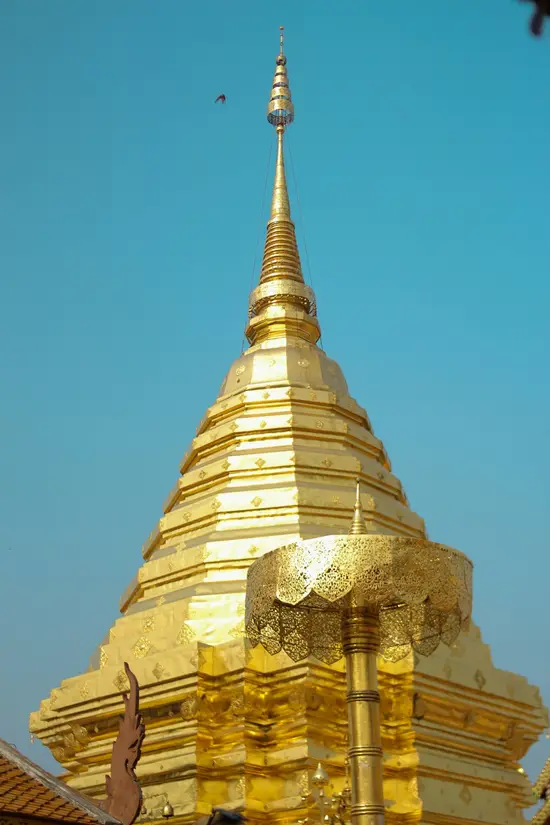
The mountain is the fifth and first. Wat Phra That Doi Suthep, the holiest site in the north, sits 1,000 meters above the city and is accessible via a 306-step Naga staircase (30 baht, cable car 20–50 baht). Visit the mountain at dawn. Songthaews depart from Chang Phuak Gate around 5:30 a.m. (40–50 baht by shared taxi). There, you can hear the monks chanting their morning hymns and experience the valley shrouded in mist. Head down when the buses arrive around 9:00 a.m. On the way down is Wat Pha Lat, a moss-covered forest temple located halfway down and connected to the city by the 45-minute monks' path. The path is marked with orange robe strips tied to the trees. Shoulders and knees must be covered everywhere, and shoes are removed in the halls.
The ascent to Doi Suthep at 6:30 am and the hike down the Monks' Path is an unforgettable morning experience in Northern Thailand. The cost is approximately 80 baht for transport, 30 baht entrance fee, and an additional 100 baht fee for foreign adults, as recently reported by visitors. Day 4 of the 7-Day Thailand itinerary describes this hike in detail.
Temples and cultural sites
Doi Suthep Temple
Wat Chedi Luang
Wat Phra Singh
Wat Pha Lat
Northern Thai food and where to eat it
In the north, the food is different: less sweet, less coconut, more herbs, smoky flavors, and pork. Chiang Mai is the capital. A typical dish is Khao Soi, egg noodles in a mild coconut curry, topped with crispy fried noodles, served with pickled mustard and lime. A bowl costs 50–80 baht. Khao Soi Khun Yai near Wat Lok Moli (from late morning to early afternoon, often sold out) and Huen Phen on Ratchamanka Road are considered the best spots in the old city, and every local probably knows a third.
Complete your meal with Sai Ua, the herb-stuffed sausage from northern Thailand (30–40 baht per skewer at any market stall), the spicy dipping sauces Nam Prik Noom and Nam Prik Ong, enjoyed with sticky rice and crispy pork rinds, and Gaeng Hang Lay, the Burmese pork belly curry. Tong Tem Toh in Nimman is the place to go for all these delicacies. Put your name on the list and wait in the alley. At Chiang Mai Gate Market, you can find the locals' breakfast from sunrise: Khao Kha Moo, braised pork knuckle with rice for 40–60 baht. And Chiang Mai is the best city in Thailand to cook this dish yourself. Half-day classes with a market tour cost 1,000–1,500 baht and are offered at schools such as Grandma's Home and Thai Akha Kitchen. You eat everything you prepare.
Restaurants & Nordic Cuisine
Huen Muan Jai
Tong Tem Toh
Khao Soi Khun Yai
Huen Phen
Markets and nights, night after night
Chiang Mai's evening program follows a weekly schedule, and planning accordingly is half the battle. Sunday is the highlight. The Walking Street stretches from 4:00 PM to about 10:30 PM along Ratchadamnoen Road from Tha Phae Gate to Wat Phra Singh. Along this kilometer, you'll find textiles and ceramics from the hill tribes, as well as the work of the city's design graduates. Food courts in the temple courtyards along the way invite you to linger. On Saturdays, there's a quieter Walking Street on Wua Lai Road, the old silversmiths' street south of the city moat. On all other evenings, the night bazaar on Chang Klan Road (6:00 PM–11:00 PM) is the larger, tourist hotspot, whose Ploen Ruedee Food Court is among the best.
During the day, the Warorot Market (Kad Luang) on the riverbank is the place to be. It's the city's main market, especially in the mornings, and the ideal spot to buy sai ua (dried chilies) and northern Chinese snacks to take home. On weekend mornings, the Jing Jai Farmers Market takes place just north of the city moat, where young Chiang Mai comes alive. After dark, the North Gate Jazz Co-op's nightly jam session at Chang Phuak Gate is the city's premier bar, and Nimman's streets keep the cocktail and craft beer scene going.
Markets & Evenings
Jing Jai Market Chiang Mai
Wua Lai pedestrian zone Saturday market
Tha Phae pedestrian zone
Waroros Market
Elephants, done right – and the day trips beyond that
Chiang Mai is home to Thailand's rescued elephants, and the criteria for choosing a sanctuary are simple: no riding, no shows, no hookups, and small groups. The Elephant Nature Park in the Mae Taeng Valley is the original rescue project and offers a full-day guided visit for 3,500 baht, which must be booked well in advance. The Maerim Elephant Sanctuary (1,600 baht) and the Elephant Jungle Sanctuary (1,900 baht) offer more affordable half-day trips (morning and afternoon) with hotel pick-up, focusing on feeding the elephants. The Elephant Jungle Sanctuary's half-day trip also includes a mud bath and bathing, which World Animal Protection advises against. Wherever riding or painting demonstrations are offered, this is precisely what the sanctuaries aim to prevent.
Other day trips into the valley, in chronological order: Doi Inthanon, Thailand's highest mountain, with its two royal pagodas, waterfalls, and boardwalk through the cloud forest (2 hours round trip; tours 1,200–1,800 baht, park fee 300 baht); the Sticky Waterfalls of Bua Tong, limestone falls that you climb barefoot, 90 minutes north and completely free; and the White Temple and the Golden Triangle in Chiang Rai, a long 12-hour trip (1,200–1,800 baht) ideally combined with an overnight stay. Pai, three and a half to four hours and 762 curves northwest, is not a day trip but requires an overnight stay. The guidebook from Chiang Mai to Pai addresses the question of van or scooter quite frankly.
Protected areas, courses & day trips
Elephant Nature Park
Doi Inthanon National Park
Maerim Elephant Sanctuary
Chiang Mai Elephant Jungle Sanctuary
Best time to travel to Chiang Mai – the calendar is more important here than anywhere else in Thailand
Most Thai destinations are worth visiting outside of peak season. Chiang Mai, however, has a clear boundary. From November to February, cool mornings with temperatures of 15–20°C, clear light in the mountains, the lanterns of Yi Peng in November, and the flower festival in early February are all appealing. Mid-February to April is slash-and-burn season, when fields are burned and the valley floor is ablaze. The Air Quality Index (AQI) is above 150 on normal days, and the peak in March 2026 made Chiang Mai one of the places with the worst air quality in the world. Avoid these months for a stay in Chiang Mai. If you are already set on this destination, travel south instead. June to October is the often-overlooked green season with afternoon rain, full waterfalls, and hotel prices 20–40% lower. The table below provides detailed information for each month. The sections "Thailand in November" and "Thailand in January" show how to combine the north with the beaches during its two best months.
Songkran (April 13–15) is the absolute highlight: Thailand's biggest water fight, a joyous festival that brings cities to a standstill, and it takes place amidst a cloud of smoke. I would celebrate it in Bangkok or on an island, unless the festival itself is the reason for your trip.
Chiang Mai: Monthly weather data, air quality index & visitor numbers
Daily budget for Chiang Mai (per person)
The 900–2,500 baht per day mentioned above in this guidebook is for a typical day trip for backpackers and represents the lower limit for a mid-range stay. Price ranges are wider here, as the listed activities range from free temple visits to paid courses. Chiang Mai is Thailand's most affordable major destination. A half-day elephant ride (1,600–2,500 baht) and a cooking class (1,000–1,500 baht) are the only significant expenses. Long-term travelers spend an average of 25,000–40,000 baht per month on all expenses. For regional comparisons, see the Thailand Travel Cost Index.
Chiang Mai by Travel Style
Chiang Mai with children
Half-day elephant watching excursions are unforgettable for children aged six and up (observation only, no riding). Grand Canyon Water Park (650 baht) and Sticky Waterfalls offer refreshing water fun; the food courts and street musicians of the Sunday pedestrian zone are suitable for all ages; the cable car up Doi Suthep (20–50 baht) saves you the climb of 306 steps. Night safaris are a matter of opinion, and the wildlife sanctuaries offer a better experience.
Chiang Mai at night
The Sunday pedestrian zone is open from 4:00 PM to 10:30 PM, on Saturdays it takes place on Wua Lai, and the night bazaar is open daily from 5:00 PM to 11:00 PM. The jam session at the North Gate Jazz Co-op is a must (Tuesday is the highlight); the best cocktail bar can be found in the sois of Nimman; Wat Phantao and Wat Chedi Luang are beautifully illuminated and can be admired for free from the street.
Free (or almost free) Chiang Mai
Most temples in the Old City are free or cost 20–40 baht. Wat Pha Lat is also free, although visitors report that foreign adults are charged a 100 baht fee to walk there on the monks' path. Talking with the monks at Wat Chedi Luang and Wat Suan Dok is free and goes both ways. In pedestrian zones, you pay for what you eat. The Sticky Waterfalls are free. And the castle moat at sunrise offers the best free photo opportunity in the city.
Hidden treasures & unique experiences
The forest tunnels of Wat Umong near the university; the dark teakwood of Wat Lok Moli on the northern castle moat; the umbrella workshops of Bo Sang; the viewpoint on the ridge of Mon Cham at sunrise; the farmers' market of Jing Jai on a Saturday morning; Wiang Kum Kam, the buried predecessor city, by bicycle.
Digital nomads
Nimman is the hub, with coworking spaces starting at 250 baht per day or 3,500 baht per month, fiber optic internet access everywhere, cafes where laptops are expected, and a large community of long-term residents. The cost of living ranges from 25,000 to 40,000 baht per month. The catch is the calendar: most long-term residents leave during the slash-and-burn season and return with the rains.
Advance further north?
Frequently Asked Questions
Frequently asked questions about the Chiang Mai city guide.
Three to four days. On the first day, visit the four major temples of the old city, get a massage, and explore the night bazaar or a walking street. On the second day, visit Doi Suthep at dawn, walk the monks' trail, and watch elephants in the afternoon. On the third day, take a cooking class or visit Doi Inthanon. On the fourth day, visit the Sticky Waterfalls or Chiang Rai. Plan to spend a Sunday evening there.
From November to February, the weather is cool, dry, and clear; in November, the lanterns of Yi Peng are lit. Avoid the period from mid-February to April. During the lantern season, the Air Quality Index (AQI) rises above 150 on normal days and peaks above 250 (March 2026 was among the worst ever recorded). From June to October, the weather is green, with afternoon rain and 20–40% better air quality.
Four things. The air during wildfire season (the real danger, and I'd rather change my plans than endure it with a mask), scooters without a valid license (checks are routine, and insurance doesn't cover driving without one), elephant rides and shows, and the overpriced night market when you can find the same things better in the pedestrian zones. Ordinary crime is rare. This is one of the safest cities in Asia.
For a first visit, the Old City near Tha Phae Gate is recommended. There you'll find temples, massage parlors, and the Sunday market, all within easy walking distance. Nimman, ten minutes west, offers cafes, coworking spaces, and a vibrant bar scene. Riverside is perfect for quiet, leafy evenings. Santitham, located between the city moat and Nimman, is known for its affordable prices.
Take a walk within the castle moat. Red songthaews (30–40 baht per ride) run between the city districts; tell the driver your destination through the window and get in the back when they nod. Alternatively, you can use Grab for fixed fares (60–150 baht) or rent a scooter (150–250 baht/day, driver's license required) for exploring the valley and mountains. A taxi from the airport costs a flat rate of 160 baht; the city is a ten-minute drive away.
Red shared taxis (songthaews) depart from Chang Phuak Gate and the beginning of Huay Kaew Street near the zoo starting around 5:30 a.m. A full ride costs 40–50 baht per person. Alternatively, you can hire a songthaew for 300–500 baht (round trip). Grab costs 250–350 baht each way. From there, it's 306 steps down the Naga Staircase (or the cable car for 20–50 baht) and a 30 baht entrance fee. It's best to leave at dawn, as buses don't arrive until 9:00 a.m. The descent via the Monk's Path leads past Wat Pha Lat.
These are very different trips. Bangkok captivates with its size, energy, and vibrant atmosphere. Chiang Mai, on the other hand, is a walled city nestled at the foot of a mountain, easily explored on foot, and costs only half as much. Most itineraries include both cities. Compared to Phuket, Chiang Mai scores points with its temples, delicious food, and attractive value for money (900–2,500 baht per day compared to roughly double that), while Phuket offers beaches and boat trips. Since the seasons vary, the calendar often determines the best time to travel.
Khao Soi is the absolute highlight: egg noodles in coconut curry with crispy noodles on top, for 50–80 baht at Khao Soi Khun Yai or Huen Phen. It's served with Sai Ua (a spicy sausage from northern Thailand), Nam Prik Noom and Nam Prik Ong (chili dips) with sticky rice, and Gaeng Hang Lay (pork belly curry). Tong Tem Toh in Nimman offers the ultimate Khao Soi experience in a cozy restaurant.
The full moon festival in November, when thousands of paper lanterns rise above the city and the Loy Krathong float parades take place on the city moat and river, is the most magical and busiest week in Chiang Mai. Therefore, book your accommodation three to four months in advance and be wary of overpriced event tickets offered online in bulk. The free city festival itself is an unforgettable experience.
Nimman remains one of the best locations worldwide: coworking spaces start at 3,500 baht per month, fiber optic internet is widely available, Nimman has a large community of long-term residents, and the cost of living ranges from 25,000 to 40,000 baht per month. The only downside is the slash-and-burn season, so plan to be elsewhere from mid-February to April, like most other residents.
Fly (1 hour 15 minutes, 900–1,500 baht, book 2–4 weeks in advance; budget airlines use Don Mueang Airport) or take the No. 9 express train, the overnight train departing Krung Thep Aphiwat at 6:40 p.m., arriving at 7:15 a.m. for 941–1,041 baht in a second-class compartment. It replaces a hotel night; compartments can be booked 90 days in advance. The Bangkok–Chiang Mai travel guide compares all options, including the bus connection.
Compare prices on the major booking portals and filter for rooms with free cancellation if you want to book now and decide later.
Compare prices on Booking.com
Compare prices on Trip.com
We may receive a commission for bookings made through these links – this will not incur any additional costs for you. Learn more.
Discover more in this guide
You might also like this
Things to do in Chiang Mai
Twenty-five things worth a trip to the north, ranked by rank, price and time of year to visit, centered around the mountain, the markets and the smoke-free months.
10 days in Thailand – Itinerary
Capital city, night train, mountains, then ferry to the Andaman coast – nine nights, one way, no return.
7 days in Thailand
Capital city, mountains, islands – six nights, two short flights and not a single day was lost to the journey.
Thailand Honeymoon Guide and 10-Day Itinerary
Villas with private pools, sunsets in a longtail boat, and evenings perfect for two.
Thailand on a budget
Thailand for less money, without sacrificing the best
I lived in Bangkok for four years and traveled throughout the country from there. The guidebooks reflect my personal opinion and are written as I would explain things to a friend planning a trip.
Ready to create your travel itinerary?
Use our free trip planner to save places, organize days, and share your trip.




Community
Comments 0
Start the conversation.