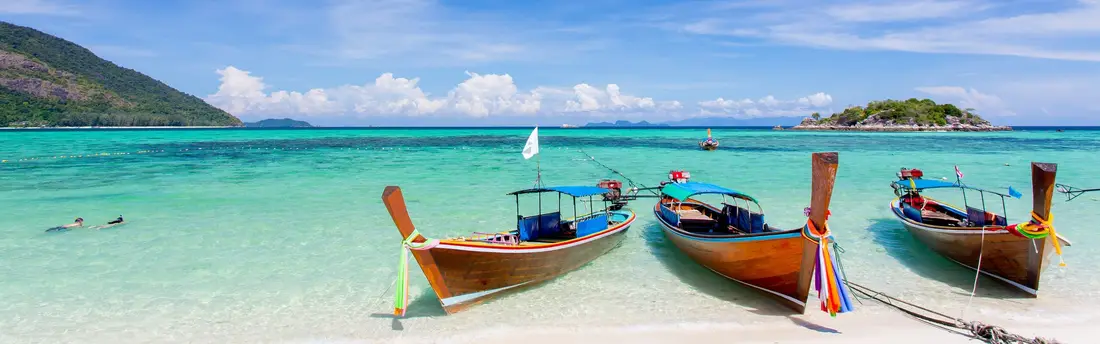
Thailand has long been associated with familiar images: a tropical beach, a golden temple, an affordable massage, street food for just a few dollars, and smiling locals. Together, these have shaped the image of Thailand as the Land of Smiles.
None of these images are fake. The seas are real. The temples are real. The food is extraordinary. Even the warmth is real.
But each one is only the first layer.
On closer inspection, Thailand proves to be more complex, multifaceted and far more interesting than the familiar image suggests.
After years of traveling through Thailand, working with local guides and communities, and listening to the experiences of travelers on the ground, we have found that many common perceptions of Thailand are incomplete.
In this article, we would like to look beyond the first level and explore Thailand behind the image.
1. A smile does not always mean agreement.
In Thailand, a smile can mean far more than just joy or agreement. It can soften disagreements, embarrassment, insecurity, or rejection.
This is closely related to the principle of "greng jai" (เกรงใจ), which states that one should not pressure others or put them in an uncomfortable position. Therefore, a direct "no" can sometimes seem too harsh. A smile can make it easier to say no without causing discomfort.
Therefore, travelers repeatedly experience a certain frustration: things seem to have been agreed upon, and then they are not honored.
Nobody lied. You simply interpreted the answer differently.
For example, a guide our team has worked with for years asks a boat captain if the sea will be safe tomorrow and receives a more honest answer than a visitor asking the same question at the pier. The smile may look the same, but the answer is not.
However, this is an important boundary.
A smile from someone who has no interest in an answer—a passerby, a vendor you'll never see again—can simply mean friendliness. Not every Thai smile needs to be deciphered.
It matters more if you are asking for something important: a price, a schedule, a favor, or an answer you might not want to hear.
2. Thailand is cheap, but cheap isn't everything.
Thailand is cheap. Really. Two dollars for lunch, thirty dollars for a room, ten dollars for an hour-long massage.
But Thailand also offers a wide price range. In Bangkok, you can eat at a noodle stand for two dollars or enjoy a tasting menu for three hundred dollars in the same neighborhood. You can treat yourself to a simple massage for a few hundred baht or spend a day at a luxurious spa resort.
You can travel cheaply or in luxury. So if you notice a large price difference for a seemingly identical experience, don't immediately ask: "Isn't Thailand usually cheap? Why is this so expensive?"
Let's take elephants as an example. A standard half-day elephant experience costs around $50, while an experience with a luxury tent can cost over $400. The difference isn't just in the tent. You experience the elephants in a completely different way, with more time and in a totally different environment.
The same applies to cooking. A cooking class for 30 people can be inexpensive. However, you can also cook with a local Lanna family, pick ingredients from their garden, and prepare a meal together in their home. The price and the experience can vary significantly.
Yes, Thailand offers many affordable options. However, there are also experiences that cost significantly more. And even if you opt for the more expensive option, Thailand is still very affordable compared to Western countries.
3. Thailand seems relaxed, but has strict social rules.
Thailand can seem very relaxed to foreign travelers. You can wear flip-flops almost everywhere, eat on a plastic stool at the side of the road, and enter a small restaurant in shorts and a t-shirt. Nobody seems to mind.
I experienced this contrast vividly at Wat Chedi Luang in Chiang Mai. The young monk who guided us through the temple wore flip-flops while explaining the temple and its customs. However, his casual appearance did not mean that the temple's traditions were equally casual.
Thailand has many social rules. These are not always visible to foreign travelers.
Thailand is a highly hierarchical society where age, status, profession, and social standing determine how people interact. This is evident in who is greeted first, how the wai is performed, which forms of politeness and pronouns are used, and who is given priority. Monks and elders enjoy special respect.
There are also everyday rules that foreigners can easily overlook. The head is considered the highest and the feet the lowest part of the body, which is why pointing at someone with your feet or stepping over their belongings can be perceived as offensive.
I saw another simple example in a temple hall. A local man kindly asked a visitor, who was sitting with his feet pointing towards a Buddha image, to change his position.
Visitors have plenty of room to make mistakes. However, when entering places like temples, it's advisable to pay closer attention to how you dress, where you place your feet, and how you interact with the monks.
4 Mai Pen Rai does not mean "I don't care".
The Thai expression “mai pen rai” (ไม่เป็นไร) can be easily misunderstood.
It is often translated as "no problem" or "it doesn't matter." However, this phrasing can be misleading, as it doesn't always mean that something is irrelevant.
For some travelers, hearing "mai pen rai" after a delay, error, or unexpected change might sound strange. They might think, "Don't they care? Don't they want to fix the problem?"
However, the meaning often depends on the situation.
In many cases, "mai pen rai" serves to prevent a small problem from becoming a larger one. It can mean: "It's okay," "Let's not make this unpleasant," or "This can be sorted out."
Many travelers expect problems to be addressed more directly. In Thailand, the reaction is sometimes more relaxed, even when the problem is taken seriously.
5. Thai monks are not always as you imagine them to be.
Like many travelers, I used to associate Thai monks with meditation, spiritual practice, and a life far removed from everyday worries.
It may therefore be surprising to see a monk with a smartphone. But monks do live in modern Thailand.
This became clear to me when I met a young monk at Wat Chedi Luang in Chiang Mai. He was studying for his doctorate, had traveled to Indonesia as part of an academic exchange, taught children English, and used his mobile phone to search for things that interested him.
If you have the opportunity, or if you participate in our temple tour with monk talk, speak with a monk during your temple visit. You might discover a completely different side of his life.
6. Elephants: More than just a symbol of Thailand
The elephant is emblazoned on the old flag, in souvenir shops, and on T-shirts everywhere. Some travelers even see it almost as a national animal: gentle and beloved.
Elephant tourism in Thailand is often criticized as unethical. This criticism is partly justified. However, the situation is more complex than simply stating that elephant camps are reprehensible.
Thailand's elephants have a long working history. For generations, they were used, along with their mahouts who developed the necessary skills to handle them, to transport teak timber from the forests. With the ban on commercial logging in 1989, many elephants and their mahouts lost their traditional livelihood. Tourism became one of the industries that took them in.
Therefore, we carefully examine what actually happens in an elephant camp before recommending it.
We observe how the elephants are treated, how much time they spend near tourists, whether riding or shows are offered, and whether the elephants are given a choice.
We do not recommend every elephant camp we inspect.
Thailand Beyond First Impressions
The first impression of Thailand is easy to understand: the smiles, the beaches, the temples, the food, the relaxed atmosphere.
But on closer inspection, Thailand reveals a different side.
This is the Thailand we want to present to our travelers.




Community
Comments 0
Start the conversation.