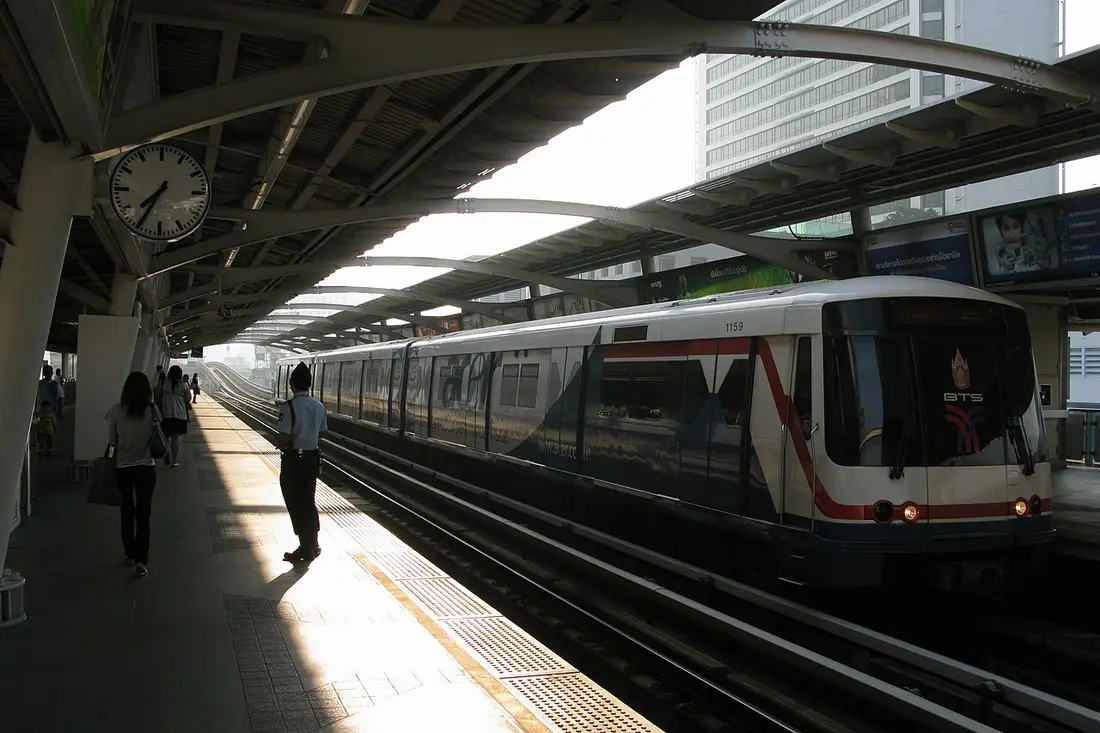
Bangkok's train network consists of two separate systems. The BTS Skytrain runs above ground along Sukhumvit Road and Silom Avenue with three lines, while the MRT is mostly underground. Its blue line runs through the old city, Chinatown, Sukhumvit Road, and Chatuchak Road, supplemented by three newer lines in the suburbs. Together with the Airport Rail Link from Suvarnabhumi Airport and the red SRT line from Bangkok-Tang Airport (Krung Thep Aphiwat), this forms the complete system.
I lived in the Rama 9 and Huai Khwang area for two or three years and in Lak Song for about a year, using the BTS when needed. The map below shows all lines and stations. You can select a specific line using the selection function and find any station using the search function. The map then displays fares and payment methods for each system, transfer options, and the nearest stations to the tourist attractions.
Bangkok BTS and MRT map
Each line has its own color, and the stations are listed in the correct order. Select a line to view it individually and list its stations, or search for a station to find it and all its associated lines. Stations with a black border are transfer stations.
Where to stay in Bangkok
This route ends in Bangkok. Search for hotels in Bangkok for your travel dates or narrow your search to a specific region. Filter for hotels with free cancellation if you'd like to book a room and decide later.
Open Booking.com with your travel dates · also on Expedia · Trip.com
My picks in Bangkok in every price category
Key facts
BTS and MRI are separate systems.
Different operators, tickets, and turnstiles. With Siam, transfers between the two BTS lines are free, but to change from the BTS to the MRT, you have to get off and pay again.
BTS ฿17-65, MRT ฿17-44
BTS fares in the city center range from 17 to 47 baht, and up to 65 baht on the extensions. A day pass costs 150 baht. The MRT Blue line costs 17 to 44 baht, and the Gold line to ICONSIAM has a flat fare of 17 baht.
Pay with your bank card on the MRT, not the BTS.
The MRT, Airport Rail Link, and Red Line accept contactless Visa or Mastercard payments at the turnstile. The BTS only accepts its own single tickets and the Rabbit Card.
From approximately 6:00 AM until midnight
Both systems operate from approximately 6:00 am to midnight; the MRT runs every 4 minutes or less during rush hour and every 7 minutes or less at other times.
The peak traffic times are from 7:00 to 9:00 and from 16:30 to 19:30.
The trains are overcrowded during both peak hours. If you are traveling with luggage, plan your journey outside of peak times.
The old town has a train station.
Sanam Chai MRT station, five minutes from Wat Pho, is the only station in the old royal district. Khao San Road has none, so riverboats and Grab cover the rest.
All Bangkok train lines at a glance
The information on routes and stations comes from the operators (BTS, BEM) and the corresponding Wikipedia articles; the station locations on the map are based on OpenStreetMap. Fares for BTS, Blue, Purple, Gold, Red, and Airport Rail Link correspond to the information in this website's travel guide, which is based on data from the operators and Thai PBS. Fares for Yellow and Pink are from third-party providers and are therefore only approximate.
The sentences a visitor actually uses
Four lines cover almost everything you might want to visit on a first trip. The BTS Sukhumvit line crosses the hotel and entertainment district from Nana to Ekkamai and continues north to Chatuchak. The BTS Silom line takes you from the Siam shopping malls through the business district to Saphan Taksin and the riverboats. The MRT Blue Line serves the Old City (Sanam Chai) and Chinatown (Wat Mangkon), and the Airport Rail Link connects you to Suvarnabhumi Airport.
The purple, yellow, and pink lines, as well as the three stops of the gold line, serve the suburbs and ICONSIAM, and most visitors don't need them. When I lived in Rama 9 and later in Lak Song, I would take the MRT to a station within walking distance or to a BTS interchange, plan each trip with Google Maps, and take a Grab or a motorbike taxi for the last leg if the station wasn't nearby.
The train stations near the tourist attractions
The ten train stations most frequently visited by visitors are shown on a map. Each station is linked to its respective station page, and there is a link to nearby hotels.
How to ride the BTS Skytrain
Purchase a single ticket from the ticket machines in the station. Select your destination or fare, pay with coins or bills, or at some machines via QR code, and hold the ticket against the reader at the turnstile. The turnstile at the exit will retain the ticket. Fares in the city center range from 17 to 47 baht, and on the extension lines, they can reach up to 65 baht.
For more than just a few trips, the 150 Baht day pass allows unlimited travel on the Sukhumvit and Silom lines on the day of purchase (available at the ticket counter). The Rabbit Card is a prepaid card that costs approximately 200–220 Baht at the ticket counter and can be loaded with 100 Baht of credit. It is required when presenting your passport. Bank cards are not currently accepted at BTS platforms.
How to ride an MRI
The easiest way to pay is to hold your contactless Visa or Mastercard to the reader at the turnstile when entering and exiting. The fare will then be charged to your card. This works on the blue and purple lines, the Airport Rail Link, and the red line. Use the same card for both journeys.
Without a contactless card, you can purchase a black plastic token from a machine or ticket counter, hold it against the reader at the entrance, and insert it at the exit. Fares on the Blue Line range from 17 to 44 baht.
Transfer between BTS and MRT
Siam is the only station where you can transfer without having to pay again, as both lines there are part of the BTS. At all other stations, you exit one system through the turnstiles and enter the other with a new ticket. The most frequently used stations are Asok/Sukhumvit, Sala Daeng/Si Lom, and Mo Chit/Chatuchak Park, which are all within easy walking distance of each other, as well as Phaya Thai, which connects the Airport Rail Link and the BTS. Bang Wa connects the Silom line to the terminus of the blue MRT line, and the yellow and pink monorails meet the other lines at Lat Phrao, Samrong, and Wat Phra Sri Mahathat, respectively.
From January 1, 2027, a unified fare is planned for all lines, ranging from 17 to 45 baht per trip, regardless of any changes. However, the government points out that this only applies to Thai nationals, so visitors should still expect to pay separately for each system.
Opening hours, peak times and luggage
The BTS and MRT Blue Lines operate daily from approximately 6:00 AM to midnight, while the Purple Line runs from 5:30 AM on weekdays. BTS trains run every 3 to 6 minutes during peak hours and every 6 to 10 minutes at other times; the MRT promises a maximum frequency of 4 minutes during peak hours and 7 minutes at other times.
Peak hours are from 7:00 to 9:00 and from 16:30 to 19:30, and it gets extremely crowded then. A common mistake first-timers make is lugging large suitcases onto the BTS, MRT, or Airport Rail Link during rush hour when there isn't enough space. If you have large luggage, you should travel outside of peak hours or use the taxi rank at the airport.
The best-rated hotels in Bangkok
Here is my ranking of the 10 best hotels in Bangkok. Each button will take you directly to the hotel's page on Booking.com, where you have already entered your travel dates.
Where the trains don't go
The old city presents a significant gap in the public transport network. Sanam Chai covers Wat Pho and the Grand Palace, but Khao San Road, the Golden Mountain, and most of Banglamphu are not connected, which is why the Chao Phraya Express boats and Grab services are used here. The river itself is the domain of the boats, operating from Sathorn Pier in Saphan Taksin upstream through Tha Tien to Phra Arthit.
Even within the train lines, many places are far from the station due to the heat. That's precisely why Grab and the motorbike taxis waiting at the station exits exist: to take you from the station to the soi (street). In Bangkok, you can get around by boat, taxi, and bus.
The official maps
The operators publish the current timetables, which you should save to your smartphone before starting your journey. On the BTS "Routes and Fares" page, you'll find the Skytrain map with a fare calculator, and the BEM network map covers the MRT Blue and Purple lines. Google Maps shows all lines and indicates the correct station and exit for each address – that's how I planned my journeys when I lived here.
Stations of the BTS Sukhumvit line, from north to southeast
BTS stations Silom and Gold Line, National Stadium to Bang Wa
MRT stations on the blue line, from Chinatown around the loop
Airport Rail Link stations, Phaya Thai to Suvarnabhumi
More information on getting around in Bangkok
Frequently Asked Questions
Frequently asked questions about the BTS and MRT map and travel guide in Bangkok.
The Sukhumvit line is the light green BTS Skytrain line that runs from Khu Khot via Mo Chit, Siam, and Asok to Kheha. The MRT Blue line also has a station called Sukhumvit, located beneath the BTS Asok station – hence the confusion.
Daily from approximately 6:00 AM to midnight. The MRT Blue Line operates at the same times, while the Purple Line opens at 5:30 AM on weekdays.
The MRT, a little bit. Fares on the blue line range from 17 to 44 baht, while the BTS costs between 17 and 47 baht in the city center and up to 65 baht on the extensions. For a whole day of BTS travel, a day pass for 150 baht can be cheaper than buying single tickets.
You can travel on the BTS with a single ticket from a ticket machine (coins, bills, or at some machines a QR code), a day ticket for 150 baht, or a Rabbit Card from the ticket counter. Contactless bank cards do not yet work on the BTS platforms.
Not yet. A contactless bank card works on the MRT, Airport Rail Link and the red line, and the Rabbit card works on the BTS as well as the yellow and pink lines, but no single card covers the BTS and the blue MRT line.
No. The Airport Rail Link runs from Suvarnabhumi to Phaya Thai, where you transfer to the BTS (45 baht). Don Mueang is on the SRT Red Line, which connects to the MRT at Bang Sue.
Sanam Chai is located on the MRT Blue Line, a five-minute walk from Wat Pho and just a few minutes' walk from the Grand Palace. The Old City is not accessible by the BTS.
No. The nearest MRT stations are Sanam Chai or Sam Yot, from which you'll need to either walk a considerable distance or take a short Grab ride. Most visitors reach Khao San Road by taking the Chao Phraya Express boat to Phra Arthit Pier or by taxi.
Sources
Compare prices on the major booking portals and filter for rooms with free cancellation if you want to book now and decide later.
Compare prices on Booking.com
Compare prices on Trip.com
We may receive a commission for bookings made through these links – this will not incur any additional costs for you. Learn more.
You might also like this
3 days in Bangkok
Temples in the old town, Chinatown after dark, the weekend market and a rooftop terrace – all timed so that you never have to turn back.
New Year's Eve in Bangkok
Midnight on the Chao Phraya, the whole river is brightly lit.
Things to do in Bangkok
Ten experiences worth traveling to – sorted by rank, price and time, so you can experience each one at the best time.
2-week Thailand itinerary
Capital city, night train, mountains, then along the Andaman coast island by island – thirteen nights, one way.
Thailand on a budget
Thailand for less money, without sacrificing the best
I lived in Bangkok for four years and traveled throughout the country from there. The guidebooks reflect my personal opinion and are written as I would explain things to a friend planning a trip.
Ready to create your travel itinerary?
Use our free trip planner to save places, organize days, and share your trip.




Community
Comments 0
Start the conversation.