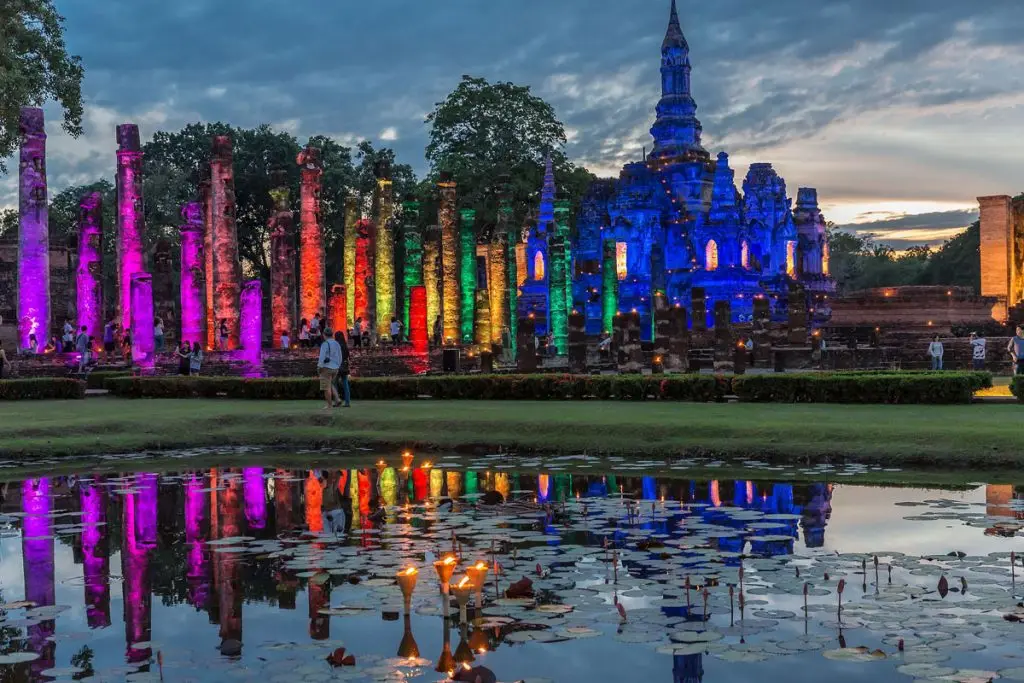
Thailand's ancient capital, Sukhothai, founded in the early 13th century, lies 427 km north of Bangkok and literally means "dawn of happiness." For 120 years, Sukhothai was ruled by many kings, the most famous of whom was King Ramkhamhaeng the Great, who created the Thai alphabet and laid the foundations for politics, monarchy, and religion.
Here are 10 reasons to visit and 10 things to do in Sukhothai.
1. Sukhothai Historical Park.
During Sukhothai's heyday, the city was the center of Southeast Asia, and the ruins from this glorious era have been declared a UNESCO World Heritage Site. The park contains the remains of royal palaces, Buddhist temples, historical monuments, as well as the remains of ancient moats, walls, and city gates. A significant feature of the complex is Wat Maha That. Inside this temple is a magnificent pagoda surrounded by eight other pagodas arranged in the shape of a lotus flower. At the main entrance stands a colossal Buddha statue called Phra Atha Ros.
2. Ban Na Ton Chan Homestay
This host family is located in Tambon Ban Tuek, Amphoe Si Satchanalai. Here you can experience the daily life of the villagers and their traditional crafts. Witness Khit weaving in the ancient floral pattern "Dok Phikun," the production of clay-soaked fabrics, basket weaving, wooden toys, and furniture made from tree roots and stumps. Also, visit the elephant sanctuary and the seasonal fruit orchards.
3. Wat Si Chum.
This temple houses a large, monumental stucco Buddha statue depicting the conquering Mara, known as "Phra Atchana." It is 11.3 meters wide. The roof has already collapsed, revealing only four walls of stucco brick. During the Phra Ruang Dynasty, monks would walk through a hidden passage and speak to the people through a hole to bolster their morale. The people believed they were hearing the voice of Buddha.
4. Si Satchanalai Historical Park.
A visit to Sukhothai would be incomplete without a trip to the historical site of the ancient city of Si Satchanalai, which, at its peak, was the second largest city after Sukhothai. The park contains the ruins of palaces, temples, and residences. Among the main attractions are Wat Phra Si Mahathat, Wat Chang Lom, and Wat Chedi Jet Taew, all built in the authentic architectural style of Sukhothai.
5. Cycling in Sukhothai Historical Park.
One of the best ways to explore this archaeological site is by bicycle. There is a bicycle rental shop in front of the historical park.
6. Loi Krathong and Candle Festival.
The Loi Krathong Festival in Sukhothai takes place annually on the full moon night of the twelfth lunar month in Sukhothai Historical Park. Activities during the festival include floating krathongs (banana leaf cups), fireworks, local games, processions, and traditional performances reflecting the lifestyle of the people as described in the stone inscription, as well as a light and sound show.
7. Sangkhalok Museum.
This private museum houses the most extensive collection of Sangkalok porcelain, a type of porcelain produced during the Kingdom of Sukhothai.
8. King Ramkhamhaeng, The Great Monument.
This attraction tells the story of Sukhothai using models of historical buildings and structures, which are best explored by tram or bicycle.
9. Ramkhamhaeng National Park (Khao Luang).
Situated at an altitude of 1200 meters, this national park, with its lush green mountain landscapes, beautiful waterfalls, and diverse wildlife, is a paradise for nature lovers. It also boasts several archaeological sites where numerous ancient tools and relics have been discovered, making them popular with historians and theologians alike.
10. Sathorn Golden Textile Museum.
The impressive Sathorn Golden Textile Museum belongs to retired textile merchant Sathorn Sorajprasobsanti. Many of the fabrics on display here originate from the village of Ban Had Saew, where the Tai Puan established their settlement during the reign of Rama II and were renowned for their handwoven textiles.




Community
Comments 0
Start the conversation.