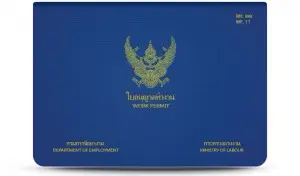
Work permit for Thailand
A Thai work permit is an official document issued by the Thai Ministry of Labour that allows foreigners to work legally in Thailand. It specifies the job, the employer, and the place of work, and ensures compliance with Thai labor laws.
Over the past two decades, Thailand has seen a steady increase in immigration. With its vibrant culture, thriving economy, and picturesque landscapes, Thailand has become a popular tourist destination and a land of opportunity. People from across Asia, Europe, and other parts of the world continue to arrive – some seeking relaxation and adventure, but many also seeking career prospects and a better life. As a result, foreign nationals have become increasingly integrated into the Thai economy and workforce.
This increasing foreign presence, particularly in urban business centers, eventually attracted the attention of Thai authorities. The noticeable expansion of foreign ownership in local businesses raised concerns about labor market balance and national interests. As a result, the Thai government introduced stricter regulations, including legal measures and bilateral agreements, to control the influx of foreign workers and manage their impact on the domestic economy.
Despite these efforts, challenges remain. A common problem is the abuse of tourist visas by foreigners—colloquially known as "falangs"—who enter the country to travel but ultimately seek employment. Many exploit so-called visa runs, briefly leaving the country and re-entering with extended residence permits, allowing them to work without valid work authorization. This loophole complicates the government's efforts to regulate foreign workers and ensure compliance with the law.
Obtaining the necessary documents for a Thai work permit
Tourists are not permitted to work in Thailand. If they wish to do so, they require a Non-Immigrant B visa. This visa is typically issued to foreigners who wish to conduct business or professional activities in Thailand. It is valid for either a single entry for 90 days or multiple entries for one year. Applications can be submitted to the Thai embassy or consulate in the applicant's home country. If tourists are already in Thailand, the application can be submitted to the immigration authorities.
Another important document is the Thai work permit. It regulates the type of work, the duration of the employment, and basic information such as the employer and place of residence of a foreign worker. (Further information can be found on Siam Legal's page on applying for a work permit.) Foreigners (including B visa holders) are practically prohibited from working in Thailand without this permit. To apply for a Thai work permit, one must already be in possession of a B visa. Like a visa, a work permit can also be extended or revoked under certain conditions.
Prohibited activities
The Thai government has categorized professions to determine which are suitable for foreigners wishing to work in the country and which are not. It fears that foreigners will take jobs away from locals and has therefore reserved some professions exclusively for Thai citizens.
However, all companies outside these categories are exempt from the ban. The following are the areas of activity prohibited for foreigners:
Foreigners are permitted to work in export, wholesale (excluding goods in categories a and b), retail trade of machinery, equipment, and tools, as well as in the production of animal feed, textiles, glassware, and ceramics. The sale of goods that promote Thai tourism is also allowed. When applying for a Thai work permit, ensure that the activity you intend to pursue is not prohibited, otherwise you will not receive your permit as quickly.
Obligations of a foreign employee
The checklist for foreign workers doesn't end with prohibited activities. It only begins once the work permit is obtained. The work permit is a thin booklet specifically designed to be carried by the holder. The foreign worker must always have this booklet with them, especially at the workplace. They may only perform the activities listed in the work permit and under no circumstances any other activities.
If you change your address, you must apply for a change of address. If your work permit is lost or damaged, you must report this to the employment office immediately. The document will then be replaced with a new one. Upon termination of employment, the document must be returned to the employment office within seven days.
It is extremely important to note that failure to comply with the aforementioned regulations is punishable by fines or, in the worst-case scenario, imprisonment. Thai authorities are generally very strict regarding violations and the interpretation of the law. Believe me, you don't want to find yourself in a position to face the consequences. After all, in a country where Western and Eastern cultures meet, no one has ever been harmed simply by following the guidelines and regulations.



Community
Comments 0
Start the conversation.