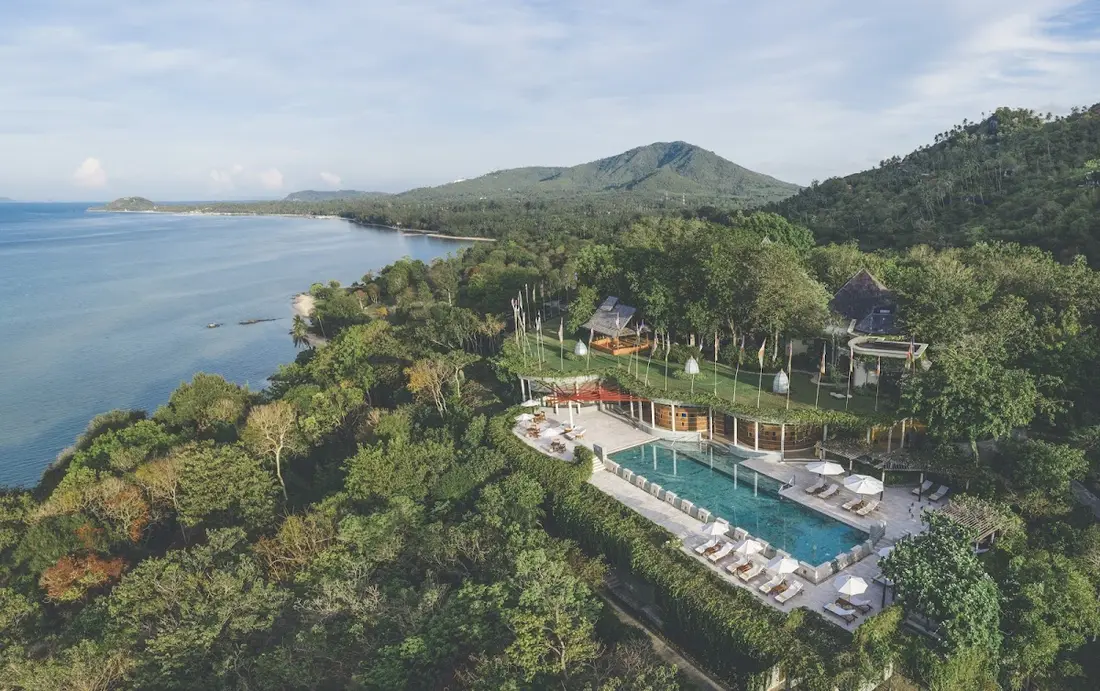
How much does a wellness retreat in Thailand cost and what kind of wellness stay are you looking for?
From voluntary donations to prices that cost more than a penthouse in Bangkok, anything is possible, because "retreat" in Thailand encompasses five very different offerings. A forest monastery like Wat Pa Tam Wua offers Vipassana courses free of charge, including room and board, while the famous ten-day silent retreat at Suan Mokkh costs 2,000 baht. The Srithanu yoga schools on Koh Phangan offer month-long programs, including accommodation, for under US$2,000.
A yoga resort perched on a cliff like Vikasa on Koh Samui is available from US$700 per week (all-inclusive). Absolute Sanctuary's three-day wellness program starts at 20,460 baht in the off-season, while detox and colon cleanse programs start at 65,500 baht. The exclusive resorts Kamalaya, Chiva-Som, RAKxa, and the 2025 RXV Award-winning RXV offer programs starting at approximately 20,000 baht per night. Use the filter below to sort all 28 offers according to your preferences and budget. Further information about each offer can be found later in this guide. Meditation retreats have their own separate guide.
Find your retreat based on goal × budget
Two questions are all it takes. Select your preferences for the week and your budget per night. The matching offers on this page will then be displayed with their actual starting price and minimum stay. All prices are the published rates of the respective providers; "On request" means you will receive an offer by email.
Choose a destination, a budget, or both, and suitable retreats will be displayed here.
The prices quoted are based on the lowest published rate offered by the provider (where available, as of September 2026) or, if no rate is available, on the resort's offers listed on booking portals. Prices vary depending on the season and room availability. "On request" means that the provider will send you an offer via email. This does not constitute medical advice.
Where to stay before, after or during the retreat
Choose the region for your retreat, then your desired location, and search by your travel dates. Most retreats are booked directly. This search therefore includes the nights before and after the program (arriving at a monastery is early in the morning, so it's recommended to stay nearby the night before), as well as resort retreats offered by Booking.com. Filter for offers with free cancellation if your travel dates are not yet fixed.
Open Booking.com with your travel dates · also on Expedia · Trip.com
Key Facts (2026)
Prices range from donations to over 25,000 baht per night.
Monastery retreats are donation-based, for example, 2,000 baht for ten days at Suan Mokkh. Srithanu yoga programs, including accommodation, cost under US$2,000 per month. Vikasa offers all-inclusive packages starting at US$700 per week. The cheapest three-night stay at Absolute Sanctuary costs 20,460 baht. A short break at RXV costs 20,000 baht; prices for Kamalaya, Chiva-Som, and RAKxa vary depending on the specific program.
Samui stands for wellness, Srithanu for yoga, and the north for meditation.
Koh Samui is home to some of the most famous yoga retreats (Kamalaya, Samahita, Vikasa, Absolute Sanctuary). The Srithanu Coast of Koh Phangan is considered Asia's most important yoga center. Chiang Mai, Pai, and Mae Hong Son boast numerous monasteries. Phuket is known for its detox and fitness programs. Bangkok's medical centers (RAKxa, RXV) are an hour from the airport, and Chiva-Som is located in Hua Hin.
Beginners are the main target group
All retreats described in this guide are suitable for beginners, including those at monasteries that teach the method from the ground up. No prior knowledge, special flexibility, or specific clothing is required; white robes are provided at Wat Pa Tam Wua.
Three days will do the trick, and one week is the optimal timeframe.
Three nights is usually the minimum stay at the retreats and monasteries. Most programs are designed for one week. Two to four weeks—the duration of a teacher training course, a 28-day detox retreat, or Kamalaya's sabbatical—can change habits. The months of November through March are the fastest to book up.
The free option is truly world-class.
The Wat Pa Tam Wua forest monastery, located between Pai and Mae Hong Son, is open to visitors daily year-round. Registration takes place between 6:00 AM and 4:00 PM. A donation is requested for the ten-day period of silence at Suan Mokkh near Surat Thani. Further information about both monasteries can be found below.
The value is higher for longer stays.
Weekly rates are generally cheaper than overnight rates, teacher training courses last about four weeks, and since September 15, 2026, most nationalities receive a 30-day visa-free entry, with the possibility of a one-time extension of another 30 days. A four-week training course is ideal; for a longer stay, either an extension or a tourist e-visa is required. Srithanu, Doi Saket, and Pai are perfect for travelers who want to extend their stay from one week to one month.
How much a retreat in Thailand costs, by category
All prices listed are the prices published by the organizer (as of September 2026) for single occupancy, unless otherwise stated. Kamalaya charges for its programs in addition to the room rate; therefore, the total cost is shown on two lines. Marketplaces such as BookRetreats offer hundreds of other programs in the price range of US$200 to US$1,500 per week, primarily on Koh Phangan, in Chiang Mai, and on Phuket.
The five types of Thai retreats (and which one is right for you)
Booking the wrong type of retreat is a classic mistake. A quiet meditation monastery and a luxurious wellness retreat offer solutions for different needs. Thailand offers all five categories at an international standard. Here's how they differ and who each is suitable for.
Wellness retreats at travel destinations offer a complete restart with full staff.
These are the places that put Thailand on the global wellness map – and the four that search engines list first. Kamalaya on Koh Samui, built around a former monk's cave, combines Asia's most awarded holistic programs with a lush jungle campus right on the beach. The programs last from 3 to 21 nights and are charged in addition to the room rate. Chiva-Som in Hua Hin is considered the inventor of the destination spa and continues to set standards with sixteen retreats, a minimum stay of two nights in the Essentials package, and all-inclusive dining. RAKxa on Bangkok's verdant island of Bang Krachao is a medical wellness retreat with genetic and gut analyses, as well as a team of doctors (adults only). Its sister hotel, RXV Wellness Village on Sam Phran, was named "Thailand's Best Wellness Retreat 2025" at the World Spa Awards the year after RAKxa and offers a children's program as well as short breaks starting from 20,000 baht. Amatara at Cape Panwa and THANN's riverside resort outside Ayutthaya round out the selection at more affordable prices. These offers are only available once a decade, and those who take advantage of them rarely regret their purchase.
Yoga retreats make up the largest category, ranging from beach shalas to boutique studios.
Koh Samui is the capital. Samahita's breath-centered programs on a tranquil southern beach, Vikasa's clifftop campus above Chaweng Noi (from US$700 per week including brunch, dinner, and unlimited classes; minimum three-night stay), and Absolute Sanctuary's hilltop programs cover the island's diversity. The north exudes rural charm: Suan Sati offers an all-inclusive retreat amidst the rice paddies of Mae Wang, True Nature provides family-run accommodation in the hills of Mae Taeng, and Mala Dhara offers mud villas and a saltwater pool in Doi Saket, where a dorm bed costs 500 baht. Island Yoga and Samadee in Krabi, as well as Oasis Yoga Bungalows on Koh Lanta, allow for yoga practice close to some of the Andaman Sea's most beautiful beaches. Scheduled retreat weeks cost between 15,000 and 40,000 baht, with accommodation and meals in the mid-price range. Most centers also welcome walk-ins for daily classes.
Meditation centers and monasteries – that's what the north is for.
Thailand's meditation tradition is deeply rooted in monasticism, and the most profound retreat experiences follow this principle. Wat Pa Tam Wua, nestled in a limestone valley on the road from Pai to Mae Hong Son, is the most famous monastery. You can drop in anytime, put on the white clothes provided, and follow the gentle Vipassana daily routine—from meditation at 5 a.m. to chanting at 6 p.m. The cost is based on a donation; accommodation and two vegetarian meals are included. Suan Mokkh, near Chaiya, offers the country's most renowned ten-day silent retreat every month, starting on the 1st. Pa Pae, located between Chiang Mai and Pai, offers three-day, monk-led retreats on set dates for approximately 500 baht per day. Thai Plum Village in Khao Yai teaches the mindfulness tradition of Thich Nhat Hanh in English and offers week-long retreats starting at around 7,000 baht, which also welcomes families. The Pai International Meditation Center offers a comfortable option: seven nights in a treehouse by a lake with hot springs for 15,700–20,700 baht. Which center is offered, what a typical day looks like, the rules, and how to register – all this can be found in the meditation retreat guide.
Detoxification treatments are Phuket's specialty.
Structured detoxification is a discipline in its own right, and Phuket is home to its specialists. Atmanjai, on Friendship Beach in Rawai, has been offering guided fasting programs for over a decade (juice, broth, and raw food menus starting at three days, with daily yoga). Santosa, above Kata, offers a gentler, plant-based option with a fully vegan menu, a minimum stay of three nights, and a recommendation of five to seven days for first-timers. Mangosteen, also in Rawai, is the Ayurvedic option, with Panchakarma programs of six to fifteen days under medical supervision. Phuket Cleanse transforms detox into an all-inclusive fitness camp for a flat rate of US$280 per night with no minimum stay. On Koh Samui, Absolute Sanctuary combines detox and comfort with resort programs starting at 65,500 baht for three nights, and on Koh Phangan, Orion offers 11- and 28-day juice cleanses by the saltwater pool. Expect an honest course of action, a bumpy second day, and then the clarity that people come back for.
Fitness retreats where you train instead of being pampered.
For those yearning for a sweat-inducing reboot, Thailand's fitness camps offer a retreat-style experience. Thanyapura in northern Phuket is the flagship: an Olympic-level sports campus with a health center and hotel, where triathletes and other guests share pools and trainers. Phuket Cleanse in Rawai offers hundreds of classes per week, ice baths, sauna, and a floatation tank for a fixed nightly rate. Titan Fitness Camp brings supervised training weeks and weight-loss programs to Phuket's Soi Ta-iad fitness hub, FITKOH is a leader in Samui's bootcamp scene, and Seaview Fitness Center on Samahita is the reason ambitious yogis train there. The country's most pronounced fitness retreat culture can be found at Muay Thai Camp: two training sessions daily, six days a week. A detailed guide is provided below.
The burnout recovery programs that were developed for this purpose
Searches for wellness facilities in Thailand have quadrupled since the end of 2025, and providers have taken notice. Some now offer programs for those suffering from exhaustion, not just illness. It's helpful to understand the differences between these offerings before sending an email. None of these facilities are a substitute for medical care. If you are experiencing a crisis, please consult a doctor first and provide accurate information on the facility's registration form, as their programs are indeed based on medical expertise.
Kamalaya is dedicated to emotional recovery. The "Embracing Change" program lasts 5, 8, or 15 nights, while the "Wellbeing Sabbatical" starts at 21 nights. Both programs fall under the "Emotional Resilience & Balance" category, which also includes programs to improve sleep and cognitive function; all costs are in addition to the room rate. Absolute Sanctuary, on the same island, offers, among other things, a burnout management program for executives, a relaxation and recovery program, and a sleep program. The three-day wellness retreat for 20,460 baht is the most affordable way to experience this concept. Chiva-Som offers relaxation and craniosacral therapy retreats in Hua Hin. RXV in Sam Phran offers three-day relaxation and mindfulness programs for 70,000–74,000 baht, and Samahita combines holistic self-care with a brain-enhancing program that includes a floatation tank and infrared sauna.
For those on a tighter budget, monasteries are honestly the top choice for anyone reporting their burnout recovery in Thailand. Wat Pa Tam Wua offers at least three-day stays with 5 a.m. meditations for a donation; three-day retreats at Pa Pae cost 500 baht per day; the mindfulness week at Thai Plum Village costs around 7,000 baht, and there are occasional retreats specifically for healthcare professionals. The Pai International Meditation Center offers the same monk-led week in a treehouse with hot springs. Museflower, situated on a lake outside Chiang Rai, hosts small-group retreats for those seeking tranquility without the rules of a monastery, and the Aleenta Retreat Chiang Mai is the hotel-style option on the city's outskirts.
What a typical retreat day looks like
In a monastery, the day dictates the practice. The daily routine for lay guests at Wat Pa Tam Wua begins at 5:00 a.m. with meditation in the kuti, followed by a rice offering to the monks at 6:30 a.m., breakfast at 7:00 a.m., and morning classes at 8:00 a.m. These consist of a Dharma talk, 40 minutes each of walking and sitting meditation, and 15 minutes of lying meditation. At 10:30 a.m., food is offered to the monks, and at 11:00 a.m., lunch, the last meal of the day, is served. Afternoon classes begin at 12:50 p.m., monastery work starts at 4:00 p.m., there is free time from 5:00 p.m., evening chants and a talk take place at 6:00 p.m., and lights out is at 10:00 p.m. At Suan Mokkh, the daily routine is stricter and starts earlier: the bell rings at 4 a.m., breakfast is at 8 a.m., lunch at 12:30 p.m., hot drinks are served at 6 p.m., and lights out is at 9:30 p.m. At Thai Plum Village, the day also begins at 4 a.m., with walking meditation at 6 a.m., silent meals, work meditation in the afternoon, and profound silence from 9 p.m. onward.
At a yoga resort, the day consists of classes and meals. The Vikasa rate includes unlimited group classes, gong, sound, and dance evenings, twice-weekly workshops, daily brunch and dinner, and use of the infinity pool and the secluded beach between it. Samahita offers dynamic yoga in the morning, restorative yoga in the afternoon, and breathing exercises in between; a fitness center is available for the rest of the time. The Srithanu schools offer week-long packages with morning and evening classes, leaving the midday hours free for the beach.
In a wellness retreat, your day is tailored entirely to your wishes. Absolute Sanctuary's programs combine morning meditation and yoga, Pilates, massages, and supportive therapy sessions around three healthy meals. Private lessons are included. Kamalaya offers its daily schedule as a program. If you'd like to get a taste of it, a wellness day pass with one holistic activity costs 1,800 ฿++, with Pilates and lunch 3,090 ฿++, and with a spa treatment 5,300 ฿++. RXV and Chiva-Som begin with consultations and create your personalized treatment plan based on those.
Yoga teacher training in Thailand
Thailand, along with India and Bali, is one of the three most popular destinations worldwide for yoga teacher training – and for good reason. Internationally recognized 200-hour courses here cost less than a month of yoga instruction in a home studio, and in places you would visit anyway. The standard course lasts three to four weeks, is full-time, and takes place in a dormitory. Including shared accommodation, it costs approximately US$2,000 to US$3,500. Vikasa's 200-hour foundation course starts at US$3,480; courses begin in late September, January, and late March in 2026 and 2027. Samahita on Koh Samui, Suan Sati and Mala Dhara near Chiang Mai, and the Srithanu schools on Koh Phangan (Orion offers 200-hour trainings in various yoga styles and 50-hour Yin Yoga trainings) all offer highly regarded programs. Choose a school based on tradition and head teacher, not just the beach. Read the curriculum, find out who is teaching your course, and make sure the training center is accredited by the Yoga Alliance if you plan to teach yourself. Plan the weeks after your course to be relatively relaxed, as nobody flies home on the day the course ends.
Select and book, it's that easy.
Choose the booking model that best suits your location. Wellness and detox centers offer programs per night, so book directly and well in advance for the months of November through March. Be aware of seasonal dates, as Absolute Sanctuary's prices are net and vary depending on the season. Vikasa offers a 25% discount on bookings made 90 days in advance. Yoga retreats offer two models: fixed retreat weeks (with set dates, book early; Suan Sati's winter retreats run from October to February) and flexible stays with daily classes (Suan Sati offers its guesthouses from May to September, True Nature starts anytime). Inquire about specific offerings. Srithanu schools offer program weeks; accommodation in the surrounding village is often booked separately.
Each monastery has an important rule. Wat Pa Tam Wua does not accept bookings; you can therefore arrive any time of year, register between 6 am and 4 pm, and plan for a minimum stay of three days and two nights. Suan Mokkh only accepts registrations in person on the last day of the month before the retreat, between 7 am and 3 pm. No further registrations are possible after this time. Pa Pae's three-day retreats have published dates, a registration form, and a registration deadline of 5 pm on the first afternoon. Thai Plum Village opens online registration for each retreat on a set date and closes it once all places are filled. The Pai International Meditation Center books through its website for fixed monthly weeks. All information can be found in the overview of meditation retreats.
Two important points to avoid disappointment. First, "wellness" on a Thai spa sign usually means an excellent massage parlor rather than a wellness retreat. The places featured in this guide are wellness retreats with programs—not to mention the (wonderful, 400 baht) hour-long Thai massage you should definitely treat yourself to. Second, tranquil and party Thailand are on the same islands, and Srithanu and Haad Rin are only 20 minutes apart. The coasts are generally quiet, but if peace and quiet on Koh Phangan are important to you during your week, consult the full moon calendar.
Retreat resorts that you can book like a hotel
Most retreats are booked directly, but these eight are listed on Booking.com. This allows you to reserve a room with free cancellation and receive the program details via email once the dates are confirmed. Each of the names listed below has been verified on the Booking.com results page; you can find the accommodation for your travel dates by clicking the "Prices" button. The comments are based on offers, not actual stays.
Koh Samui & Koh Phangan
Phuket
Chiang Mai & Ayutthaya
Kamalaya, Chiva-Som, RAKxa, RXV, Suan Sati, Santosa, Atmanjai, and The Sanctuary are not listed on Booking.com and must be booked directly. The monasteries do not accept bookings.
The great wellness oases
Kamalaya Wellness Sanctuary
Chiva Som Hua Hin Wellness Resort
RXV Wellness Village
RAKxa Integrative Wellness
Amatara Wellness Resort
THANN Wellness Destination
Yoga retreats on Samui and in the north
Vikasa Yoga
Samahita
Absolute refuge
Suan Sati Yoga Retreat Center
True Nature Chiang Mai – Yoga and Meditation Retreat
Mala Dhara
Samadee Yoga & Retreat Aonang Krabi
Island Yoga Thailand
Oasis Yoga Bungalows
Accommodation in Koh Samui
Compare current hotel prices for the stops listed in this travel guide on Koh Samui.
Compare prices on Booking.com
Compare prices on Trip.com
Sponsored – we may receive a commission at no extra cost to you. Learn more.
The Srithanu coast is the yoga village of Koh Phangan
Orion Healing
Wonderland Healing House
The sanctuary
Samma Karuna
Accommodation in Koh Phangan
Compare current hotel prices for the stops listed in this travel guide on Koh Phangan.
Meditation in monasteries and mountain retreats
Wat Pa Tam Wua
Pai International Meditation Center
Pa Pae Meditation Retreat
Suan Mokkh International Dharma Hermitage
Thai Plum Village
Museflower Retreat & Spa
Where to stay in Pai
Compare current hotel prices for the stops listed in this travel guide in Pai.
Detox & Fitness
Thanyapura Sports and Health Resort
Mangosteen Ayurveda & Wellness Resort
Phuket Cleaning
Atmanjai
Santosa
Titan Fitness Camp
FITKOH
Where to stay in Phuket
Compare current hotel prices for the destinations in Phuket listed in this travel guide.
Three retreats on video
To get an idea of the three categories before booking, take a look at other people's experiences. A five-day retreat program on Koh Samui, a week led by monks in Pai, and a three-day forest retreat near Chiang Mai. None of these are my own offerings; the respective channels are listed. The stay at Absolute Sanctuary was sponsored, as noted in the video.
Frequently Asked Questions
Frequently asked questions about wellness retreats in Thailand, sorted by destination and cost.
Five price categories. Monastery retreats are donation-based, and Suan Mokkh's ten-day silent retreat costs 2,000 baht all-inclusive. Budget-friendly yoga and homestay retreats cost under 3,000 baht per night (Mala Dhara's dorm costs 500 baht; Samma Karuna's 28-day programs start at US$1,856 including accommodation). Mid-range all-inclusive yoga resorts and detox centers cost between 3,000 and 8,000 baht per night, Vikasa starts at US$700 per week, and the three-day wellness retreat at Absolute Sanctuary starts at 20,460 baht. Premium camps with fixed prices, such as Phuket Cleanse, start at US$280 per night. The protected areas sell programs, RXV from 20,000 Baht for one night and 70,000 Baht for three nights, Kamalaya, Chiva-Som and RAKxa on request.
It depends on your goals, so this page offers a selection. For a holistic retreat with doctors and therapists, Kamalaya on Koh Samui is the most awarded option; for medical diagnostics near Bangkok, RAKxa (adults only) or RXV, Thailand's best wellness retreat according to the World Spa Awards 2025; for a unique destination spa, Chiva-Som in Hua Hin. Absolute Sanctuary offers good value with various programs. For yoga, Vikasa or Samahita on Koh Samui and Suan Sati near Chiang Mai are ideal. For meditation, Wat Pa Tam Wua is suitable for a spontaneous stay, and Suan Mokkh for a ten-day silent retreat.
For meditation, Thailand's donation-based monasteries are among the most affordable in the world. At Wat Pa Tam Wua, a stay including room and board costs the amount of your choosing, and ten days at Suan Mokkh cost 2,000 baht. India's ashrams and Nepal's monasteries compete in this price range. For resort-style retreats with pools and unlimited classes, Bali and India are often less expensive than Thailand's sanctuaries. However, Thailand's mid-range prices are hard to beat: Vikasa starts at US$700 per week all-inclusive, and the Srithanu schools cost less than US$2,000 per month including accommodation.
Yes, and some are specifically built for this purpose. Wat Pa Tam Wua accepts visitors daily throughout the year without prior registration (registration between 6 a.m. and 4 p.m., minimum stay three days), provides white clothing, a bed, and two vegetarian meals, and simply requests a donation. Suan Mokkh offers a fixed ten-day course each month; registration is done in person on the last day of the preceding month. Pa Pae hosts three-day retreats with monks on set dates for 500 baht per day. Thai Plum Village offers week-long retreats in English. All of these facilities are suitable for beginners.
Yes. Monastery retreats are donation-based. Wat Pa Tam Wua is the best-known and most foreigner-friendly monastery. You can arrive at any time, join the program, stay in the dormitories or kutis, take the two daily vegetarian meals, and donate an amount of your choice upon departure. Dipabhavan on Koh Samui offers its short courses free of charge as a Dhamma gift. Pa Pae suggests 500 baht per day, and Suan Mokkh charges 2,000 baht for ten days—which is practically free considering what's offered.
It depends on the level. In a monastery, the day consists of exercises: starting at 4 or 5 a.m., sitting and walking meditation, a Dharma talk, two vegetarian meals before lunch, chores, evening chanting, and bedtime at 10 p.m. In a yoga resort, classes are held in the morning and evening around brunch and dinner, with time in between by the pool or on the beach. In a spiritual center, the day begins with an initial consultation and is then individually tailored with treatments, movement classes, meals adapted to the program, and periods of rest. Each level includes a kind of initial assessment; be honest during this process.
They are largely designed for solo travelers. The monasteries are deliberately geared towards individual stays, with single rooms or gender-segregated dormitories and a schedule that makes company unnecessary. Absolute Sanctuary and Samahita, on the other hand, seat their guests at communal tables and offer group classes, so solo travelers have company by the second day at the latest. The retreats' program prices are listed per person; couples pay the price of a double room. The schools in Srithanu are like a village, and the loneliest thing there is trying to be alone.
Yes, and the term has several meanings. At Vikasa, rooms, unlimited classes, brunch, dinner, workshops, and airport transfers are included starting at US$700 per week. Phuket Cleanse offers a fixed price for rooms, all classes, all meals, and most treatments starting at US$280 per night with no minimum stay. Samahita and THANN offer all-inclusive stays. Absolute Sanctuary's programs include rooms, treatments, meals, and classes. Kamalaya is an exception, as its programs are charged separately from the room rate.
Some, but not most. RXV Wellness Village near Bangkok welcomes families and offers a three-day wellness program for children starting at 29,000 baht. The mindfulness retreats at Thai Plum Village are suitable for children from around five years old, accompanied by a parent. Amatara in Phuket is a full-fledged resort, so a family can vacation while one person participates in the program. RAKxa is adults-only, and its monasteries and detox centers cater to practicing adults. Inquire before booking, as offerings vary depending on the program.
These options can be helpful for burnout. Kamalaya's "Embracing Change" (5, 8, or 15 nights) and the 21-day "Wellbeing Sabbatical," Absolute Sanctuary's "Executive Burnout Recovery" and "De-stress & Recovery" programs, Chiva-Som's "Tension Release Retreat," and RXV's three-day "Destress and Mindfulness" programs are all designed for people feeling exhausted. Monasteries are the more affordable option and, frankly, where most people who report on their recovery experiences in Thailand have stayed. However, none of these programs are treatments for mental health conditions. If you are feeling unwell, please consult a doctor first and be truthful on the retreat registration form.
Suan Mokkh near Chaiya is a well-known example: ten days of silence, surrendering mobile phones, beginning on the first day of each month; entrance fee: 2,000 baht. At Thai Plum Village, silence is observed from 9 p.m. onwards, and meals are also eaten in silence. Wat Pa Tam Wua and Pa Pae offer silence without enforcing it, making them a better choice for a first retreat than many expect. Museflower near Chiang Rai and the other shrines offer silence as an option, not an obligation.
It's quite simple, and that's precisely where the value lies. Samma Karuna on Koh Phangan offers 28-day programs starting at US$1,856 including accommodation; Orion runs a 28-day detox program called "Renew & Revitalize"; Kamalaya's wellness sabbatical starts at 21 nights; Absolute Sanctuary's "Lifestyle Change" lasts 30 or 60 days; and a 200-hour yoga teacher training course takes three to four weeks. Since September 15, 2026, the visa-free stay is 30 days and can be extended once by 30 days at the immigration office for a fee of 1,900 baht. So, a one-month stay is possible; for five weeks, an extension is required.
Beginners are the primary target audience. All retreats described in this guide, including the monasteries, start from scratch and introduce newcomers to the meditation method on a daily basis. You don't need flexibility, experience, or equipment. The only common requirement is modest clothing that covers shoulders and knees. At Wat Pa Tam Wua, the monastery provides a white set.
Two options. Koh Samui offers exclusive retreat resorts (Samahita, Vikasa, Absolute Sanctuary – all top-notch programs in beach or hillside locations), while the Srithanu coast on Koh Phangan beckons with its authentic village life. There, schools like Orion, Wonderland, and Samma Karuna line the streets, where the entire neighborhood practices. The rural surroundings of Chiang Mai, with Suan Sati, True Nature, and Mala Dhara, are the underrated and most affordable option.
Yoga is one of the world's three leading yoga centers, alongside India and Bali. Accredited 200-hour courses last three to four weeks and cost approximately US$2,000 to US$3,500, including shared accommodation. At Vikasa, courses start at US$3,480, with courses beginning in late September, January, and late March. Samahita, Suan Sati, Mala Dhara, and the Srithanu schools also offer reputable programs. Choose your course based on the instructor and curriculum, and ensure that the courses are accredited by the Yoga Alliance if you plan to teach them yourself.
Three nights are considered the minimum stay almost everywhere (Wat Pa Tam Wua, Absolute Sanctuary, Vikasa, and Santosa all offer this duration) and allow for a true break. Most programs are designed for one week, as is the case with the retreats at Pai and Plum Village. Two to four weeks are suitable for profound transformations, such as the ten days at Suan Mokkh, a 28-day detox, a teacher training program, or Kamalaya's 21-day sabbatical. Longer stays are popular in Thailand as weekly rates decrease. However, since September 15, 2026, the visa-free stay is limited to 30 days. Stays longer than one month require an extension for 1,900 baht or a tourist e-visa.
Retreats are offered year-round, though the cooler months from November to March are the most pleasant. Therefore, book well in advance. At the Pai International Meditation Center, prices increase from 15,700 to 20,700 baht per week between October and February, and prices also rise at Absolute Sanctuary during peak season. The off-season (May to October) offers afternoon rain, quieter shalas, and more affordable prices. However, this isn't really a concern for a meditation retreat, as rain on a forested roof is practically part of the experience. Suan Mokkh takes place every month, regardless of the weather.
Compare prices on the major booking portals and filter for rooms with free cancellation if you want to book now and decide later.
We may receive a commission for bookings made through these links – this will not incur any additional costs for you. Learn more.
Discover more in this guide
You might also like this
2-week Thailand itinerary
Capital city, night train, mountains, then along the Andaman coast island by island – thirteen nights, one way.
Thailand Honeymoon Guide and 10-Day Itinerary
Villas with private pools, sunsets in a longtail boat, and evenings perfect for two.
10 days in Thailand – Itinerary
Capital city, night train, mountains, then ferry to the Andaman coast – nine nights, one way, no return.
7 days in Thailand
Capital city, mountains, islands – six nights, two short flights and not a single day was lost to the journey.
Thailand on a budget
Thailand for less money, without sacrificing the best
I lived in Bangkok for four years and traveled throughout the country from there. The guidebooks reflect my personal opinion and are written as I would explain things to a friend planning a trip.
Ready to create your travel itinerary?
Use our free trip planner to save places, organize days, and share your trip.




Community
Comments 0
Start the conversation.