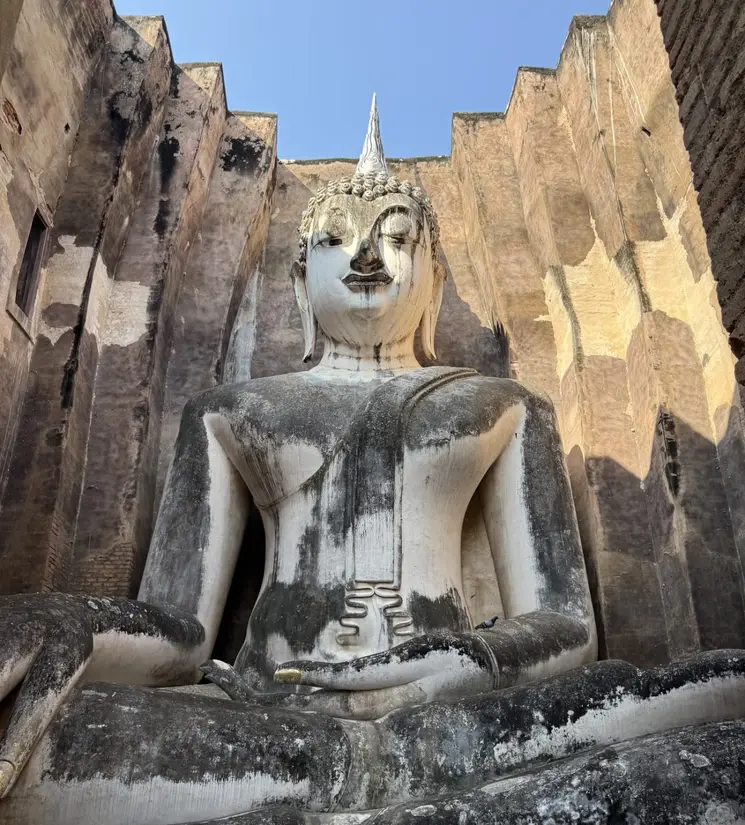
Over the years, we've seen some incredible temples in Thailand, but none compare to Wat Si Chum in Sukhothai. The Buddha statue there, called Phra Achana, sits peacefully in an open shrine. It becomes visible when you approach it through a vertical opening in the brick walls. Although this temple complex is significantly smaller than some of the other sites in the area, it was nonetheless (by far) the highlight of our Sukhothai visit.
Sukhothai is exactly the kind of place we think far more travelers should visit, instead of automatically taking a day trip to Ayutthaya. It has a relaxed, authentic atmosphere, and the temples are, in our opinion, far more impressive. We opted for two nights in Sukhothai—a short, intense trip, which Kat's mother also joined us on. We flew with Bangkok Airways and stayed at the Midtown Sukhothai—a reasonably priced, comfortable hotel with poolside villas.
We had planned to spend a whole day in the historical park and the rest of the time relaxing at the hotel, trying street food, and simply soaking up the city's atmosphere. The day at the ruins was phenomenal—from the tuk-tuk rides to the sukhothai noodles and the temple visits, everything was fantastic. But looking back, the visit to Wat Si Chum was the absolute highlight.
Read more: Sukhothai travel guide: Best itinerary, temples & hotels
The legend of the "Talking Buddha"
One of the discoveries we made about Wat Si Chum is its rich history, which stretches back 700 years, to the 13th and 14th centuries. We learned about the legend of the "Talking Buddha," which fascinated us. It tells of the king's soldiers who participated in a campaign and returned to Sukhothai demoralized after fierce fighting. The king had an ingenious plan to rebuild the soldiers' spirits: he took them to Wat Si Chum, where they believed they were participating in a religious ritual.
The king, however, had sent one of his soldiers up a secret staircase (behind the Buddha's head) and ordered him to deliver a speech as soon as the soldiers reached the narrow gap in the front wall. His words echoed within the shrine, bouncing off the brick walls and spurring the soldiers on to victory. Whether the story was true or not was irrelevant to us; it simply added a special and mysterious touch to this already enchanting place.
Architectural highlights of Wat Si Chum
Phra Achana: The giant seated Buddha
The absolute highlight of Wat Si Chum is undoubtedly Phra Achana, the Buddha statue seated with its left hand in its lap and its right hand dangling over its knee – its elegant fingers covered in gold leaf. Many Thais come here to earn merit by first praying and then placing gold leaf on the statue's fingers. Kat's mother also participated with deep reverence. If you arrive around mid-morning, you can witness the sun streaming into the open sanctuary, creating fantastic photo opportunities.
The Mondop: A refuge without a roof
Phra Achana is located in a roofless shrine called a "mondop," built of brick and stucco. It is square and windowless, creating an eerie atmosphere upon entering. On the way to the mondop, one sees ruined columns and crumbling brick foundations, but also a narrow, vertical opening that offers a glimpse of the statue—crowned by an "ushnisha," symbolizing Buddha's transcendent wisdom.
The smaller seated Buddha statue
The biggest surprise for us at Wat Si Chum wasn't the unveiling of Phra Achana, but the smaller, seated Buddha statue to the right of the mondop, right next to the giant mango tree. We were captivated by this statue, as it had a weathered, anthracite-colored patina with shimmering flecks of gold leaf. The open door in front of the statue also provided a perfect backdrop for photos, and some of our favorite pictures of Wat Si Chum were taken from there.
Small seated Buddha statue
Visitor guide for Wat Si Chum
Information on admission price and tickets
We visited Wat Si Chum in March 2026. At that time, the entrance fee was 120 THB for foreign visitors (Cam) and 20 THB for Thai citizens (Kat). This ticket also granted us access to the Khmer-style ruins of Wat Phra Phai Luang in the northern zone of the Sukhothai Historical Park, which we visited immediately afterward. Wat Si Chum offers excellent value for money, as it is one of the most beautiful temples in Thailand and, at 500 THB entrance fee, is significantly cheaper than, for example, the Grand Palace.
Opening Hours & Best Time to Visit
Wat Si Chum opens its gates daily at 7:30 a.m. and closes at 5:00 p.m. However, the best time to arrive is around 9:00 a.m. That's exactly what we did – and we were able to enjoy the temple without the midday heat and the crowds of tourists. If you stay until 10:00 or 11:00 a.m., the sun is already high enough to let light into the dark, roofless sanctuary – a truly impressive sight.
Dress code and cultural etiquette
Wat Si Chum's dress code is similar to that of most temples in Thailand: shorts, sleeveless tops, and other revealing clothing are not appropriate. Sarongs can be rented from the small shops next to the ticket office if needed. Shoes must be removed upon entering the mondop (temple), and it is important not to point your feet at the Buddha statue – small gestures that are highly valued in Thai Buddhist culture.
How to get to Wat Si Chum
Travel from Bangkok to Sukhothai
Sukhothai Airport (THS) is owned and operated by Bangkok Airways. Therefore, you must book with this airline for a direct flight. A round-trip flight typically costs between 4,000 and 5,000 THB per person and takes 1 hour and 20 minutes. This is the only slightly expensive aspect of a trip to Sukhothai, as everything else is inexpensive: from accommodation and food to entrance fees. We particularly enjoy flying with the boutique airline Bangkok Airways, as their customer service and private airports are consistently excellent.
Getting around in the Sukhothai Historical Park
We found that the easiest way to explore the historic park is by taking a tuk-tuk for the day. Since Wat Si Chum is located outside the old city walls, you can also reach it by bicycle, scooter, or taxi. Keep in mind that only bicycles and golf carts are allowed within the city walls. Therefore, it's advisable to rent a golf cart to visit the various temples and leave a tuk-tuk driver waiting.
Frequently asked questions about visiting Wat Si Chum
Does the ticket for the Central Zone also include Wat Si Chum?
You need a separate ticket for Wat Si Chum. In addition to the Central Zone pass, which also includes classic ruins like Wat Mahathat and Wat Si Sawai, a separate entrance ticket is required. Unfortunately, Sukhothai Historical Park no longer offers combination tickets that grant access to all zones. While this might seem a bit inconvenient, the ticket prices aren't too high, and Wat Si Chum is definitely worth a visit.
Is Wat Si Chum the best temple in Sukhothai?
In our opinion, Wat Si Chum is the most beautiful temple in Sukhothai. Admittedly, some temples in the historical park do start to look a bit similar after a while, but that's not the case with Wat Si Chum – it's absolutely unique. The white, gray, and gold colors of the Phra Achana statue and its peaceful expression are captivating. Add to that the open shrine and the exciting unveiling – it's no wonder this temple is at the top of the list of must-see places.
Which other temples should I visit in Sukhothai?
Wat Mahathat and Wat Si Sawai are two more temples we highly recommend in Sukhothai. Wat Mahathat is the most famous, with its brick pathways, imposing Buddha statues, and ritual pools that beautifully reflect the ruins. Wat Si Sawai houses three Khmer-style prangs and an impressive ficus tree with hundreds of intertwined roots at its base. These two temples, along with Wat Si Chum, are must-sees when exploring the historical park. But be sure to also allow yourself plenty of time to discover Sukhothai itself – after all, it's a UNESCO Creative City.
Community
Comments 0
Start the conversation.