A travel guide to Ubon Ratchathani
Off the beaten track in Thailand lies Ubon Ratchathani, a city on the banks of the Mun River. Upon arrival, you might have Ubon all to yourself. Explore its natural beauty, temples, riverside cafes, and quaint markets for an unforgettable adventure.
The charm of Ubon lies in its relaxed tranquility, which permeates all the sights of the region.
Arrival
Several daily flights from Bangkok's Don Mueang and Suvarnabhumi airports take approximately one hour to reach Ubon Ratchathani Airport. Taxis and tuk-tuks are readily available at the arrivals area for a fixed fare and will quickly take you to your hotel.
Buses from Bangkok depart from the bus station near the Mo Chit BTS station and take 10 hours for the journey. Trains from Bangkok connect the capital with the provincial capitals of the southern Isaan region. Ubon Station is located in the Warin Chamrap district. From both stations, songthaews and buses transport arriving tourists to the city center.
The Candle Festival is the busiest time of year in Ubon Ratchathani, so book your tickets early if you plan to visit in July.
locomotion
In Ubon Ratchathani, a network of songthaews operates on fixed routes. You can identify these shared taxis by their colors and the number codes on the front. A map and route guide are available at the Tourism Authority of Thailand office in Ubon Ratchathani.
Activities in Ubon Ratchathani
A visit to Ubon should begin at Thung Si Muang Park, a compact square in the city center that connects visitors with several attractions:
-The candle sculpture in the center of the park, which rises about 22 meters high from a boat decorated with a Garuda (eagle) and a Naga (snake).
The Ubon Ratchathani National Museum, located south of the park, is a century-old building that served as Ubon's town hall before being converted into an exhibition center showcasing the province's attractions. It features exhibits on geology, local history, and regional crafts.
Wat Si Ubon Rattanaram, southwest of the park, is the founding temple of the city. It houses a Buddha statue carved from a single topaz rock.
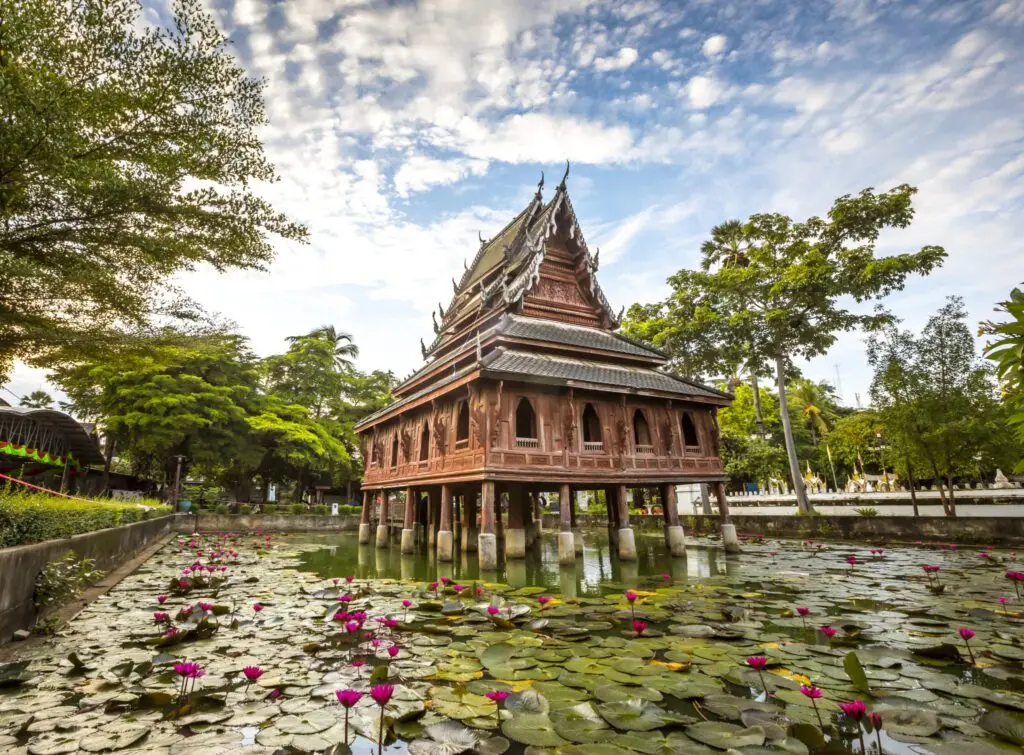
-Wat Thung Si Muang, located east of the park, is especially known for its wooden scripture hall (Ho Trai), which was built in the middle of the pond to protect the wooden structure from termites.
From here, visitors can reach the province's main cultural attractions by songthaew bus, tuk-tuk (auto rickshaw), or samlor (a three-wheeled bicycle with a passenger carriage), including:
Talat Yai Morning Market is a traditional market (Talat Sod) offering fresh meat and other products for the local population. Visit it to experience the authentic hustle and bustle of the locals going about their daily lives and enjoy affordable, local food.
Kham Pun is a teakwood house that contains a textile museum, introducing tourists to the finest handcrafted products of the Isaan region and their history. An adjacent café serves Thai cakes and coffee.
Wat Nong Pah Pong is a forest monastery founded by the late Ajahn Chah, one of Thailand's most revered meditation masters. Visit the stupa and learn more about Chah in the museum dedicated to his memory.
On the south wall of Wat Sirindhorn Wararam stands a graceful tree made of ceramic tiles, which glows in the dark after sunset.
Wat Tham Khuha Sawan houses Thailand's largest gong and is the final resting place of a revered Buddhist monk.
Ubon Ratchathani might not seem like it at first glance, but along with Udon Thani, Khorat, and Khon Kaen, it is one of the four largest cities in the Isaan region. The capital, Bangkok, lies approximately 630 km west of Ubon, while the borders with Cambodia and Laos are less than 100 km away.
The Emerald Triangle, where the three countries meet, has long been known for its pristine landscapes, with imposing mountain ranges and lush jungles crisscrossed by rivers. To see just how wild the Emerald Triangle's terrain can be, visit the region's most impressive natural formations:
Phu Chong Na Yoi National Park covers approximately 680 square kilometers at the eastern end of the Dângrek Mountains (also known as the "Portable Pole Mountains"). Its main attraction, the Namtok Huai Luang Waterfall, plunges about 30 meters into a brilliant blue pool with a white sand beach. Hiking trails crisscross the park, leading to rock gardens, streams, and mountaintop viewpoints.
Pha Taem National Park is a true natural paradise: a 340-square-kilometer park at the easternmost tip of mainland Thailand, covered with deciduous dipterocarp trees. It boasts Thailand's largest flower field and the Cha Na Dai Cliff, a viewpoint overlooking the Mekong River and Laos beyond. Every morning, this is the first place in Thailand to see daylight. Some caves in Pha Taem show traces of human habitation—most notably prehistoric cave paintings that may be up to 4,000 years old.
Maenam Song Si is the point where the Mun River flows into the Mekong and the rivers mix. The reddish-brown water of the Mekong meets the bluish waves of the Mun.
During the dry season, the Sam Pan Boak Gorge reveals the beautiful effects of erosion and time: a channel carved through sandstone, which has been described as a smaller version of the Grand Canyon.
At the beginning of the Buddhist Lenten season – Khao Phansa, usually at the end of July – Ubon is in the most festive mood.
The Candle Festival bids farewell to Buddhist monks with parades featuring beeswax sculptures depicting scenes from Buddhist and Hindu mythology as they depart for their annual retreat during the monsoon season. Tourists can observe candle making at Wat Pholphaen, Wat Thungsrimuang, and Wat Sripradoo. Afterward, they can watch the parade from Wat Si Ubon Rattanaram, which concludes at Thung Sri Muang Park.
During the Candle Festival, the Thai-style Ban Khampun mansion complex opens its doors to the public, offering cultural performances, silk weaving demonstrations, and other events that adorn the beautiful mansion grounds and interiors.
Ubon Ratchathani is also known for its cuisine. The so-called Isaan cuisine offers many famous dishes that are widely enjoyed in Ubon Ratchathani. You may have heard of Larb, a dish made with minced meat such as chicken, pork, duck, or beef, mixed with vegetables like shallots and onions, and seasoned with chili and lime. Another popular dish is Isaan sausage, a flavorful, fermented pork sausage.
During the winter months, you'll often find Khao Gee, sticky rice formed into balls or circles, brushed with egg and salt, and then grilled twice. This dish is considered ideal for the cooler seasons because it warms you up when eaten.
Another must-try is mok. Mok is prepared with meat or vegetables seasoned with curry and lemon basil, steamed or grilled in banana leaves. What makes this dish special is that it can be prepared with ant larvae, fish, tadpoles, or roe as the main ingredient.
Selected articles about Ubon Ratchathani
A guide to stargazing in Thailand: The best places for stargazing, national parks and planetariums
In short: Thailand is one of Southeast Asia's best destinations for stargazing, with certified star parks, mountain viewpoints, island paradises,...
Discover inner peace: Meditation retreats throughout Thailand
In a fast-paced world, mental clarity can seem like a luxury. Meditation is...
Raise the rainbow flag: Celebrate Pride Month with festivities throughout Thailand.
When it comes to Pride Month celebrations, it should come as no surprise that LGBTQ+-friendly Thailand knows how to throw a big party...
Do you need travel information?
Discover everything you need to know before your trip – from visa requirements and entry guidelines to essential travel tips and frequently asked questions.




Community
Comments 0
Start the conversation.