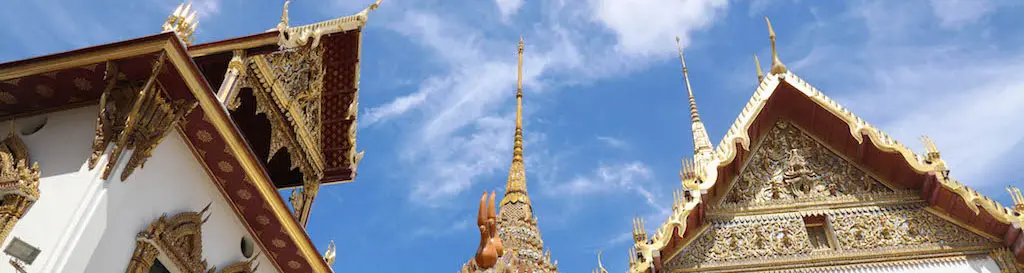
Travel blogger Holly O'Sullivan (THATraveller) gives tips on how to find your way around Bangkok's most beautiful temples.
The Grand Palace and Wat Phrakew
The Grand Palace, undoubtedly Bangkok's most famous landmark, continues to attract countless visitors with its history, magnificent architecture, and intricate decorations. It comprises several impressive buildings, temples (wats), gardens, and courtyards—each with a degree of asymmetry resulting from its organic development. Over the centuries, the complex was expanded by successive kings. Although no one has resided there since 1925, it remains in use for official functions, and only two of the throne rooms are open to the public.
One of the most important buildings here is Wat Phrakaew, the Temple of the Emerald Buddha. The Emerald Buddha dates back to the 14th century and was carved from a single block of jade. Although small, it is considered the most important symbol for the Thai people. Three times a year, His Majesty the King of Thailand changes the Buddha's seasonal robe, corresponding to summer, winter, and the rainy season. This is believed to bring good fortune to the country in each season and is an important ritual in the Buddhist calendar. It is not permitted to approach the Emerald Buddha or to take photographs inside the temple – however, it can be admired from the outside.
At the entrance, you'll find maps in various languages with detailed information about each building in the palace. A guide is available from 10:00 AM to 2:00 PM, and audio guides are available in over five languages. Whether you join a guided tour or not, the route through the palace is largely predetermined, making it very easy to find your way around.
Wat Arun (The Temple of Dawn)
Wat Arun is located on the west bank of the Chao Phraya River and is known for its riverside location and its architectural differences from other temples in Bangkok. Its spire is one of Bangkok's world-famous landmarks and is particularly beautiful at sunset and at night when it is illuminated.
Its imposing spire is 70 meters high and decorated with tiny pieces of colored glass and Chinese porcelain. You can climb the central prang, but the steps are quite steep – beware of the heat and high humidity! From the top, you'll be rewarded with a panoramic view of the winding Chao Phraya River, the Grand Palace, and Wat Pho, located on the opposite bank.
The legend… Wat Arun, named after Aruna, the Indian god of dawn, is an architectural representation of Mount Meru, the center of the world in Buddhist cosmology. “In the mythology of Tibetan Buddhism, Mount Meru embodies both the center of the universe and the concentration of mind sought by adepts. Thousands of kilometers high, Meru lies beyond physical reality, in a sphere of perfection and transcendence. The square prang of Wat Arun, which houses images of the guardian deities of the four cardinal directions, underscores this mystical symbolism.”
Directly opposite Wat Pho, from the Sapphan Taksin boat pier, you can take a riverboat that stops at pier 8. From there, a small shuttle boat will take you from one side of the river to the other for only 3 baht.
Wat Pho – Temple of the Reclining Buddha
The Temple of the Reclining Buddha is one of the largest temple complexes in Bangkok. The Buddha statue is 46 meters long and completely covered in gold leaf.
Wat Pho temple is just a 10-minute walk from the Grand Palace, and English-speaking guides are happy to tell you about its history for around 200–400 baht. Wat Pho is often considered Thailand's premier massage school – so where better to enjoy a traditional Thai massage? Or simply unwind with a foot, shoulder, and neck massage after a long day on your feet?
For a bit of luck, you can purchase a bowl of coins at the entrance to the hall and toss them into one of the 108 bronze bowls placed along the walls. The money goes to the monks and helps them with the renovation and maintenance of Wat Pho.
Wat Traimit – Temple of the Golden Buddha
Wat Traimit houses the world's largest seated Buddha made of gold, standing almost 5 meters tall, and is located at the end of Yaowarat Road in Chinatown.
A bit of history: In the past, artisans crafted Buddha statues from gold and covered them with stucco and plaster to conceal them from invading armies. The Buddha at Wat Traimit was discovered by chance when it accidentally fell, revealing a beautiful, solid Buddha in the Sukhothai style beneath its layer of plaster. Plaster fragments are still on display in the museum today (entrance: 10 baht).
Dress code for temples
Although temples (or “Wats”) are popular with tourists, they are also important places of worship, which is why appropriate clothing is important – these sites are incredibly sacred.
Anyone who appears at the gate inappropriately dressed will either be turned away or directed to a nearby location where they can buy or rent a sarong to cover themselves.
Here you can find more travel guides from THATraveller and on Instagram: @holly_osullivan, there are even more great photos to see.
Community
Comments 0
Start the conversation.