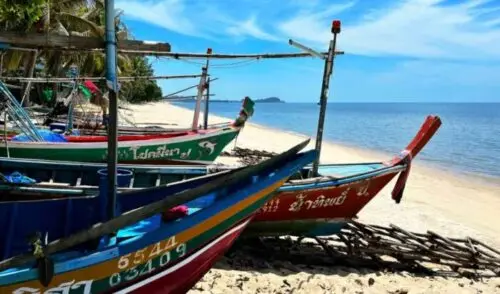
Sichon, Thailand, July 2, 2023 / TRAVELINDEX / Southern Thailand continues to captivate travelers from around the world with its sandy beaches, spectacular landscapes, and rich cultural heritage. Now, a new destination is poised to establish itself internationally as an oasis of "quiet tourism." With the opening of the brand-new international terminal at Nakhon Si Thammarat Airport in the fourth quarter of 2023, the coastal enclave of Sichon is well on its way to becoming a new jewel in Thailand's tourism crown.
– The coastal enclave in Nakhon Si Thammarat now receives international flights. – Travelers can discover the region's authentic cultural and natural heritage. – Former Laguna Phuket CEO Ravi Chandran praises the destination's enormous potential. – Sichon Beach is ranked among Thailand's top 10 beaches by Lonely Planet.
Sichon is a tranquil and peaceful place where travelers can experience Thailand as it has existed for centuries. Buddhists pay their respects to the ancient temples, fishermen haul their catch from the emerald waters onto the beach, farmers harvest coconuts from the towering palm trees, and artisans patiently weave fabrics dyed with natural colors from local fruits. Community life unfolds at its own pace and pulses to its own rhythm.
Everything is framed by the crystal-clear waters of the Gulf of Thailand, especially Sichon Beach, which the world-renowned travel guide Lonely Planet has named one of Thailand's ten most beautiful beaches. Behind it rises the imposing Khao Luang mountain range, its slopes crisscrossed by waterfalls that hikers can climb to enjoy breathtaking views from the summit. And although wonderfully off the beaten track, it's only 40 minutes from the new international airport.
One person who was impressed by the potential of the destination is Mr. Ravi Chandran, the former CEO of Laguna Phuket (part of Banyan Tree Holdings), who was part of the management team that played a role in transforming Phuket's former tin mining area into Southeast Asia's leading integrated resort destination.
As a senior consultant for Urasaya, a residential and hotel development project to be unveiled on Sichon beach in the coming months, he is developing the site into a beacon for carefully managed, environmentally conscious and locally inspired tourism.
“Sichon is something very special. Far from the tourist crowds, you can experience life in southern Thailand as it was 30 years ago – naturally beautiful, culturally authentic, and absolutely peaceful. This is exactly the Thailand visitors want to see, and this is exactly where people want to live,” said Mr. Ravi Chandran. “I am convinced that this is a new beginning for southern Thailand and offers the chance to get it right the first time – by creating a future shaped by tradition, nature, and sustainability.”
Sichon is neither now nor in the planning stages a new mass tourism center. No high-rise hotels will be built along the coast, and the roar of banana boats and jet skis will not be heard offshore. Instead, the atmosphere will remain perfectly in tune with modern life. And therein lies its greatest charm.
Visitors can explore the local beach market, stroll through coconut palm groves and swim in the cool waters of the Gulf of Thailand, with the island of Koh Samui in full view and the pink schools of dolphins on the horizon.
Travelers can discover the rich heritage for which the province of Nakhon Si Thammarat in Thailand is known. The provincial capital of the same name is one of Thailand's oldest cities, boasting a history spanning over 1200 years. Its centerpiece is Wat Phra Mahathat, the oldest temple in the kingdom and an annual destination for Buddhist pilgrims.
Active adventurers and nature lovers can discover the lush landscapes of Khao Luang National Park, home to the 1,780-meter-high Khao Luang Mountain, Thailand's second-highest peak, and a great variety of flora and fauna, including 300 orchid species, 340 bird species, and even mammals such as tapirs, leopards, and porcupines.
“Naturally, sustainability will shape every aspect of Sichon’s future development,” Mr. Chandran adds. “The concept is already deeply rooted in the region’s traditions, as locals have practiced responsible, environmentally friendly crafts for centuries. Take, for example, the village of Kiriwong, where fabrics are handwoven and organically dyed with the fruits of native trees, including mangosteens. Or go to the Pak Phanang River and watch the fishermen casting their nets. This is the most authentic and natural destination I have seen in Asia.”
Community
Comments 0
Start the conversation.