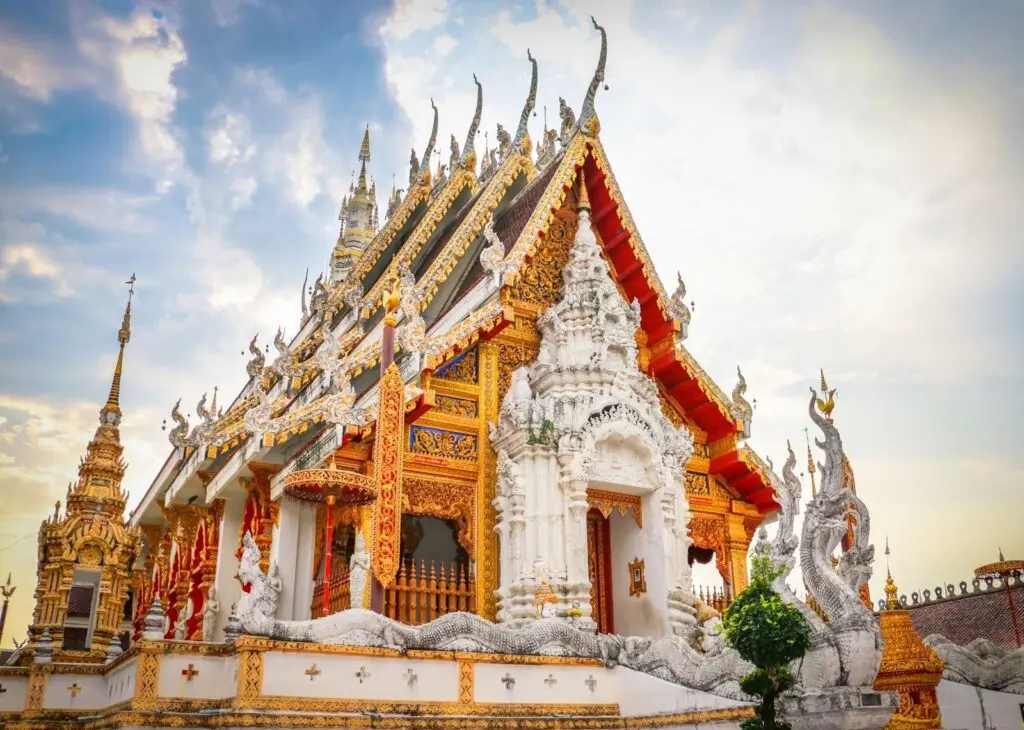
A Guide to Phrae
Phrae is known for its sacred, gilded pagoda, beautiful indigo textiles, historic houses, excellent woodwork, and a promising food culture.
Phrae is known for its teak and malaria-ridden forests, its rebellious spirit, its blacksmithing, romantic tragedies, and moonshine. But this northern province is also famous for a sacred, gilded pagoda, beautiful indigo textiles, historic houses, excellent woodwork, and a promising food culture. Once a roadside rest stop where travelers refueled and fortified themselves with noodles before continuing their journey, Phrae has now reinvented itself as an artisan town with the finest naturally dyed textiles, a unique culture, and exceptional culinary experiences.
Arrival
Phrae is accessible by air. The nearest airport is Lampang Airport, located about an hour and a half south of the city by car. Nan Airport is about a two-hour drive north of Phrae.
The northern railway line from Bangkok to Chiang Mai stops at Den Chai station – from there Phrae can be reached by car in 30 minutes.
Phrae is connected to the northern provinces of Thailand by bus routes, and most buses stop at the Phrae bus station. Numerous buses depart daily from Bangkok's Chatuchak bus station to Phrae (7 hours/385 Baht).
locomotion
The town of Phrae is small and has no taxi network. Residents use motorcycle taxis, three-wheelers, and the songthaews common in the area. For longer distances, a songthaew is recommended; however, the fare should be agreed upon before starting the journey.
Activities in Phrae
About 10 kilometers from the center of Phrae lies Wat Phra That Cho Hae, home to the gilded Cho Hae Pagoda – one of the holiest Buddhist sites in Thailand. Legend has it that the people of Phrae received a piece of fine satin (locally called "Hae") from the ancient kingdom of Sipsongpanna (present-day Xishuangbanna in southern China). They wrapped the Cho Hae Pagoda in this beautiful silk as an offering to Buddha and Buddhism. If you visit Phrae around the full moon in March, you can experience the annual Phra That Cho Hae Festival and immerse yourself in the local culture. Look forward to cultural performances, folk music, an alleyway with authentic food, beautiful handicrafts, and colorful processions. The 33-meter-high, gilded pagoda is worth visiting any time of year to experience the local culture and way of life. It is also a pilgrimage site for those born in the Year of the Tiger.
Old wooden houses, cozy cafes, handicrafts, delicious street food, and haggling draw locals and visitors to Kad Kongkao on Saturday evenings. The air is filled with the aroma of chili, herbs, spices, and fish sauce, accompanied by the sizzle of frying oil, the sizzling of grilled meat, and the booming calls of vendors. A stroll through the historic Kham Lue leads to a plethora of delectable street food. Grilled and smoked sausages, egg noodles with chicken soup, poached eggs in banana leaves, sweet and creamy rice cakes, and many unusual dishes are sinfully tempting. Wandering deeper into the throng, the legendary street reveals its charm with old houses and mansions. Many historic buildings have been transformed into stylish tavernas, cafes, and boutiques.
The Kad Kongkao market is located on Kham Lue Street in the city center of Phrae.
The bold, pink, and ornate facade, adorned with intricate details, will immediately captivate you upon entering the front garden. This magnificent pink mansion was built in 1897 by a Chinese architect from Guangzhou and served as the bride's house—a wedding gift from the last prince to his stepdaughter. Now a century-old home, it houses a museum and warmly welcomes visitors and culture enthusiasts interested in Phrae's glamorous past. The house itself is an architectural masterpiece. It is the first so-called "gingerbread house" in Phrae—at the time, most locals lived in stilt houses. The entire house is constructed of teak. Incorporating European, Chinese, and local Lanna elements, this historic "gingerbread house" is truly unique, with its colonial design, Chinese symbols, and typical Lanna gables.
Each of Khum Wongburi's 20 rooms is impressive, featuring historical photos and family heirlooms.
Wongburi House Museum, Nai Wiang, Mueang Phrae, Phrae
Opening hours: Open daily from 9 am to 5 pm
Telephone: +6681 883 0546
Entrance fee: 30 Baht (0.96 USD) per person
The people of Phrae and their indigo-dyed cotton clothing, called "Mo Hom" by the locals, are inextricably linked. Everyone here feels comfortable in the light, soft garments. Farmers wear them, as do mahouts, loggers, teachers, and food vendors—with the exception of Buddhist monks, who wear saffron robes. Ban Matjai Homemade and Café, a café with an attached art studio in Phrae, offers a creative escape with indigo. Surrounded by lush mango and longan trees, visitors and indigo enthusiasts can try their hand at dyeing, discovering beauty and harmony in the clay pots and indigo dye baths. Whether you're looking for inspiration for a project, planning a fun group activity, or want to take up hand-dyeing as a new hobby, this batik workshop fosters mindfulness and a sense of community.
Ban Matjai, 88 Huai Ma, Mueang Phrae, Phrae. It is about a 20-minute drive from Phrae city center.
Telephone: +6695 493 0909
Phrae is becoming the perfect destination for creatives. Thanks to the young people from the province who have returned home with creative ideas, Phrae has developed into a creative hub. Just 20 minutes from Phrae's town center, Kummee Studio is one of the best places to learn new baking techniques while enjoying homemade pizza. Run by a creative couple, Kummee Studio is a bakery with a difference. The husband, a ceramic artist, fires the clay in the kiln, while his wife bakes pizzas in the oven. The studio offers a ceramics workshop and a short course for visitors who want to try their hand at working with clay in a relaxed and welcoming atmosphere. For those who don't want to participate in a ceramics workshop, learning how to make a delicious Margherita pizza with double cheese is a tempting alternative.
Kummee Studio is located about 20 minutes from the city center.
Ban Mae Khami, Mueang Phrae, Phrae
Opening hours: 10am-4pm (closed Tuesday and Wednesday)
Telephone: +6685 867 9358
Phrae was the most important center of Siam's teak industry between the late 19th and early 20th centuries. For fifty years, rulers and landowners amassed fortunes from the timber trade. Numerous teak villas, incorporating elements of colonial architecture, were built in the town, and most of them still stand today. The historic quarter is best explored on foot.
From the old eastern gate, Pratu Chai, follow the green path north along the old city wall. Phrae was an outpost of Chiang Mai in the 16th century, and its former size is easily discernible from the old city wall. To the right is the city moat, and to the left is the city center, where old and new buildings meet.
Just ten minutes from the East Gate lies the North Gate, which separates the Old City from the New City. Here you'll find the area around Wat Hua Khuang, where the Coffee & Craft Café serves freshly roasted coffee and Hom 2493 is ideal for noodles and light meals.
From the North Gate, turn left onto Kham Sean, the straight road connecting the South Gate to Khom Lue Road. This will bring you to Khum Chao Luang. The majestic colonial building was constructed in 1892 and served as the royal residence of the last Prince of Phrae. When Shan ethnic groups stormed downtown Phrae in 1902 to resist Siamese rule, the Prince of Phrae was suspected of organizing the infamous uprising. He abandoned the residence and fled to Luang Phrabang in northern Laos. Today, the historic building houses a museum, inviting visitors to discover a little-known chapter of Phrae's history.
At the corner of Phra Non Tai Alley and Khum Doem Road is the two-story Teak Museum, built on the former grounds of the Danish East Asian Company. A guided tour provides insight into the methods used in the 19th century to fell, extract, and ship teak wood to Bangkok and Europe. A colonial building, once the residence of an officer of the East Asian Company, stands atop the old city wall.
East of the Teak Museum, on Wichai Racha Road, is the restaurant Khao Soi Klang Wiang – the perfect place to end your walk with sensational noodles and local specialties.
Gingerbread House Gallery
What began as a cozy café serving pasta and drinks has evolved into a gingerbread house gallery with an attached three-room hotel. The charming establishment boasts striking brick and wood architecture. Excellent coffee and smoothies are served for breakfast. A small craft shop is also available. On the second floor, three spacious and elegant teakwood rooms in a modern Lanna style await. With free Wi-Fi and a central location, the gingerbread house gallery offers convenient access to the attractions surrounding the town of Phrae.
Gingerbread House Gallery, Charoenmueang Rd 94/1, Mueang Phrae, Phrae
Opening hours: 9am-4pm (food)
The Hug Inn Phrae is a modern and stylish hotel in the heart of Phrae, offering its guests an inspiring retreat. The rooms, available with either a king-size bed or two single beds, are elegantly decorated with naturally dyed indigo textiles and local handicrafts. At the Hug Inn Phrae, you can expect comfortable beds, a generous breakfast, and helpful tips for exploring the surrounding area and visiting craft workshops.
Hug Inn Phrae, 61 Tesaban Rd 2, Thung Kwao, Mueang Phrae, Phrae
Telephone: +6662 572 0077
Indigo-dyed fabrics are ideal for people with sensitive skin or allergies. They are hypoallergenic, antibacterial, and skin-soothing. Local textile designers and artisans in Phrae are developing their indigo culture with a focus on both fashion and sustainability.
Founded by a local family, Kaew Wanna has been a renowned brand of naturally indigo-dyed fabrics for two decades. With a firm commitment to the sustainable production of Phrae indigo textiles, Kaew Wanna sources its indigo dyes from organically grown "Hom" plants in the mountain valley. Kaew Wanna's light blue and white cotton, which conveys intelligence and culture, is highly sought after by Japanese fashion designers. In the lanna wood house, you can purchase indigo-dyed, handwoven cotton textiles, wallets, handkerchiefs, clothing, and scarves. Visit the atelier and experience the natural indigo dyeing process or treat yourself to a bowl of "Khao Soi," a Japanese egg noodle soup.
Kaew Wanna is located about 10 minutes from the town of Phrae.
160 Ban Khanomsen, Muang Phrae,
Opening hours: 9:00-16:30
Telephone: +6681 960 4502
Born and raised in Phrae, the young fashion designer Kamonchanok Sasenssopha returned to her homeland, developed her sustainable design label, and opened Kamon Indigo after leaving her career in the fashion industry. She works with indigo, marigold, lacquer, and black ebony, using natural dyeing techniques. Her batik designs are sustainable and add a touch of style to any wardrobe.
Kamon Indigo is located about 10 minutes from the city center.
Ban Muang Mo, Mueang Phrae,
Opening hours: 9:00-17:30
Telephone: +6686 401 6741
Selected articles about Phrae
A travel guide to Thailand: How to find the perfect gifts
Part of the fun of traveling is shopping for gifts. And while that might not be everyone's cup of tea, Thailand offers plenty of gift options...
Do you need travel information?
Discover everything you need to know before your trip – from visa requirements and entry guidelines to essential travel tips and frequently asked questions.




Community
Comments 0
Start the conversation.