Happy National Politeness Month!
Thai culture is considered one of the most polite and friendly in the world. However, as in any culture, there are rules of etiquette that are observed by both Thais and visitors. Here are some of these customs and rules of conduct that you should be aware of before visiting Thailand or meeting your Thai friends abroad.
Rules of etiquette
Take off your shoes
The first rule of Thai etiquette when entering a house, temple, or palace is to remove your shoes. This is a polite gesture to protect the house or temple from dirt that you might bring in on your shoes. It is considered disrespectful not to remove your shoes before entering Thai homes and temples.
In some cafes and restaurants, you are expected to remove your shoes. This is because some smaller establishments are located in private homes. To gauge whether you should take your shoes off, simply observe what the other guests are wearing and adjust your behavior accordingly.
Do not step on thresholds.
When going through a door, it is customary to walk over the threshold and not step directly on it, as it is believed that spirits live in the threshold, and that by stepping on the threshold one might anger the spirit, who could then take revenge on the inhabitants of the house and bring them misfortune.
Appropriate clothing
Although Thailand is a very cosmopolitan and free country, it is still considered good manners to dress appropriately when entering a temple or palace. This is a sign of respect for the monks and residents of these historical sites. It is considered respectful to at least cover the knees and shoulders. Men may wear shorts, while women should ideally choose a long skirt or trousers. Tank tops, revealing sportswear, or T-shirts with inappropriate designs are not suitable.
Always return the wai greeting.
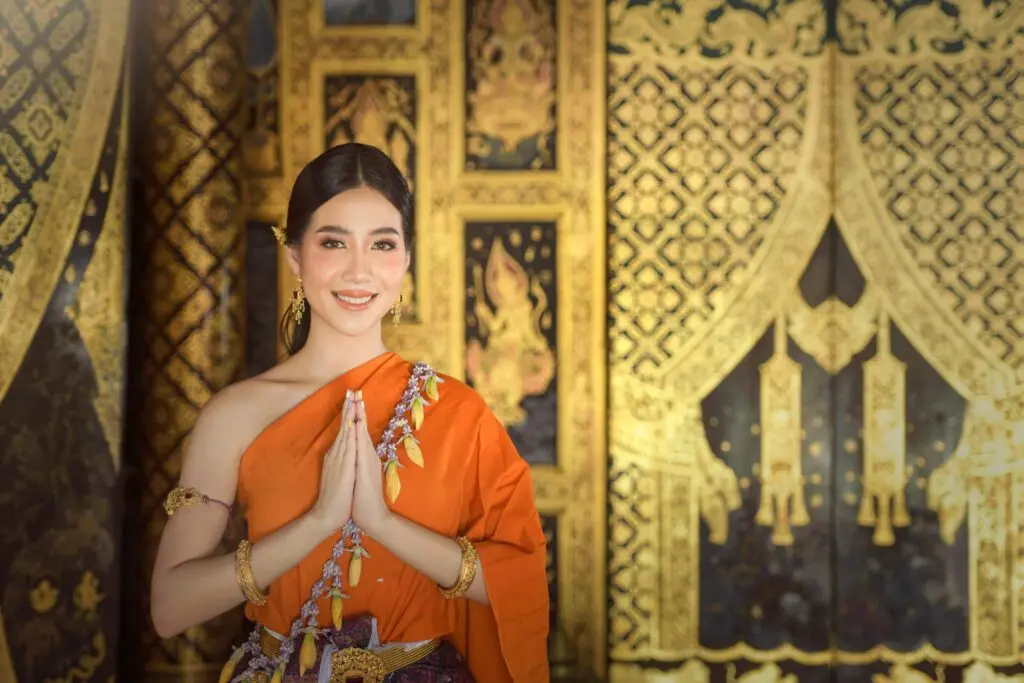
The wai (pronounced "wai") is a traditional greeting in Thailand. It is usually accompanied by the phrase "sawasdee" and serves as a greeting, thank you, farewell, or apology. While tourists are not expected to return a wai to Thais first, they are expected to do so if one is extended to them. Monks are not obligated to return wais, and the wai is not required when greeting younger people.
Respect the monks and do not touch them.
Monks are highly respected in Thailand and are treated with respect by visitors. Please do not touch a monk, especially if you are a woman. Monks believe that the female body contradicts their Buddhist vows. Therefore, women are not allowed in certain areas of many temples, and women should never touch a monk. If you encounter a monk, you may bow (wai), but avoid asking overly personal questions. It is important for Thais to behave appropriately towards monks, as they are held in such high esteem. For example, bus passengers commonly offer their seats to monks.
Be mindful when taking photographs
When visiting a temple in Thailand, it is generally permitted to take photos of the temple and the Buddha statue. However, please be considerate of worshippers and those in the prayer halls. Before taking photos, check the temple rules, which are posted on signs, or ask a local. You can also express your gratitude for permission to photograph by placing a donation in the donation boxes. Visitor donations contribute to the upkeep of the temples and palaces.
Smile
Thailand is known as the "Land of Smiles." It's no wonder, then, that smiling is so important in Thai etiquette! When you're in Thailand, be cheerful and smile, and return the smiles that others give you on your trip.
However, you should be aware that a smile in Thailand doesn't always mean joy. It can express many things: embarrassment, frustration, worry, and much more. Giving someone a smile for a reason other than joy might be just what they need to lift their spirits.
Rules of etiquette
As in any culture, there are things you simply shouldn't do in Thailand if you want to be polite to your Thai hosts. Here are just a few habits you should break before your trip to Thailand.
Don't touch other people's heads.
In Thailand, the head is considered sacred. It is also regarded as the purest part of the body and should therefore never be touched. As in most countries around the world, touching a stranger's head is considered impolite. Touching the head of a statue, especially a Buddha statue, is also considered disrespectful. However, close friends and family members often touch each other's heads or hair, which is not considered impolite. If you accidentally touch a stranger's head or hair, politely ask for forgiveness. If you need to reach something above someone's head, say "Excuse me" beforehand.
Do not put your feet on tables or elevated surfaces.
Since the feet are considered the lowest part of the body and are naturally regarded as unclean, they should never be placed on tables or other surfaces. In Thai culture, the feet are considered the least important and most impure part of the body. When in a temple, do not point your feet forward, especially not towards a monk or a Buddha statue. Other objects, such as books and food, are highly respected in Thai culture. Therefore, do not place your feet on a coffee table or point them towards food. This is considered vulgar.
Avoid excessive displays of affection in public.
Although Thailand is a loving country and open to many expressions of affection, Thais tend to be reserved when it comes to public displays of affection. Therefore, it is advisable not to be overly affectionate in public.
Do not collect coral fragments or shells from their natural habitat.
There are many practical reasons not to collect shells and coral fragments in their natural habitat. Primarily, this disrupts the area's ecosystem. These pieces contribute to the formation of pristine sand on Thailand's famous beaches. They can also be used as nesting sites by native species.
Due to global warming, coral reefs in Thailand are declining. Therefore, the country has intensified its efforts to protect coral reefs in recent years. Anyone who removes coral or shells from Thai waters faces a fine and may be arrested.
For this reason, it is recommended to take other souvenirs home. There are many options for choosing typical Thai items, such as Buddha statues, Thai silk scarves, and coconut oil.
Do not show
As in many cultures, pointing with your finger is considered impolite in Thailand. If you must point at someone, it is recommended to raise your head and point with your chin. Pointing at objects and animals is sometimes acceptable, but you should use your whole hand and not just a finger.
Like any travel destination, Thailand has its own set of rules of conduct that visitors are expected to follow. While visitors are not expected to know all of these cultural norms, it is certainly polite to learn them and adhere to them during your stay in Thailand.
Community
Comments 0
Start the conversation.