When I'm planning a trip to Bangkok for a private client, I always explain that the city needs to be divided into two areas. The first and most important step is to divide it into the "new city" and the "old city".
The new city is now significantly larger and divided into many more districts than the old one. Broadly speaking, these include areas such as Siam, Sathorn, Silom, and Sukhumvit, which can be further subdivided depending on the length of stay.
I suppose this also applies to some extent to the old city, but in most cases it's actually a binary decision: the more popular island of Rattanakosin on the east bank of the Chao Phraya River or Thonburi (the subject of the Bangkok Thonburi travel guide I'm sharing today) on the west bank of the river.
Thonburi and I have known each other for a long time.
It's no exaggeration to say that I've been perfecting my Bangkok and Thonburi itinerary for over a decade. To be precise, it was in 2012 that I first crossed the Chao Phraya River at Saphan Phut, also known as the Memorial Bridge, and approached the white stupa of Wat Prayoon. For a long time, walking along this stretch of the river (which also took me past a Catholic church and a Chinese shrine) was something of a ritual.
It's similar to using a website like TradingView to optimize your finances. You access the dashboard repeatedly until it becomes routine, just like I got used to walking through the turtle ponds at Wat Prayoon or smelling the incense at Kian Un Keng Shrine, so I no longer needed a map app for navigation.
Things to do in Bangkok's Thonburi district
Start at Wat Pak Nam or Wat Arun
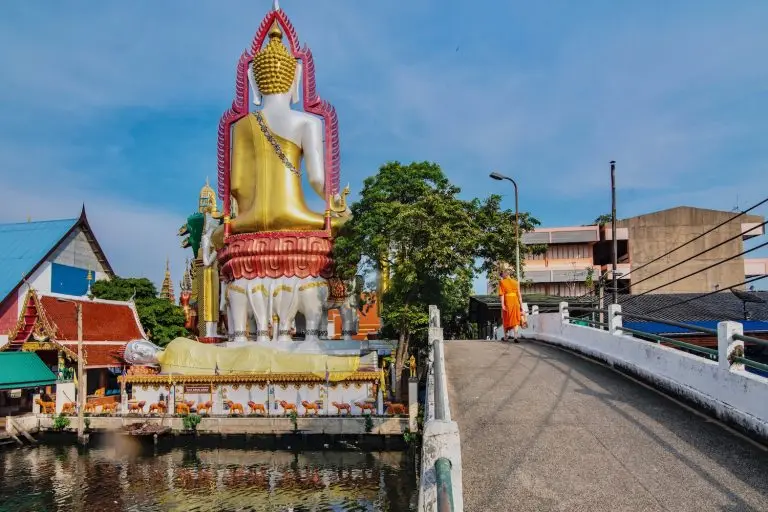
Strictly speaking, Thonburi is the former capital of Thailand, but you wouldn't know it from walking around. What does immediately catch your eye, however? Some of the district's temples are among the most beautiful in Bangkok, including the riverside Wat Arun (the Temple of Dawn, one of the city's most famous temples) and the somewhat lesser-known (but increasingly popular) Wat Pak Nam further west. The best place to start your day is at one of these temples.
Take a Khlong tour
What else do I love to do in Thonburi? Take a boat trip on the numerous khlongs (canals) that wind their way through this district. They also pass through Rattanakosin and the newer neighborhoods, but out here they're significantly less polluted. Plus, life along these khlongs feels much more authentic than in the heart of modern Bangkok.
Explore more sights along the waterfront promenade
As I've already mentioned, I regularly took walks along the Thonburi waterfront, which I almost considered a ritual. I usually began my walks by crossing the Memorial Bridge to the gleaming white Wat Prayoon and then continued north to Santa Cruz Church, the Kian Un Keng Shrine, and Wat Kalayanamitr. Sometimes I also went from there to the aforementioned Wat Arun, but often I didn't.
Treat yourself to a delicious meal
On those days – when I skipped Wat Arun – it was usually around midday, which makes perfect sense given my Thonburi guidebook. On those occasions, I skipped the Temple of Dawn and went straight to Supatra River House, one of my favorite upscale restaurants for authentic Thai cuisine. I especially enjoy coming here in the evenings when the view across the Chao Phraya River to Rattanakosin is simply breathtaking.
Finish with one of two sunsets.
I love it when things come full circle. That's why I recommend enjoying the sunset at one of the two temples – Wat Arun or Wat Pak Nam – that I mentioned in the first part of this article. If you want to watch the sunset behind Wat Pak Nam, I suggest walking from the Icon Siam shopping center (itself a relatively new building in Thonburi) to that bridge and using either a telephoto lens or your smartphone's strongest digital zoom.
How Thonburi compares to Rattanakosine
The simple answer is: Rattanakosin is home to many of Bangkok's—and Thailand's—most famous sights, but it's also a popular tourist destination. After all, it's just a short walk from Khao San Road, meaning that many of the backpackers staying there can easily visit attractions like the Sao Ching Cha "giant swing" or even the Grand Palace.
In contrast, while some tourist attractions in Thonburi are famous – Wat Arun and, increasingly, Wat Pak Nam – most of the neighborhoods along the khlongs (canals) remain largely hidden from foreign tourists. Of course, more and more Thais are drawn here to gain more authentic experiences in their capital. However, even at the busiest sights and on the most crowded days, Thonburi is significantly less overrun than Rattanakosin.
Other frequently asked questions about visiting the Thonburi district in Bangkok
What is there to do in Thonburi?
Thonburi is a fascinating district of Bangkok, located on the west bank of the Chao Phraya River. While it boasts several tourist attractions – most notably the temples Wat Arun and Wat Pak Nam – the true charm of this neighborhood lies in the authentic encounters with the locals.
Is Thonburi worth a visit?
Thonburi is definitely worth a visit, especially now that it's easily accessible from Bangkok via the MRT and BTS. Alternatively, you can walk across the Memorial Bridge from Chinatown or take a riverboat from Sathon Pier or Wat Pho Pier.
How do I get to Thonburi?
There are several easy ways to get to Thonburi. You can take the BTS station and get off at stations like Krung Thonburi, Wutthakat, or Talat Phlu, depending on your destination. The Bang Phai MRT station is closest to Wat Pak Nam. Alternatively, you can take one of the many riverboats or travel by Grab or taxi.
Conclusion
I hope my Bangkok and Thonburi travel guide was helpful. Much like comparing Silom and Sukhumvit in "new Bangkok," the first step to understanding Thonburi—aside from its many sights—is to look at Rattanakosin, the far more popular part of old Bangkok. Simply put, Thonburi is more authentic and less touristy, while Rattanakosin is one of Thailand's biggest tourist centers, not just in Bangkok. Need help planning your off-the-beaten-path Thailand trip? I'd be happy to assist you!




Community
Comments 0
Start the conversation.