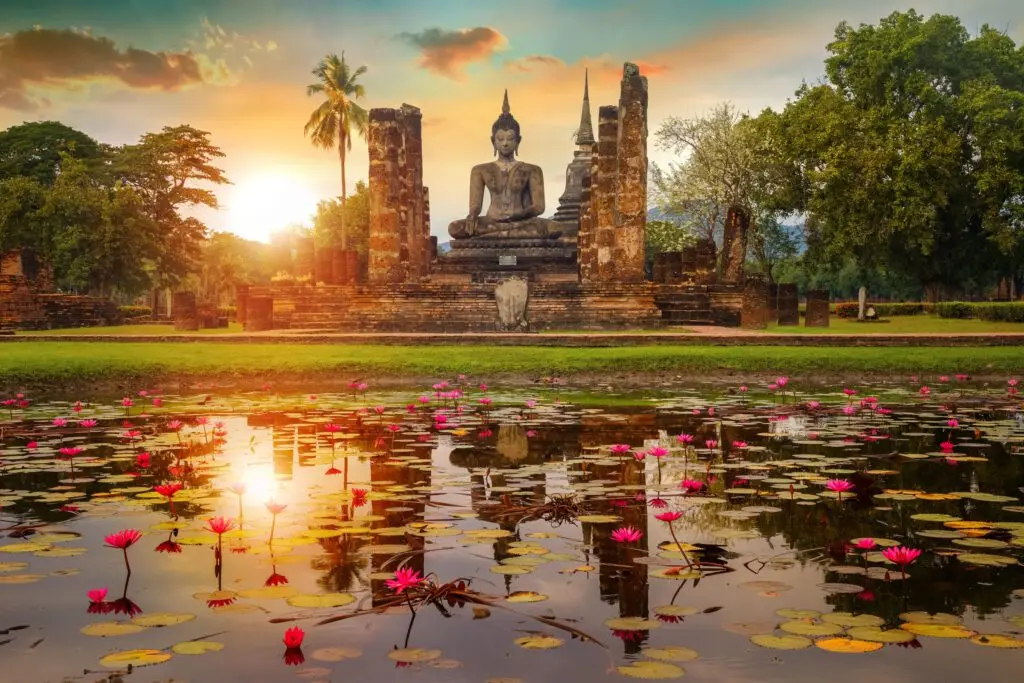
Thailand is rich in historical temples, statues, artworks, and literature, making it a true paradise for history buffs. The various eras that shaped the country's eventful history have stood the test of time, and many of the ruins of ancient Thailand can be explored by visitors.
Each era of Thailand is characterized by its own architecture and history, from Sukhothai to Rattanakosin. Learn more below about the different eras of Thailand and the most beautiful travel destinations!
The Sukhothai era is considered the first era of Thailand and was founded in 1238 by King Sri Indraditya. However, the monarchy ended in 1438 with the death of King Ramkhamhaeng, who is credited with, among other things, the development of the Thai writing system.
Today, in Sukhothai Park in southern Thailand, you can visit the ruins of the once-flourishing kingdom (whose name means "Arrival of Happiness"). Visitors can also discover impressive Buddha statues, temples, and even a history museum. The park is divided into five different zones, each with its own entrance fee. Therefore, it's best to bring tickets for the specific zones you wish to visit.
Many of the ruins in Sukhothai Park are attributed to the Khmer style, as this was one of the most important architectural styles before the Sukhothai era. This UNESCO World Heritage Site contains almost 200 ruins to explore.
Here are a few ruins that you absolutely must see when visiting Sukhothai Park.
Wat Mahathat should not be confused with other temples named Wat Mahathat, but is a common temple name throughout Thailand. It means "Great Relic" and can be used for any temple that houses Buddha relics. It was originally built to house the Buddha relics of Sukhothai.
Wat Mahathat was once considered the main temple of Sukhothai and is a truly impressive structure. The city is laid out according to the model of a mandala, which symbolizes the universe.
The temple consists of a main stupa in the shape of a lotus bud. It is surrounded by 168 stucco sculptures of Buddhist disciples. A total of eight stupas surround the temple, four of which are outstanding examples of Mon-Haripunchai-Lanna architecture, while the others are built in the Khmer style. The main stupa is flanked by two 9-meter-high Buddha statues, known as Phra Attharot.
Monument to King Ramkhamhaeng
This bronze sculpture commemorates King Ramkhamhaeng. The king is depicted seated on a Manangkhasila asana throne, holding a book that symbolizes his focus on education.
Enclosed by a laterite wall, Wat Si Sawai consists of three pagodas in the Lopburi style. Excavations revealed that the temple was originally built as a Hindu temple and later converted into a Buddhist temple. The building is believed to date back to the pre-Sukhothai period.
Today, visitors can explore Wat Si Sawai and pause to reflect on the vast pond.
The Ayutthaya era lasted from 1351 to 1757. The King of Ayutthaya, King Uthong, introduced Theravada Buddhism and the Dharmasastra legal code to Thailand until the end of the 19th century.
The Ayutthaya era is considered Thailand's "golden age" of arts, literature, and trade with East and West. It was also an era of great medical advancements for the country before it fell to the Burmese army in 1767.
Today, Ayutthaya is known as the Ayutthaya Historical Park and is a UNESCO World Heritage Site. Visitors can admire artifacts such as murals, sculptures, and even manuscripts written on palm leaves. Within Ayutthaya, there are numerous ruins to explore, including:
Built in 1630 by King Prasat Thong, Wat Chaiwatthanaram is one of the most popular attractions in the Ayutthaya Historical Park. This Khmer-style temple consists of a 35-meter-high prang and four smaller prangs on a rectangular platform.
On the central platform, eight chapel-like chedis are connected by a rectangular, cruciform passageway, which was once roofed but now consists only of its foundation. The chapels are decorated with paintings inside and reliefs on the outside. Over the years, the temple was plundered by thieves but underwent restoration between 1987 and 1992.
Wat Lokayasutharam houses the famous Reclining Buddha statue, believed to depict Buddha at the moment of his death and entry into Nirvana. The statue is 42 meters long and 8 meters high and is thought to have been erected in the 14th century. It is believed to have once served as an assembly hall in front of an inner courtyard.
The Thonburi era lasted from 1767 to 1851. The kingdom was founded by Taskin the Great, who was overthrown in 1782. Taskin is credited with reunifying Siam, which had fragmented into five separate states after the collapse of Ayutthaya.
The ruins of the kingdom have been uncovered through archaeological excavations, but many of them require close-up viewing. Tourists can gain insight into historical Thonburi at the Siriraj Bimuksthan Museum and the Museum Siam, and visit Wichai Prasit Fort from Pak Khlong Talat or – with naval permission – at close range.
Founded in 1782 and existing until 1932, the Kingdom of Rattanakosin was established by Rama I of the Chakri dynasty and replaced Thonburi as the capital of Thailand. Following an economic crisis, King Prajadhipok transferred some of his power to the prime minister. This, however, met with popular discontent. On June 24, 1932, the Bangkok garrison mutinied, seized control of the monarchy, and thus ended 800 years of monarchy.
Today, visitors to the Kingdom of Rattanakosin can see numerous relics from the 150-year reign, including the Great Palace.
The Grand Palace houses many memorable relics, including Wat Phra Kaew.
Wat Phra Kaew, better known as the Temple of the Emerald Buddha, is considered the holiest temple in Thailand. Consecrated in 1782, the Temple of the Emerald Buddha is Bangkok's most visited attraction and a sacred pilgrimage site for many Buddhists.
Although the Emerald Buddha statue is only about 66 cm tall, it fascinates historians and worshippers alike. Its origin is unknown, but some scholars believe it dates from the 13th or 14th century. The Emerald Buddha sits enthroned on a gilded throne, which not only protects it but also elevates it so that it can be seen from afar by the many visitors entering the temple.
Wat Suthat, one of the oldest temples from the Rattanakosin era, is one of the six first-class royal temples. Construction of the temple was commissioned in 1782 by Rama I, the first king of the Rattanakosin kingdom. However, it was not completed until 1847 under King Rama III.
Wat Suthat is also known as the Temple of the Giant Swing because of the enormous red swing located in front of the temple. The swing was erected in 1784 for a religious ritual of the Brahmins. Later, it was used for games in which young men tried to swing as high as possible to catch a bag of gold coins with their teeth. However, this practice was deemed too dangerous and was discontinued in the 1930s.
Today you can visit Wat Suthat and its 21-meter-high giant swing, although you're not allowed to swing on the religious monument itself. Nevertheless, it's a fascinating excursion and offers fantastic photo opportunities!
Thailand through the ages
There are many ways to plan a trip to Thailand, but for history buffs, exploring the Land of Smiles through its different historical periods is an exciting way to understand Thailand's rich history and shows that there really is a destination to suit every dream.




Community
Comments 0
Start the conversation.