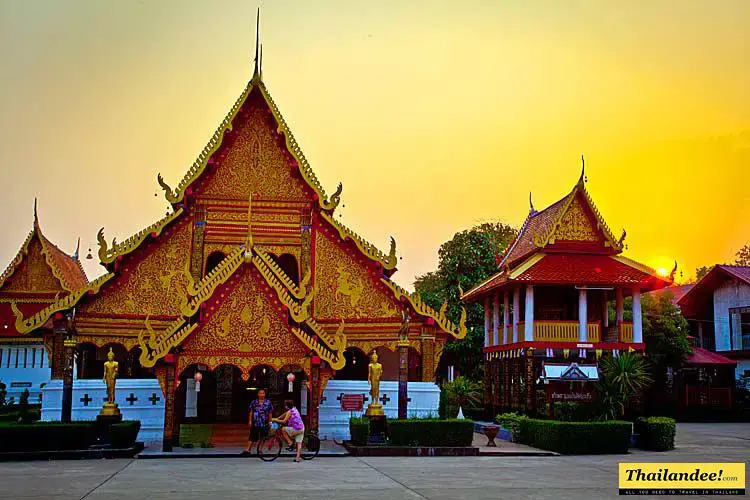
Things to see and do in Phrae: The town of Phrae is easy to explore. A must-see during your stay is Wat Phra That Cho Hae, a large temple located about eight kilometers outside the town. Alternatively, we recommend a walk through the old town (the former city center), which includes temples such as Wat Phra Bat Ming Muang, Wat Luang, Wat Pong Sunan, Wat Phra Non, and perhaps the Vongburi House. If you have a vehicle, you can also explore the surrounding area and, for example, drive to Phayao with its lake or to Den Chai to visit Wat Phra That Su Thon Mongkhon Khiri.
Sights in Phrae: Wat Pong Sunan (วัดพงษ์สุนันท์) My rating: 5/5 stars. A relatively new temple, but worth a visit for the large reclining Buddha in the temple courtyard alone. There is also a golden chedi, a main building with a double-flight Naga staircase, and numerous statues. The temple is located right next to Wat Luang. Wat Phra Non (วัดพระนอน) My rating: 5/5 stars. Literally translated: Temple of the Reclining Buddha. The 9-meter-long statue is truly impressive, but the architecture and the artistic decoration of the main hall are also beautiful. Wat Phra That Cho Hae (วัดพระธาตุช่อแฮ) My opinion: 5/5 Located 8 miles outside of Phrae on a small hill, it is THE temple you should visit if you come here. There is a saying that you haven't really come to Phrae if you have come to Phrae without visiting Wat Phra That Cho Hae. Wat Phra That Suthon Mongkhon Khiri (วัดพระธาตุสุโทนมงคลคีรี) My opinion: 5/5 This temple is certainly new, but it is not lacking in interest. Of course, but not only because of its large reclining Buddha with its impressive feet. Its architecture blends Lanna and Burmese styles and houses many interesting statues and details. It's one of my favorite temples, still relatively unknown to foreign tourists in Northern Thailand. Saturday Pedestrian Zone (Kad Phra Non) My rating: 5/5 stars. The "Kad Phra Non," which means "Market of the Reclining Buddha" due to its proximity to Wat Phra Non, is a cozy night market held every Saturday evening in the center of Phrae, in a charming little pedestrian zone. Pedestrian zones are plentiful in Thailand, but the atmosphere here is unique, more authentic, more relaxed, and less touristy. Indigo Dyeing Village (บ้านทุ่งโฮ้ง) My opinion: 4/5 stars. Indigo dyeing in Mo Hom is Phrae's most famous specialty, and in my opinion, you can't come here without dyeing a handkerchief, scarf, or shirt yourself. It's fun and possible in Ban Thung Hong Village, not far from the city. This will give you a unique memory.
Other places worth seeing in Phrae: Wat Phra Bat Ming Muang is usually the first temple visitors see in Phrae's old town. Its chedi is considered the heart of the city. The Kosai Buddha statue and the sacred Buddha footprint are other points of interest. Wat Na Khu Ha: There are many interesting temples in the mountains surrounding Phrae, but this one, with its bamboo bridge over the fields, the mountain with two caves, and the breathtaking viewpoint, is definitely one of my favorites. It's located 27 kilometers east of the city and is barely mentioned, even in Thai guidebooks. Wat Luang: The oldest temple in Phrae, like its chedi (the oldest building in the temple complex), has been restored and renovated. The temple houses a small museum, which is open on Saturdays. The Vongburi House: one of the most remarkable old teakwood houses in Phrae. Today, it's a museum about the history of teakwood use in the province. Wat Chetawan (★★★★) This temple is barely mentioned, if at all, in guidebooks for the city of Phrae. Yet it is beautiful. I particularly liked the entrance gate and the Naga heads that line the stairs to the ordination hall. Wat Phra That Chom Chaeng (★★★★) This lesser-known and therefore less visited temple is only 2 kilometers from Wat Phra That Cho Hae. I personally like the atmosphere (except perhaps the area around the "Garden of Hell," which is often renovated or expanded). I recommend visiting this temple after Wat Phra That Cho Hae. The Golden Rock Temple (Wat Phra That Din Kwaen) is located 23 km east of Phrae. Its highlight is a smaller-scale replica of the sacred golden rock in Myanmar. However, I also find the short walk along the brick paths interesting. Combining it with Wat Na Khu Ha and its bamboo bridge, which are a little further away, makes for a lovely day trip. The Phae Muang Phi Forest Park, 12 kilometers from Phrae, is famous for its erosion-formed stone pillars. Although they cover only a small area, they are still worth seeing. And why not take a short walk along the forest paths? Wat Chom Sawan, a Burmese-style temple built entirely of teak, is certainly not the most interesting sight in Phrae. However, those who are curious and want to see different architecture should take a look.
Other sights to see in Thailand: Ao Noi in the north. The beach is less appealing, but if you continue along the road, you'll reach a beach with fishing boats. To the right, a small path leads into the mountains to a charming temple… (see details on Ao Noi) Damnoen Saduak Floating Market: Probably the most famous and most visited floating market. It's particularly worth a visit early in the morning… (see details on Damnoen Saduak Floating Market) Wat Phra That Choeng Chum Worawihan: Located in the center of Sakon Nakhon, it's the holiest temple in the province and one of the most important in all of Thailand. Beautifully illuminated in the evening, a visit to… (see details on Wat Phra That Choeng Chum Worawihan) and the Bueng Boraphet Aquarium are worthwhile. This aquarium, with its remarkably low entrance fee, is located on the shores of Bueng Boraphet Lake and is home to a wide variety of native freshwater fish species found in the Chao Phraya River and its tributaries. (see details on Bueng Boraphet Aquarium)




Community
Comments 0
Start the conversation.