January 1st (Gregorian calendar)
New Year's Day: Thailand has adopted the internationally recognized New Year's Day as its New Year since 1941, and this practice continues to this day. New Year's Day activities include monks performing good deeds, holding memorial services for deceased relatives and friends, bathing Buddha statues with perfume, hanging the national flag, reflecting on the merits and demerits of the past year, and setting goals for the new year.
Lunar New Year's Day to the third day
Chinese New Year: Thai Chinese have long preserved their traditional customs and traditions. In Thailand, the most vibrant areas during the Lunar New Year are Chinatown (Yaowarat Road) and Samut Prakan Province. The streets are lined with various festive foods and decorations, and there are lion dances, dragon dances, street parades, and even a "Miss China" beauty pageant. Not only the Chinese, but other ethnic groups in Thailand also enjoy celebrating the Lunar New Year, as Chinese business owners often pay double salaries and enjoy holidays, usually from the first to the third day of the Lunar New Year. Small shops and companies typically close, but Thai government departments and banks remain open.
The 15th day of the third month in the Thai calendar (the full moon day in February in the Gregorian calendar)
Makha Puja (Thai New Year): This festival commemorates the faith and respect of believers for the Buddha. For Thailand, a predominantly Buddhist country, this festival holds significant religious importance. Activities include morning charitable acts by monks; afternoon chanting and sermons; evening gatherings of monks at a pre-arranged time for Buddhist rituals; and the display of national flags throughout the country.
April 6th (Gregorian calendar)
Chakri Day: April 6, 1782, marks the coronation of King Rama I, establishing the Chakri Dynasty and the present-day Bangkok Dynasty. National events on this day include the raising of national flags, religious ceremonies, and the laying of flowers at royal memorial sites.
April 12-15 (Gregorian calendar)
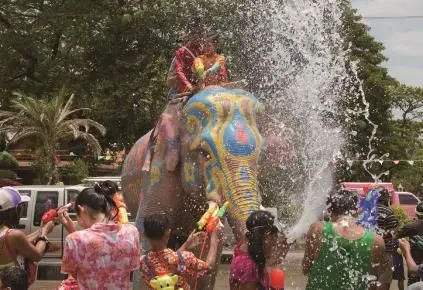
Songkran, the Thai New Year: Also known as the Water Festival, Songkran is the Thai New Year, a four-day national holiday. Like the Chinese New Year, the annual Water Festival is a vibrant and festive occasion. Large celebrations and various activities are held in all Thai cities. Thais believe that splashing water washes away the troubles and worries of the past year, and everyone in the streets and alleys is busy splashing water, exchanging greetings and blessings. Especially in the hot weather, a refreshing shower can completely dispel the heat.
May 1st (Gregorian calendar)
National Labor Day: Thailand first promulgated labor regulations in 1932, and subsequently designated May 1st of each year as National Labor Day to reward workers. The whole country takes a day off as a matter of course.
May 5th (Gregorian calendar)
Thailand's Coronation Day: The celebrations last for three days, during which national flags are flown throughout the country. The celebrations begin on May 3rd with a royal religious charity ceremony; on May 4th, a Brahmin bishop reads the proclamation commemorating the King's accession to the throne; on May 5th, the royal family conducts almsgiving for monks in the morning, and at noon, the army and navy each fire a 21-gun salute in celebration. His Majesty the King also bestows the Order of Rama V upon outstanding individuals.
May 15th (Gregorian calendar)
Ploughing Ceremony: Every May, during rice planting season, the royal family holds a grand ceremony to plant rice seedlings in the royal fields. Participants in this royal event wear brightly colored clothing and perform various rituals to pray for a bountiful harvest in the coming year. After the planting ceremony, thousands of people who had gathered around the square rush into the fields to dig up the seeds from the soil, filling plastic bags with the soil along with the seeds to take home. They believe that these seeds and the "sacred soil" of the royal fields will bring a bountiful harvest and good fortune.
June 15th in the Thai calendar
Buddha's Birthday (Khao Phansa Day): Also known as the Bathing Buddha Festival, it commemorates the birth of Buddha Shakyamuni. Although the Buddha's birth, enlightenment, and Nirvana occurred in different years, the date is the same: the 15th day of the sixth month of the Thai (Buddhist) calendar. In leap years, Buddha's Birthday falls on the 15th day of the seventh month of the Thai calendar. On this day, Buddhist temples hold fasting and chanting ceremonies, and bathe Buddha images with various fragrant waters and fresh flowers. Devotees visit temples to offer incense and participate in the bathing Buddha ceremony.
August 12th (Gregorian calendar)
Queen Sirikit's Birthday (Mother's Day): Queen Sirikit was a model of traditional Thai womanhood. She assisted His Majesty the King in promoting various beneficial programs for the people and the nation, achieving remarkable results. To commemorate her, the people designated her birthday as an important holiday. Mother's Day in Thailand was originally April 15th.
In 1976, the date was changed to August 12th, coinciding with Her Majesty the Queen's birthday, and it was decided that the white jasmine flower would symbolize great motherhood. Festival activities include flying the national flag nationwide and holding welfare and charitable events.
16th of the eighth month of the Thai calendar
Buddhist Lent (Buddhist Vidgchen): The Buddhist Lent lasts for three months, with two distinct periods: the pre-Vidgchen period (16th of the 8th month to 15th of the 11th month in the Thai calendar) and the post-Vidgchen period (16th of the 9th month to 15th of the 12th month in the Thai calendar). It is an important Buddhist festival, and the Temple of the Emerald Buddha holds a grand ceremony to change the Emerald Buddha's robes, usually presided over by the King or his representative. This signifies the beginning of the rainy season in Thailand, and monks enter a three-month period of meditation and chanting. Except for going out to collect alms in the morning, monks are not allowed to leave the temple at other times. Meals are limited to two meals a day, morning and evening, with dinner consisting only of liquids.
October 23rd (Gregorian calendar)
Chulalongkorn Day: King Chulalongkorn, the fifth king of the Chakri Dynasty, was born on September 20, 1853, and passed away in 1910 at the age of 58. During his 42 years on the throne, he promoted science, encouraged education, reformed the economy, and innovated the tax system. His various policies benefiting the people deeply resonated with them, earning him the title of "Father of the Nation." On this day, people join monks in observing a vegetarian meal and performing acts of charity as a sign of respect, and offer homemade flower garlands and wreaths to the "King Chulalongkorn's Horse Statue" monument.
December 5th (Gregorian calendar)
King's Birthday (Longevity Day, Father's Day): His Majesty King Bhumibol Adulyadej was born on December 5, 1927, and ascended the throne on June 9, 1946, becoming the ninth monarch of the Chakri Dynasty. Thailand celebrates December 5th as Longevity Day, which also serves as Father's Day. Festival activities include displaying the national flag, holding Buddhist ceremonies, observing vegetarianism and performing charitable acts, celebrating the king's birthday, and organizing welfare activities.
15th of the 12th month of the Thai calendar
Loy Krathong (Floating Light Festival): The customs of Loy Krathong originated in the Sukhothai Kingdom. The officiant lights candles and incense, then places the floating lanterns on the water's edge, hoping the candlelight will burn long and travel far with the current.
The flames symbolize the fulfillment of dreams and longevity. Along the riverbanks, visitors can buy pre-made lanterns and join the celebrations. At that time, Bangkok is ablaze with activity, a magnificent spectacle of thousands of lanterns floating on the water. The most vibrant areas are along the banks of the first royal bridge, Khao Linh Park, and Khlong Khoon.
December 10th (Gregorian calendar)
Constitution Day: On June 24, 1932, Thailand ended its more than 700-year-long monarchical rule and adopted a constitutional monarchy. Three days later, it promulgated its first provisional constitution, stipulating that supreme power belonged to the people, with the King, the people, the National Assembly, and the courts acting as agents of this power. On December 10 of the same year, His Majesty the King promulgated a formal constitution, stipulating that the country be governed by a parliament. The promulgation of the constitution marked Thailand's entry into the democratic era. To commemorate this great transformation, December 10th is officially designated as "Constitution Day."
Community
Comments 0
Start the conversation.