What is Songkran?
Songkran is the Thai New Year festival, celebrated nationwide every year from April 13th to 15th. The dates always remain the same, so in 2027 Songkran will take place from Tuesday, April 13th, to Thursday, April 15th. It is Thailand's most important holiday and has been recognized as part of UNESCO's Intangible Cultural Heritage since 2023. In the mornings, worshippers collect merit at temples and sprinkle fragrant water on the hands of the elderly. At midday, the world's largest water fight takes place, starting a day earlier in Chiang Mai and continuing until April 19th in Pattaya's Wan Lai.
Things work differently in Bangkok, Chiang Mai and Phuket, and this guide covers what you should know beforehand, the official dates and city expansions, where to party, what to wear, what not to do, when to book and which dishes you absolutely must try.
Where to stay, starting in Bangkok
This guidebook covers two regions. Select your desired region, then your preferred location, and search by your travel dates. Filter for free cancellation if you'd like to book a room and decide later.
Open Booking.com with your travel dates · also on Expedia · Trip.com
Songkran 2027 – Key Facts
It takes place every year from April 13th to 15th, so the next one will be from April 13th to 15th, 2027.
Most banks and offices close around April 11th to 17th for the holidays. The water fights begin on April 12th in Chiang Mai and last until April 19th (Wan Lai) in Pattaya.
Chiang Mai is the best city for this, followed by Silom Road in Bangkok.
The moat of Chiang Mai's old city is the site of a 5-kilometer-long water battle that lasts 5-6 days and showcases some of the strongest temple traditions. Bangkok's Silom Road (BTS station Sala Daeng) and Khao San Road host the city's biggest street festivals. Phuket and Pattaya are known for beach holidays and parties.
The water washes away the bad luck of the past year.
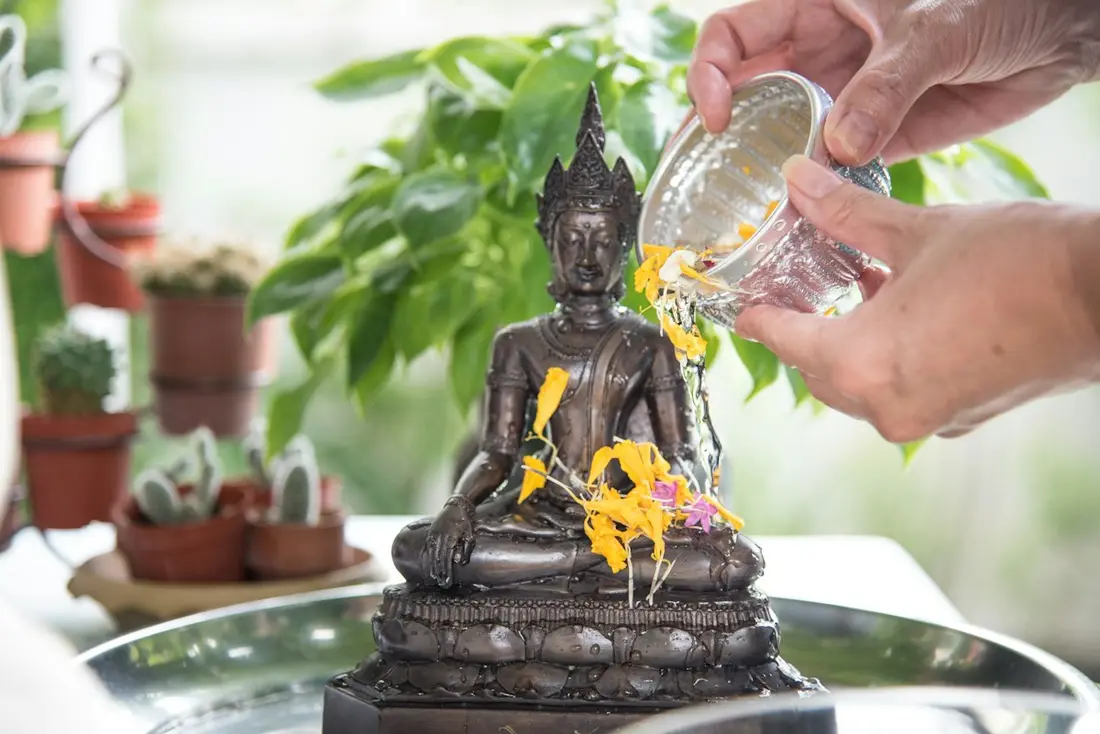
Songkran began with the custom of sprinkling fragrant water (rod nam dam hua) on Buddha statues and the hands of elders to cleanse and bless them. From this blessing evolved the water fights in the streets, which is why no one minds getting wet.
Monks, elderly people, babies and moving motorcycles are forbidden.
Avoid splashing dirty or ice-cold water in your face from close range, splashing anyone who is clearly not playing along, and do not ride a motorcycle. The number of traffic accidents increases dramatically during the "seven dangerous days." White clothing becomes see-through when wet.
The feast consists of Khao Chae and mango sticky rice.
Khao Chae (jasmine rice cooked in chilled, flower-infused water with artfully arranged side dishes) is the typical dish of Songkran and is mainly served in April. The mango season reaches its peak at the same time.
Book flights until November, hotels until January and train tickets until February.
International flights are about 30% cheaper when booked 4–6 months in advance. Hotels in Chiang Mai's old city and Bangkok's Silom district offer double or triple rooms with a minimum stay of 3 nights, and sleeper trains can be booked 90 days in advance and sell out within hours. My advice: Book early.
Songkran 2027 – Important Dates
The official dates are set for April 13-15 each year; most offices and banks close between April 11-17. The Maha Songkran World Water Festival in Bangkok and the S2O Music Festival hold their own programs during this period – see the "Festivals" section below.
Planning for Songkran 2027 and when to book flights, hotels and trains
The next Songkran festival will take place from Tuesday, April 13th, to Thursday, April 15th, 2027. The dates are fixed each year and do not change. Most Thai banks and offices are closed from April 11th to 17th. In Chiang Mai, the water fights begin a day earlier (around April 12th), and in Pattaya, the celebrations continue until April 19th (Wan Lai). Below you will find the planning guide. Information on the festivities in individual cities, traditional ceremonies, and tips for a successful festival can be found in the following sections.
Some booking deadlines are particularly advantageous. International flights to Bangkok or Chiang Mai are around 30% cheaper if booked 4–6 months in advance (e.g., by mid-November 2026 for Songkran 2027). Domestic flights between Bangkok, Chiang Mai, and Phuket sell out 6–8 weeks in advance, so you should book by the end of February at the latest. Sleeper trains (Bangkok ↔ Chiang Mai) can be booked 90 days in advance, and the northbound trains from April 11–13 and the southbound trains from April 16–17 sell out within hours. Hotels in Chiang Mai's Old City and along Silom Road in Bangkok often double or triple their prices for these periods and require a minimum stay of 3 nights. To secure the best rooms, book by January 2027.
If you're flexible with your travel dates, you can save 30–50% on flights and hotels by traveling either the week before (April 6–10) or after (April 16–22). This way, you can still experience the cultural ceremonies in early April or the water fights in Wan Lai, Pattaya, until April 19. That's what I would do.
Songkran Planning Checklist 2027: Book international flights by November 2026. Book domestic flights and night trains by February 2027. Book hotels in Chiang Mai Old City/Bangkok Silom by January 2027 (minimum stay 3 nights). Pack a waterproof bag for your mobile phone and passport before you leave.
Suvarnabhumi → Your hotel in Bangkok
Book your airport transfer in advance – taxis during Songkran are chaotic.
During Songkran, major roads are closed (e.g., Silom in Bangkok, the moat road in Chiang Mai), taxis with meters are scarce, and anything with an open window will get soaked. A car pre-booked through 12Go guarantees a fixed price and will get you to your hotel dry. It's best to book it for the same dates as your flights.
Sponsored link. We may receive a small commission if you book – this will not incur any additional costs for you. Learn more.
When is Songkran? Official dates and schedule
The 13th to 15th of April are the national holidays every year – but the celebrations begin earlier.
Songkran spans three official days, each with its own name and significance. April 13th is Wan Sangkhan Loy (also known as National Elders' Day). On this day, Thai families clean their homes, prepare offerings, and pay their respects to elders. April 14th is Wan Nao, the day between the old and new year. On this day, families prepare for the festival and visit temples. April 15th is Wan Payawan, Thai New Year's Day. On this day, people visit temples to earn merit, bathe Buddha statues, and perform the Rod Nam Dam Hua ceremony (in which fragrant water is poured over the hands of elders to ask for their blessings).
In practice, the festivities last far beyond the official three days. The Thai government usually declares an extended holiday weekend, and most offices and banks remain closed from April 11 to 17. In Chiang Mai, the water fights begin on April 12 and continue until April 15 or 16. Pattaya holds its own extension, called Wan Lai, on April 19, making it the longest Songkran celebration in the country.
Two major events now dominate Bangkok's festival calendar. The Maha Songkran World Water Festival, the free flagship of the Tourism Authority of Thailand, offers five days of parades, cultural performances, and water festivals from April 11-15 (the 2026 edition was held in Benchakitti Park; please check the current venue). The S2O Songkran Music Festival is its ticketed counterpart, featuring huge stages and water cannons synchronized to international EDM headliners. It takes place at the S2O Land site in Ratchada, usually from April 11-13. S2O sells out in advance and attracts tens of thousands of visitors, so early booking is recommended.
The most important dates are the same every year. Official holidays are from April 13th to 15th. Most offices are closed from April 11th to 17th. The water fights reach their peak from April 13th to 15th in Bangkok and from April 12th to 15th in Chiang Mai. In Pattaya, the party in Wan Lai lasts until April 19th.
Operating instructions for the individual cities from April 13th to 15th
Bangkok — Silom Road closure
Silom Road will be closed to all vehicular traffic between the Sala Daeng and Surasak BTS stations during the three-day Songkran festival (April 13–15). The BTS Skytrain will operate as usual, however, expect heavy traffic at the Sala Daeng and Chong Nonsi stations from late morning onwards. To ensure smooth travel, it is recommended to arrive no later than 11:00 AM or after 7:00 PM. Khao San Road will also be closed to traffic during the same period, with the heaviest traffic expected after 2:00 PM.
Chiang Mai – Timekeeping on the castle moat
From April 12th to 15th, the moat of the old city transforms into a massive water fight every day from approximately 9 am to 7 pm. The Tha Phae Gate serves as the main stage, and there is live music in the evenings. Songthaews no longer travel through the moat itself; you'll have to walk or rent a scooter (and be prepared to get wet). On April 13th, the Phra Singh Buddha procession takes place at Wat Phra Singh. Those who want a good view of the traditional ceremony before the water spectacle begins should arrive by 8 am.
Phuket – Patong & Bangla Road
The biggest Songkran celebration takes place on April 13th at Patong Beach and Bangla Road – the busiest day on the island. Foam parties on Bangla Road usually start around 1 p.m. In Phuket Old Town, traditional ceremonies are held on the morning of April 13th in Saphan Hin and the town center – a quieter alternative for those who want to experience the culture without the crowds of Patong.
Pattaya – Wan Lai extended until April 19th
The main Songkran celebrations take place on Beach Road and Walking Street from April 13th to 15th, but Pattaya's unique Wan Lai Festival extends the festivities until April 19th, with April 19th itself being the highlight. Pattaya is the only city in Thailand where you can still experience the full chaos of the water fights almost a week after the rest of the country has returned to work.
Recurring rules that you can plan around.
The Tourism Authority of Thailand promotes an alcohol-free zone around the Grand Palace and Sanam Luang (public alcohol consumption is prohibited in the temple precinct). Pick-up trucks carrying water barrels are not allowed on Bangkok's main roads during rush hour, so the water games are concentrated in pedestrian zones. I recommend bringing a waterproof bag for your phone and passport. Water damage during Songkran is the most common claim Thai travel agencies are handling this week.
Why do Thais throw water at each other during Songkrane? History and meaning
The word "Songkran" comes from the Sanskrit word "Sankranti," meaning "astrological transition." Originally, it marked the sun's entry into the zodiac sign Aries and the beginning of a new solar year. The festival has been celebrated in Thailand for centuries and has its roots in both Hindu-Brahmin astrology and the merit traditions of Theravada Buddhism. Similar water-based New Year's festivals exist throughout Southeast Asia, such as Pi Mai in Laos, Thingyan in Myanmar, and Chaul Chnam Thmey in Cambodia.
The traditional heart of Songkran is deeply spiritual. Thai families visit their local temple in the morning to offer food to the monks and sprinkle Buddha statues with fragrant water—a purification ritual meant to wash away the misfortunes of the past year. On the temple grounds, people build small sand pagodas (chedis), symbolically returning the sand they have carried on their feet throughout the year. The most emotionally significant ritual is Rod Nam Dam Hua, in which younger family members pour jasmine water over the hands of their parents and elders to ask for forgiveness and receive blessings in return. It is one of the most moving ceremonies in the Thai calendar, and if you have the opportunity to witness it, don't miss it.
The exuberant water-throwing evolved from the respectful tradition of water pouring. What began as gentle sprinkling grew into a neighborhood water game and eventually into the full-blown water fight we see today. The Thai government has repeatedly attempted to curb the festivities by banning alcohol sales at certain times, restricting the use of water trucks, and promoting the traditional aspects. However, Songkran's current reputation as the world's biggest water fight is firmly established. Both versions exist side by side, so you might experience a quiet, reverential temple ceremony in the morning and find yourself in the midst of absolute, water-soaked chaos by midday.
The best places to celebrate Songkran in Thailand
Bangkok – Silom Road and Khao San Road
Bangkok offers the most diverse Songkran experience. Silom Road is the main event: a two-kilometer stretch is transformed into a scene of exuberant water fights. The road is closed to traffic, and hundreds of thousands of people flock there armed with water pistols, hoses, and buckets. Khao San Road is the backpacker mecca with a younger, international crowd. The Tourism Authority's free Maha Songkran World Water Festival is the highlight of the cultural program (in 2026 it will be held in Benchakitti Park; please check for the current venue). Royal City Avenue (RCA) is the center of the club and party scene. BTS and MRT trains run continuously, making it easy to travel between the different districts.
Chiang Mai, the epicenter of Songkran
Ask Thais about the best Songkran festival, and the answer will be Chiang Mai. The old city's moat transforms into the center of a five-kilometer water fight, with pickup trucks cruising along as passengers and spectators splash each other. Tha Phae Gate is the central meeting point. The festivities here last the longest in the country, often five or six full days, and the atmosphere is more festive and relaxed than in Bangkok. The traditional ceremonies at Wat Phra Singh and Wat Chedi Luang are among the most beautiful in Thailand. If you can only choose one city, pick Chiang Mai.
Phuket — Songkran Beach
Phuket combines a relaxed beach atmosphere with the exuberant Songkran celebrations. Patong Beach and Bangla Road are the main party zones, where foam parties and DJ stages add to the fun of water fights. Saphan Hin Park hosts a more traditional celebration with local performances. Phuket Old Town offers a quieter, more cultural experience with temple ceremonies and heritage events. Phuket's beachfront location gives it a unique appeal that other cities lack: here, you can take a refreshing dip in the Andaman Sea between festivities.
Pattaya – The Extended Party
Pattaya doesn't just celebrate Songkran, it extends the festivities. While the official dates are observed as usual, the city also hosts Wan Lai on April 19th, further lengthening the celebrations by several days with water fights and street parties. Beach Road and Walking Street are the main party zones. Pattaya's Songkran attracts a large international audience and is considered the most festive of all Thai cities. Those who miss the main dates elsewhere have a second chance in Pattaya.
Koh Samui — Songkran Island
For a more relaxed, island-style Songkran experience, Koh Samui offers a laid-back atmosphere. Chaweng Beach Road is the main celebration hub, but it's smaller and more family-friendly than Bangkok or Pattaya. Local festivities also take place in Lamai and the fishing village of Bophut. Thanks to its island location, you're never far from a beach for a refreshing dip. It's a great choice if you want to celebrate Songkran away from the hustle and bustle of the big cities.
Songkran Music Festival
Two events dominate the festival. The free, government-sponsored Maha Songkran World Water Festival offers five days of parades, cultural performances, and water displays in central Bangkok (in 2026, it was held in Benchakitti Park). The ticketed S2O Songkran Music Festival, on the other hand, features international EDM stars (in 2026, Zedd, Kygo, and Alan Walker performed) with giant water cannons synchronized to their sets. It usually takes place from April 11th to 13th at S2O Land in Ratchada. S2O tickets cost between 1,500 and 5,000 baht, depending on the category, and often sell out in advance. So, anyone keen to attend music festivals should book early.
Accommodation during Songkran — Bangkok
Millennium Hilton Bangkok
Siam Kempinski Hotel Bangkok
The Peninsula Bangkok
Four Seasons Hotel Bangkok on the Chao Phraya River
The best hotels in Bangkok
My hotel selection in Bangkok in every price category, based on Google's hotel rating system. My top 10 hotels are displayed first, followed by the highest-rated ones. Each button takes you directly to the hotel's page on Booking.com, where your travel dates are already entered.
Accommodation during Songkran — Chiang Mai
Shangri-La Chiang Mai
Anantara Chiang Mai Resort
U Chiang Mai Hotel
Meliá Chiang Mai
The best hotels in Chiang Mai
My hotel selection in Chiang Mai in every price category, based on Google's hotel rating system. My top 10 hotels are displayed first, followed by the highest-rated ones. Each button takes you directly to the hotel's page on Booking.com, where you've already entered your travel dates.
What to expect from the Songkran water fight
Anyone outside during Songkran is going to get soaked. There are no exceptions, no safe zones, and not even the loudest "I don't want to play!" will help. A water fight is inevitable in the streets. Pick-up trucks drive slowly around with huge barrels of water on the back, the passengers armed with hoses and buckets. Street vendors have set up refill stations with garden hoses and enormous containers of ice water. Strangers of all ages (toddlers, grandmothers, monks – yes, some even join in) squirt you with water pistols, buckets, and occasionally, garden hoses. The ice water is the part that completely takes first-timers by surprise. Nothing prepares you for having a bucket of ice-cold water splashed onto your back when it's 38°C outside.
The intensity of the celebrations varies greatly depending on the location and time of day. In the early morning, the temples are quiet and respectful, with fragrant water carefully poured from silver bowls. From 10 a.m. onwards, water pistols are brandished. By midday, the streets resemble a battlefield. The chaos reaches its peak between 1 p.m. and 4 p.m. The main celebration zones (Silom, the Chiang Mai Castle moat, Patong Beach Road) are the wildest, and you can be completely soaked within 30 seconds of entering. The side streets and residential areas are quieter, with families setting up small water stations for their neighbors. Around 6 p.m., the water fights subside, and the streets transform into a vibrant scene of food and music.
Chalk paste (Din Sor Pong) is part of the tradition. People apply it to each other's faces and arms as a blessing and sun protection. It is harmless and washes off easily. Talcum powder is also still seen, although it is used less frequently nowadays. Some people mix the chalk with water to make it easier to apply. Don't be alarmed if a stranger gently applies white paste to your cheeks – it is a sign of goodwill.
Songkran Survival Guide: What to wear, pack and know
What you should wear
Quick-drying clothing is essential. Cotton stays wet and heavy for hours. Dark colors are better, as white fabrics become completely see-through when wet. Waterproof sandals with good tread are a must, since flip-flops are slippery on wet streets and easily lost in a crowd. Many wear Hawaiian shirts or floral shirts as unofficial Songkran attire. Wear swimwear underneath your clothes. Avoid jeans, leather shoes, or anything else you value and don't want to get damaged.
Protect your valuables
A waterproof phone case is the most important item you should buy. They are available for 50–100 baht at any 7-Eleven, from street vendors, or in electronics stores. Buy two: one for your phone and one for cash, hotel keys, and cards. Leave your passport, laptop, and expensive electronics at the hotel. If you absolutely must carry a bag, use a waterproof dry bag (available in outdoor stores for 200–500 baht). Waterproof phone cases are touchscreen compatible, so you can still take photos and use maps.
Water etiquette and what to avoid during Songkran
Water guns come in all price ranges, from small pistols for 50 baht at 7-Eleven to huge, backpack-mounted tanks for over 500 baht from street vendors. A medium-sized pump-action water gun (150–300 baht) is best—enough firepower to participate without being too heavy to carry all day. Refill stations are everywhere. Shops place water containers and charge 5–10 baht per fill, or you can refill for free at public taps. Etiquette is important. Never splash monks, elderly people who are clearly not participating, or motorcyclists at high speed. Don't use dirty water. Avoid splashing people directly in the face at close range, especially with ice water.
Songkran Security
Road safety is the biggest concern during Songkran. The Thai government tracks the seven most dangerous days surrounding the festival. During Songkran 2026, the Road Safety Centre recorded 1,242 accidents and 242 fatalities. The main causes were excessive speed and driving under the influence of alcohol, with motorcycles being the most frequently involved vehicle. Do not ride a motorcycle during Songkran. Avoid driving under the influence of alcohol at night, as this is when the number of drunk driving incidents is highest. Other safety tips: Protect your eyes from dirty water (inexpensive swimming goggles are recommended), apply waterproof sunscreen regularly (wetness can mask sunburn), and be careful of slippery surfaces. Wet tiles, stairs, and roads cause many injuries. If you wear contact lenses, switch to glasses or swimming goggles to avoid eye infections from road water.
Conquer the heat
April is Thailand's hottest month. In Bangkok and the central plains, temperatures regularly reach 35–40°C. The constant water fights often lead to an underestimation of the actual sun's intensity, and sunburn and heatstroke are common consequences for tourists who spend all day in water fights without realizing how dehydrated they are. Drink water regularly (not just beer), reapply waterproof sunscreen every one to two hours, wear a hat if possible, and seek shade between noon and 2 p.m. Carry a reusable water bottle and refill it regularly.
Transportation during Songkran
During Songkran, public transportation is the only reliable option. In Bangkok, the BTS Skytrain and MRT subway run throughout the festival, and the BTS Sala Daeng station takes you directly to the Silom festival district. Roads near the major festival areas are closed or congested. Grab and taxi fares are extremely high (3 to 5 times normal), especially around sunset. Domestic flights sell out weeks in advance, and prices double or triple, so book at least 6–8 weeks ahead. The same applies to long-distance buses and trains. VIP bus tickets from Bangkok to Chiang Mai should be booked a month in advance.
What do Thais do during Songkran? Temples, alms collection, and Rod Nam Dam Hua.
Beyond the boisterous water fights, Songkran remains Thailand's holiest holiday. Every family visits their local temple on the morning of April 13th, and for visitors, participating in these ceremonies is one of the most enriching cultural experiences Thailand has to offer. The day begins early. Thai families offer food to the monks at dawn and then participate in the ritual washing of the Buddha statues. Temple visitors carefully sprinkle the Buddha statues with fragrant water infused with jasmine, rose petals, or turmeric, praying for good fortune in the new year. In Chiang Mai, the statue of Phra Buddha Sihing is carried through the streets on a decorated cart, and people line the route to pour water over it. In Bangkok, the most elaborate ceremonies take place at Wat Pho, Wat Arun, and Wat Phra Kaew.
The most emotionally significant Songkran tradition is the Rod Nam Dam Hua, in which fragrant water is poured over the hands of parents, grandparents, and respected elders—a gesture of respect, gratitude, and a silent plea for forgiveness. The elders sit with folded hands while younger family members gently pour water over their hands and offer them flowers. In return, the elder blesses the coming year. Visitors invited to participate in this ceremony with a Thai family in Chiang Mai are often deeply moved. The room is completely silent except for the sound of the water, and it is common to see several family members with tears in their eyes. This side of Songkran is rarely seen by tourists, yet it is the heart of the festival.
You can experience the traditional Songkran festival at any temple, but the most famous ceremonies take place at Wat Phra Singh and Wat Chedi Luang in Chiang Mai, Wat Pho and Wat Saket in Bangkok, and Wat Chalong in Phuket. Cultural events are also offered at the National Museum in Bangkok. Arrive early (7–9 a.m.) to see the ceremonies before the water fights begin. Dress respectfully, covering your shoulders and knees, and remove your shoes before entering the temple buildings.
The best temples for Songkran ceremonies
Wat Phra Kaew
The Grand Palace
Wat Arun
Doi Suthep Temple
Wat Phra That Doi Kham
Wat Chedi Luang
What to eat during Songkran, the traditional festival meal
Songkran has its own signature dish: Khao Chae. This is jasmine rice served in chilled, jasmine-infused water, along with a selection of carefully prepared accompaniments such as stuffed shallots, sweet dried pork strips, crispy shrimp paste balls, and stuffed green peppers. Khao Chae is one of the most elaborate dishes in Thai cuisine and was originally prepared at the royal court. It is primarily available in April. Upscale Thai restaurants in Bangkok, especially those specializing in Central Thai cuisine, serve the finest versions, but simpler versions can also be found at street stalls. If you only want to try one special dish during Songkran, make it Khao Chae.
Besides Khao Chae, Songkran coincides with the peak season for mangoes. This means that mango sticky rice (Khao Niaow Mamuang) tastes especially delicious: golden-yellow, fragrant Namdokmai mangoes with warm sticky rice in coconut cream. In April, you'll find street vendors selling this specialty on every corner. Other festive foods include various kanom (Thai sweets), particularly kanom tuay (steamed coconut pudding) and kanom tom (coconut balls). Many regular street vendors close during the holiday as they return to their home provinces. Those that remain open often offer special Songkran menus.
Beer is the unofficial drink of Songkran. Big brands sponsor the water fight stages, and cold Leo, Chang, and Singha flow freely. The rules have recently been relaxed. Thailand's old ban on alcohol sales between 2 p.m. and 5 p.m. was lifted at the end of 2025 and made permanent in 2026. Licensed shops and bars are now allowed to serve alcohol continuously from 11 a.m. to midnight. However, some zones remain alcohol-free, including temple grounds and the area around the Grand Palace. Drink plenty of water between beers, as the combination of heat, sun, and alcohol on an empty stomach catches many tourists off guard.
Where to eat during Songkran
Krua Apsorn
K. Panich Sticky Rice
Mae Varee
Kao Soy Nimman
Khao Soi Islam
Han Teung Chiangmai
How much a Songkran trip costs
Prices increase by 30–100% during Songkran week, especially for accommodations near the main celebration areas. Book 4–8 weeks in advance to get the best rates.
Planning your Songkran trip
Book flights and hotels early
Domestic flights between Bangkok and Chiang Mai, Phuket, or Koh Samui triple in price during the Songkran festival. Hotels in Chiang Mai's Old City, Bangkok's Silom district, and near Khao San Road are booked weeks in advance. Book flights at least 6–8 weeks ahead and accommodations 4–6 weeks ahead to secure the best selection and prices. If you're looking to save money, consider staying just one BTS/MRT stop away from the main areas. Prices drop significantly just a few blocks from the action.
Choose your city wisely
Chiang Mai offers the most intense and longest celebrations (5-6 days, a walk around the castle moat, strong traditional elements). Bangkok impresses with its diversity and size (Silom, Khao San Road, music festivals, temples). Phuket combines beach and party. Pattaya beckons with an extended party calendar (Wan Lai on April 19). Koh Samui offers a relaxed, family-friendly island atmosphere. Visiting two cities during Songkran is not possible, as transportation between them is extremely difficult during the holidays. Therefore, choose one city and stick with it.
The daily rhythm
A typical Songkran day follows a predictable pattern. From 6 to 9 a.m., temple visits and merit rituals are on the agenda (peaceful and dry). Between 9 and 10 a.m., the streets come alive with water pistols being fired. From 10 a.m. to 6 p.m., exuberant water fights take place, reaching their peak between 1 and 4 p.m. From 6 to 8 p.m., the streets transform into a vibrant hub of activity with food stalls, live music, and evening markets. From 8 p.m. onward, restaurants, bars, rooftop parties, and music festivals beckon. Plan your day around this rhythm: temple visits in the morning, water fights in the afternoon, and meals and socializing in the evening.
Packing list for Songkran
Essential items include 2-3 waterproof phone cases (as these tear easily, bring spares), quick-drying clothing (3-4 changes of clothes), waterproof sandals with ankle straps, reef-friendly sunscreen (SPF 50+, waterproof), a small waterproof bag or waist pack, swimwear, inexpensive swimming goggles (to protect your eyes), insect repellent (for the evenings), a reusable water bottle, and dry clothes to leave at the hotel for the night. Optional extras include an action camera or a waterproof camera for photos and a portable charger (packed in a waterproof bag).
Where you can celebrate Songkran 2027. Choose your destination and then plan.
Frequently Asked Questions
Frequently asked questions about the Songkran Festival in Thailand.
Songkran 2027 takes place from Tuesday, April 13th, to Thursday, April 15th, 2027. The official dates are April 13th to 15th each year and do not change. The government usually extends the holidays, so most offices and banks are closed from around April 11th to 17th. In Chiang Mai, the water fights begin on April 12th, and in Pattaya's Wan Lai, the festivities last until April 19th.
Yes. Songkran follows the solar calendar and takes place every year from April 13th to 15th, unlike Loy Krathong or Chinese New Year, which follow the lunar calendar. What does change is the surrounding holiday, as the government extends it into a long weekend (roughly from April 11th to 17th), and Chiang Mai and Pattaya extend their water shows by a few days.
Do not spray monks, the elderly, babies, or people on moving motorcycles. Do not throw dirty or icy water in your face from close range. Do not ride a motorcycle yourself (there are 300–400 traffic accidents nationwide every day), and do not wear white clothing, as it becomes see-through when wet. Leave passports and electronic devices at your hotel, dress appropriately for temple ceremonies, and consider the chalk paste on your cheeks a blessing.
The mornings are dedicated to accumulating merit: offering food to monks, bathing Buddha statues with fragrant water, building sand pagodas on the temple grounds, and practicing Rod Nam Dam Hua, the pouring of jasmine water over the hands of parents and elders to ask for blessings. On April 13th, families clean their houses, and on April 15th, Thai New Year, they visit the temples. From late morning onward, water fights take place in the streets, and the evenings are reserved for food, music, and family.
Water is a blessing. Songkran began with the practice of pouring fragrant water over Buddha statues and the hands of elders to wash away the misfortunes of the old year and ensure good fortune for the new. Over generations, this gentle sprinkling spread from the temples to residential areas, evolving into today's water fights in the streets. Being splashed by a stranger originally meant wishing someone a happy new year.
Songkran is the Thai New Year, celebrated annually from April 13th to 15th. The name comes from the Sanskrit word "Sankranti," meaning "astrological transition." Traditionally, Songkran involves visiting temples, bathing Buddha statues with fragrant water, and pouring water over the hands of elders as a sign of respect (a ceremony called Rod Nam Dam Hua). Today's water fights evolved from these gentle water-pouring traditions. Songkran now blends profound Buddhist merit practices with the world's largest water festival, and both customs coexist and are celebrated simultaneously.
Chiang Mai is widely considered the best destination for Songkran. The festivities around the old city moat last 5-6 days, the atmosphere is celebratory but not overwhelming, and the traditional temple ceremonies are among the most beautiful. Bangkok's Silom Road and Khao San Road offer the most accessible locations for the celebrations thanks to excellent transport links. Phuket combines beach fun with water fights. Pattaya offers the longest celebrations, with the extension to Wan Lai on April 19. Koh Samui is the most relaxed and family-friendly option.
Wear quick-drying, dark clothing, as white fabrics become see-through when wet. Waterproof sandals with good tread are essential, as the streets are extremely slippery and flip-flops can easily slide in the crowd. Many people wear Hawaiian shirts or floral shirts as unofficial Songkran attire. Wear swimwear underneath your clothes. Bring a waterproof phone case (available at any 7-Eleven for 50–100 baht) and leave valuables at your hotel. Avoid jeans, leather shoes, or anything you don't want to ruin.
The water fights themselves are safe and welcoming for tourists, and Thais are happy to share Songkran with visitors. The biggest safety hazard is traffic accidents. During the "seven dangerous days" of Songkran 2026, 242 people died on Thailand's roads, most of them on motorbikes. The main causes included excessive speed and drunk driving. Do not ride motorbikes during Songkran, avoid the roads at night, and use public transportation or the BTS/MRT. Also, protect your electronic devices with waterproof cases, use sunscreen (wetness protects against sunburn), and drink plenty of fluids, as temperatures in April can reach 35–40°C.
Khao Chae is the traditional Songkran dish: jasmine rice served in chilled, jasmine-infused water, accompanied by elaborately prepared side dishes such as stuffed shallots, sweet dried meat, crispy shrimp paste balls, and stuffed green peppers. It is one of the most elaborate dishes in Thai cuisine, originally prepared at the royal court, and is mainly available in April. The best versions are served in upscale Thai restaurants in Bangkok specializing in Central Thai cuisine. Simpler versions can also be found at street stalls during the festival.
You can experience the traditional Songkran festival without the water fights by visiting temples for ceremonies in the morning (7–9 a.m., before the water fights begin), attending cultural events at the National Museum or on the palace grounds, and staying indoors during the peak water fight times (10 a.m.–6 p.m.). Many upscale hotels host elegant Songkran events with controlled water fights. However, if you spend the day outdoors in one of the festival areas, getting wet is inevitable. The water fights are unavoidable for spectators.
Two events are staples of the calendar. The Maha Songkran World Water Festival is the free flagship event of the Tourism Authority of Thailand, offering five days of parades, cultural performances, and water festivals from April 11-15 (it was held in Benchakitti Park in 2026, so check the venue for the current year). The S2O Songkran Music Festival is a ticketed EDM extravaganza at S2O Land in Ratchada, usually held from April 11-13, featuring water cannons synchronized to performances by international headliners. Tickets cost around 1,500-5,000 baht and often sell out quickly, so early booking is recommended. Information on the 2027 lineup will be available on official channels as soon as it is announced.
Where you can stay during your trip
Start below with Bangkok – this guide also covers Chiang Mai; everything can be researched on the respective booking sites.
Compare prices on Booking.com
Compare prices on Trip.com
We may receive a commission for bookings made through these links – this will not incur any additional costs for you. Learn more.
Discover more in this guide
You might also like this
2-week Thailand itinerary
Capital city, night train, mountains, then along the Andaman coast island by island – thirteen nights, one way.
7 days in Thailand
Capital city, mountains, islands – six nights, two short flights and not a single day was lost to the journey.
10 days in Thailand – Itinerary
Capital city, night train, mountains, then ferry to the Andaman coast – nine nights, one way, no return.
Thailand Honeymoon Guide and 10-Day Itinerary
Villas with private pools, sunsets in a longtail boat, and evenings perfect for two.
Thailand on a budget
Thailand for less money, without sacrificing the best
I lived in Bangkok for four years and traveled throughout the country from there. The guidebooks reflect my personal opinion and are written as I would explain things to a friend planning a trip.
Ready to create your travel itinerary?
Use our free trip planner to save places, organize days, and share your trip.
Community
Comments 0
Start the conversation.