Before departing for Thailand: Few people know this, although the rule isn't new: Since 1979, tourists entering Thailand have been required to prove they have sufficient funds for their stay. The official figure is 20,000 baht per person (approximately €500 / US$550) or 40,000 baht per family. Ideally, this amount should be presented in cash at immigration control; alternatively, recent bank statements are required. Thai immigration officials may conduct random checks and request proof of sufficient funds. While this is very rare, it can happen, so be prepared. In any case, it's cheaper to travel to Thailand with cash (euros, US dollars, or pounds sterling, preferably in large denominations) and exchange it locally rather than withdrawing cash, as various fees apply (see below). IMPORTANT: Inform your bank about your trip to Thailand, as withdrawals or payments made there could otherwise be flagged as suspicious and your card could be blocked.
How should you manage your money during your trip to Thailand? The Thai currency is the Baht (THB). Although the exchange rate fluctuates, it has been between 35 and 40 Baht per Euro (approximately 32 to 36 Baht per US Dollar) for several years. Cash is widely used in Thailand (guesthouses, small hotels, taxis, restaurants, etc.), and card payments are rare. While smartphone app payments have become widespread in recent years, they are hardly accessible to tourists without a Thai bank account, except through certain apps that often offer unfavorable exchange rates. Therefore, it's advisable to always carry some Baht. You can easily withdraw cash from the numerous ATMs throughout the country using a Visa or Mastercard. However, a fixed fee applies to each withdrawal (current information: 250 THB per withdrawal with Visa and 350 THB with Mastercard, regardless of the amount, usually with a limit of 20,000 THB per withdrawal). It is therefore cheaper to bring cash in large bills and exchange them than to withdraw money from an ATM. Some online banks do not charge fees for payments and withdrawals abroad, but the Thai ATM fee still applies; only the other fees are waived with these cards. It seems possible to avoid this fee by withdrawing cash at a bank counter with your passport and card. This takes longer, and, most importantly, you have to insist, otherwise you might be sent back to the ATM. WARNING: ATMs in Thailand dispense the money BEFORE returning the card. Be careful, as it's easy to forget to take it with you out of habit. Generally, I recommend using ATMs inside bank branches whenever possible: If the machine retains your card, it's much easier to get it back!
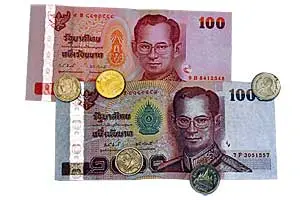
The Thai currency (THB) consists of banknotes ranging in value from 20 to 1,000 THB. Some hotels and restaurants accept euros or dollars, but this is rather the exception, unlike in some neighboring countries (Cambodia, Myanmar, etc.) where dollars are preferred. In Thailand, everything is paid for in the local currency. Withdraw or exchange money for baht immediately upon arrival (there are ATMs and exchange bureaus in the airport arrivals hall, but the best exchange bureaus are located in the basement to the left of the Airport Rail Link entrance). Get into the habit of always carrying some cash in baht. Two series of banknotes and coins are in circulation simultaneously: the series featuring King Rama IX (Bhumibol) and the series featuring King Rama X (Vajiralongkorn), which has been issued since 2018. Both are widely accepted. All coins feature the King's portrait on the obverse. In recent years, banknotes have been gradually converted to polymer, a plastic material that is more durable and counterfeit-proof: the 20-baht note since 2022 and the 50- and 100-baht notes since November 2025. The designs remain unchanged, and the old paper notes are still legal tender. 20-baht banknote (green): Made of polymer since 2022. Rama X series: Obverse: King Vajiralongkorn in the uniform of the Royal Thai Air Force; Reverse: King Rama I with the Grand Palace and King Rama II. Rama IX series: Reverse: King Ram Khamhaeng, credited with inventing the Thai writing system, and his famous stele. 50-baht banknote (blue): Rama X series: Reverse: King Rama III with a Chinese junk, a symbol of trade with China, and King Rama IV (Mongkut) with the Khao Wang Palace in Phetchaburi. Rama IX Series: Reverse: King Naresuan on his war elephant and the large chedi of Wat Yai Chai Mongkhon in Ayutthaya. 100-baht banknote (red). Rama X Series: Reverse: King Rama V (Chulalongkorn) and his 1907 trip to Norway, and King Rama VI (Vajiravudh), founder of the Thai Scouts. Rama IX Series: Reverse: King Taksin, his statue at the Wongwian Yai roundabout, and the Wichai Prasit fortress in Thonburi. 500-baht banknote (purple). Rama X Series: Reverse: King Rama VII (Prajadhipok) and the country's first constitution, and King Rama VIII (Ananda Mahidol) visiting the Sampheng Chinatown. Rama IX Series: Reverse: King Rama I, founder of Bangkok, the chedis of Wat Pho, and the Phra Sumen fortress. 1000 Baht banknote: Brown banknote, the largest banknote in circulation. Rama X series: Reverse: King Rama IX (Bhumibol) visiting Nakhon Phanom and King Rama X meeting with the people in the provinces. Rama IX series: Reverse: King Rama V (Chulalongkorn), his equestrian statue in the Royal Square, the Ananta Samakhom throne hall, and the abolition of slavery. 25 Satang coin (16 mm): Small copper-colored coin (one quarter baht), mostly given as change in supermarkets. Rama X series: The royal monogram of King Vajiralongkorn. Rama IX series: Wat Phra Mahathat in Nakhon Si Thammarat. 50 Satang coin (18 mm): Copper-colored coin (one half baht). Rama X series: The royal monogram of King Vajiralongkorn. Rama IX Series: Wat Phra That Doi Suthep, the temple overlooking Chiang Mai. 1 Ø 20 mm 1 Baht Coin: Small silver-colored coin. Rama X Series: The royal monogram of King Vajiralongkorn. Rama IX Series: Wat Phra Kaew, the Temple of the Emerald Buddha in the Grand Palace of Bangkok. 2 Ø 21.75 mm 2 Baht Coin: Gold-colored coin, not to be confused with the 1 Baht coin, which is almost the same size. Rama X Series: The royal monogram of King Vajiralongkorn. Rama IX Series: The Golden Mountain of Wat Saket in Bangkok. 5 Ø 24 mm 5 Baht Coin: Large, thick silver-colored coin. Rama X Series: The royal monogram of King Vajiralongkorn. Rama IX Series: Wat Benchamabophit, Bangkok's Marble Temple. 10-baht coin (26 mm diameter): Bimetallic coin with a gold-colored core and silver-colored ring, the largest coin in everyday use. Rama X series: The royal monogram of King Vajiralongkorn. Rama IX series: Wat Arun, seen from the Chao Phraya River.
Bank cards in Thailand: Most cards that allow international payments and withdrawals are accepted in Thailand, whether Visa, Mastercard, or American Express. ATMs are readily available except in the most remote rural areas and on some uninhabited islands. Note that a fixed fee (in addition to your bank's fees) applies to each withdrawal, regardless of the amount. Depending on the bank, the withdrawal limit is 15,000 or 20,000 THB. If possible, use an ATM located inside a bank branch: In case of problems (e.g., if your card is retained), staff will be available to assist you, making the process much simpler. Remember to also take the phone number you need to call to report your card being lost or stolen (this is now also possible via banking apps). Important: Inform your bank a few days before your departure for Thailand to prevent your card from being blocked in case withdrawals in Thailand are flagged as potential fraud or theft, which occasionally happens. In large hotels and restaurants, department stores, and supermarkets, you can usually pay by card, often with a fee of around 3%. For everything else, you should always carry cash: Thais pay a lot in cash. In larger cities and tourist hotspots, exchanging euros, US dollars, or pounds for baht is straightforward. Outside of Bangkok, it can be a bit more complicated with other currencies. Every reputable exchange bureau will ask for your passport (this is required by law) and sometimes your address. Only banknotes, not coins, can be exchanged, and these must be in very good condition. Each exchange bureau has its own buying and selling rates, which vary from branch to branch. In Thailand, Superrich is known for its favorable rates but doesn't have branches everywhere. One branch is located at Suvarnabhumi Airport in Bangkok, on the lower left at the entrance to the Airport Rail Link. Value+ also offers good rates right in front of it. In my video "Arriving at Bangkok Airport," I show you where to find the exchange bureaus with the best rates, so you can exchange money as soon as you arrive in Thailand. Exchanging cash is cheaper than withdrawing it, but it means carrying larger amounts of money. Given the risk of theft—which, while low in Thailand, isn't zero—this isn't always easy. The best solution is probably a combination of both. Cost of living in Thailand: Thanks to the favorable exchange rate with Western currencies, the cost of living in Thailand is low for tourists. However, it has increased in recent years: Don't expect everything in Thailand to be dirt cheap—that's no longer the case! Nevertheless, you can still eat, stay overnight, and even travel by train in Thailand for just a few dollars. Even in Bangkok, for example, you can get a serving of the famous Pad Thai for about a dollar, a decent hotel room for around $12–15, and a bed in a dormitory even cheaper. Trains and buses between cities are also very inexpensive. Domestic flights, on the other hand, are no longer as cheap as they used to be. And if you want a luxurious vacation without breaking the bank, Thailand offers some of the best luxury hotels in the world. Such value for money is hard to find in most countries: for a dream room with a spa, pool, beach access, etc., you pay the price of a 2-star room in the center of a major Western city. Money transfer to Thailand: Although this is more relevant for expats than tourists, if you want to transfer money to Thailand, I use the WISE service. The transaction fees are among the lowest, and the exchange rate is fair. Many other providers add a markup to the exchange rate, which increases the final cost. But be aware: for WISE accounts with residents in Thailand, the rules are changing and will become less favorable during 2026.
Find accommodation in Thailand Booking.com (function(d, sc, u) { var s = d.createElement(sc), p = d.getElementsByTagName(sc)[0]; s.type = 'text/javascript'; s.async = true; s.src = u + '?v=' + (+new Date()); p.parentNode.insertBefore(s,p); })(document, 'script', 'https://aff.bstatic.com/static/affiliate_base/js/flexiproduct.js');
Community
Comments 0
Start the conversation.