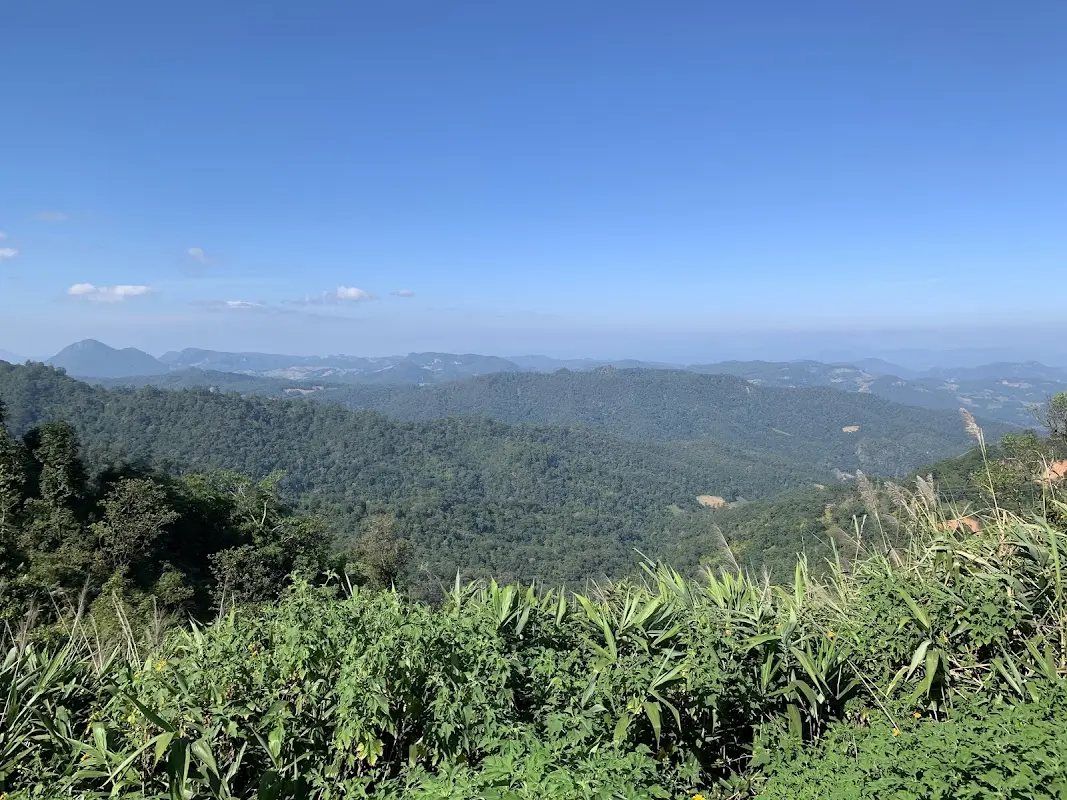
The Mae Hong Son loop is a roughly 600 km long road trip that begins and ends in Chiang Mai and circumnavigates Thailand's westernmost province. The route passes through the hill town of Pai, the lakeside provincial capital of Mae Hong Son near the Myanmar border, and the river town of Mae Sariang. It is famous for its winding roads – there are 762 on the road to Pai alone before reaching Mae Hong Son, and a total of 1,864 – as well as for its limestone caves, Burmese-style temples, a Yunnan tea village, verdant hills, and Thailand's highest mountain.
Most people travel the route on a rented motorcycle, some by car, and the journey takes five to eight days. The best time to travel is between November and February, when the weather is cool, dry, and clear.
Accommodation in Mae Hong Son
This route ends in Mae Hong Son. Search for hotels in Mae Hong Son for your desired travel dates. Filter for hotels with free cancellation if you'd like to book a room and decide later.
Open Booking.com with your travel dates · also on Expedia
Key facts
Approximately 600 km, all from Chiang Mai.
From Chiang Mai to Pai 130 km, from Pai to Mae Hong Son about 107 km, on to Mae Sariang about 162 km and back to Chiang Mai about 196 km, before detours.
Five to eight days
Five people are the minimum to fully enjoy the tour. With six or seven people, there will still be time for Ban Rak Thai and Doi Inthanon. Plan for 120 to 150 km per day.
A 125cc semi-automatic engine is sufficient.
Renting a bicycle in Chiang Mai costs approximately 200–350 baht per day, either upon presentation of a passport or a deposit of around 5,000 baht. Bicycle insurance costs an additional few baht.
Drive legally
You need an international driving permit with motorcycle authorization; otherwise, your travel insurance may not cover you in the event of an accident. Police checkpoints are common in Chiang Mai.
November to February
Cool, dry, and clear. March and April bring heat and haze, and from May to October, rain, slippery roads, and landslides.
Carry cash
There are only a few ATMs between the towns, and you have to pay in cash at the village inns, for fuel and parking fees.
The route and which way is the right one
The circular route follows two main roads. Route 1095 leads northwest from Chiang Mai over the mountains to Pai and on to Mae Hong Son – the most winding section. Route 108 runs south from Mae Hong Son through Khun Yuam and Mae Sariang, then east back to Chiang Mai. The final stretch from Hot is a straight highway. Expect speeds of 30 to 40 km/h in the mountain sections, so the journey takes longer than it looks.
The route can be driven in either direction. The classic route goes counter-clockwise, starting via Pai. You begin on the famous road and end on the well-maintained motorway. Going clockwise, first via Mae Sariang, you get the monotonous motorway out of the way on the first day, reach Doi Inthanon early, and save Pai, a good rest stop, for the end. Many drivers travel both routes, and the scenery is the same in both directions.
A six-day tour around Mae Hong Son
Counter-clockwise. For a five-day trip, skip the rest day in Pai. For a seven- or eight-day trip, plan an overnight stay in Doi Inthanon, a homestay in Ban Ja Bo, or a second night in Mae Sariang.
The best stops along the tour, in the correct order
Counterclockwise from Chiang Mai. Go through the list in reverse if traveling in the other direction.
Mae Hong Son City
Mae Hong Son lies halfway along the tour and is its most tranquil town. This small provincial capital, with approximately 7,000 inhabitants, is nestled in the Shan Mountains on the Pai River and built around a lake. Until the 1890s, it belonged to Shan State, a fact reflected in its Burmese-style temples. Wat Chong Kham and Wat Chong Klang are situated on the lakeshore, while Wat Phra That Doi Kong Mu overlooks the hill above.
Spend two nights here. This will give you the opportunity to travel north to Pang Ung and Ban Rak Thai in the morning, visit the Su Tong Pae Bridge in the afternoon, and enjoy the sunset at Doi Kong Mu. From November to January, the guesthouses are very popular with Thai tourists, so book well in advance for this period.
Rent a bicycle and ride safely
Rent a motorbike in Chiang Mai, where there are dozens of rental shops. A 125cc semi-automatic (with a manual transmission but no clutch) is ideal, as it offers more control and engine braking on long descents than a full automatic. The rental cost is around 200 baht per day for a week. If you prefer not to shift gears, take a 150cc automatic for about 300 baht per day, as a small automatic transmission struggles on steep inclines. Expect to leave your passport or a cash deposit of around 5,000 baht, purchase motorbike insurance, check the brakes and tires before riding, and ask for straps to secure your bag instead of carrying it on your back.
The roads are paved and mostly flat, but steep, narrow, and full of blind curves. The biggest risks are fatigue, excessive speed, and rain. Ride only during the day, wait until the morning fog has lifted in the high valleys, stick to 120 to 150 km per day, and wear a suitable helmet. Legally, you need an international driving permit with motorcycle authorization. Without this, travel insurance will not cover accidents in most cases. If you have never ridden a motorcycle before, this route is not the right place to learn.
By car, bus or plane
For the tour, a car is the most comfortable way to travel and the better choice, especially for families or in rainy weather. Rent a car at Chiang Mai airport or in the city, or book a car with a driver for the entire journey. The roads are the same, so the same rule applies: drive during the day and slowly.
The province can be explored even without your own vehicle. Prem Pracha minivans run several times daily from Chiang Mai to Mae Hong Son, a journey that takes about six hours. Prices range from approximately 340 to 380 baht (via 12Go). Ezy Airlines offers flights between Chiang Mai and Mae Hong Son using a 12-seater turboprop aircraft. The flights take about 50 minutes and cost from around 3,000 baht. A common route involves taking a bus to Pai, then continuing on to Mae Hong Son, and finally flying back.
Bookable departures · updated daily
Chiang Mai → Mae Hong Son: Departure times you can book now
All flights currently bookable via 12Go on this route, sorted by booking class. The prices shown are distributed across the different booking classes; the exact price for a seat and a specific date can be found on the booking page.
bus
12Go timetables and fares are updated daily. Services that operate only locally—regular trains, weekend trips, and ferry terminal tickets—are not listed; these can be found in the table above. Sponsored link: We may receive a commission if you book, at no extra cost to you.
Chiang Mai → Mae Hong Son
Check the vans from Chiang Mai to Mae Hong Son
12Go lists the Prem Pracha minivans and other transport options from Chiang Mai to Mae Hong Son, including timetables and e-tickets if you prefer not to travel. Prices include a booking fee.
Sponsored link – We may receive a small commission if you book, at no extra cost to you. Learn more.
When should you go?
The best time to visit is from November to February: cool, dry, and clear. In January, temperatures in Mae Hong Son drop to around 14°C, and on the mountain peaks, they can fall to near freezing at dawn. Pack a warm jacket. In November and December, the sunflower fields of Doi Mae U Kho are also a popular attraction. January is the busiest month, and room rates are highest.
March and April are hot months, with the province reaching an average temperature of 38.7°C in April and holding the Thai record of 44.6°C. The forest fire season shrouds the valleys in smoke and haze. From May to October, it's the rainy season, with afternoon thunderstorms, wet roads, and landslides in the mountainous regions. Therefore, travel by car or be sure to pack good rain gear.
Is the Mae Hong Son loop worth it?
Yes, if you enjoy the journey as much as the destinations. This tour is one of the most beautiful road trips in Southeast Asia: quiet mountain roads, mist-shrouded valleys, villages of the Shan and hill tribes, and a province that is significantly less visited than Chiang Mai or Pai. The towns themselves are small and tranquil, so the charm lies in the road and the stops along the way.
For nervous drivers, people with limited time, or in rainy weather, this tour is less worthwhile. Five days covering 100 to 200 km of winding mountain roads is strenuous, and those in a hurry will miss the beautiful detours. If time is short, the drive from Chiang Mai to Pai and back is recommended, or taking a van to Pai and Mae Hong Son and then flying home.
Frequently Asked Questions
Frequently asked questions about the Mae Hong Son circular trail.
The route from Chiang Mai and back is approximately 600 km and passes through Pai, Mae Hong Son, and Mae Sariang. With detours, it can be up to 660 km or more. In the mountainous sections, the average speed is 30 to 40 km/h.
A minimum of five people, six to eight are recommended. This allows for a rest day in Pai, two nights in Mae Hong Son for Ban Rak Thai, and a side trip to Doi Inthanon. Plan for 120 to 150 km per day.
Both are possible. The classic route is counter-clockwise, starting in Pai. The clockwise route, starting in Mae Sariang, allows you to tackle the motorway early and save Pai for the end, when you might need a break.
Not if you drive slowly, in daylight, and with some experience. The roads are paved, but steep and winding, and the biggest risks are fatigue, excessive speed, and rain. Novice drivers should therefore practice elsewhere first.
Yes, you need an international driving permit with motorcycle authorization as well as your national driving license. In Chiang Mai, the police will check this, and without it, most travel insurance policies do not cover motorcycle accidents.
Yes. A rental car or a car with a driver covers the same distances more comfortably and is the better choice for families and during the rainy season.
From November to February, the weather is cool, dry, and clear. Sunflower fields bloom in November and December. Avoid March and April due to heat and smoke, and May to October due to rain and landslides.
A rented 125cc semi-automatic motorcycle costs approximately 200–350 baht per day. Additional costs include fuel, accommodation, food, and parking fees, for example, 300 baht in Doi Inthanon and 200 baht in Mae Surin. Bring cash, as there are few ATMs between towns.
Where to stay on Mae Hong Son
Compare current hotel prices in Mae Hong Son for your desired travel dates. Filter for rooms with free cancellation if you'd like to book a room and decide later.
Compare prices on Booking.com
We may receive a commission for bookings made through these links – this will not incur any additional costs for you. Learn more.
You might also like this
Best time to travel to Thailand
The best time to travel is from November to February; the rest of the year is best on the east coast.
Thailand on a budget
Thailand for less money, without sacrificing the best
Is Thailand safe?
What actually poses risks, what is only mentioned in the news, and what do four government advisories say – destination by destination?
Thailand Visa and Entry Requirements
Who is allowed to enter visa-free, what entry controls are in place, what is the TDAC, and how can you extend your stay?
Ethical elephant sanctuaries in Chiang Mai
No riding, no shows, and the protected areas where you watch rather than wash.
I lived in Bangkok for four years and traveled throughout the country from there. The guidebooks reflect my personal opinion and are written as I would explain things to a friend planning a trip.
Ready to create your travel itinerary?
Use our free trip planner to save places, organize days, and share your trip.




Community
Comments 0
Start the conversation.