A travel guide for Lampang
Lampang, a small and peaceful county in the north, is a paradise for culture enthusiasts and anyone who appreciates a slower pace of life. Rich in cultural heritage, Lampang is definitely worth a visit.
Thailand offers numerous travel destinations, but few explore lesser-known provinces like the Eastern Lanna region. The high-altitude area of the legendary Lanna Kingdom, encompassing the provinces of Lampang, Phrae, and Nan, stretches into northeastern Thailand, bordering the remote border with Laos and the ancient city of Luang Prabang to the east. Teak forests, ethnic culture, handicrafts, religious art, and scenic beauty make this part of Thailand a rewarding destination. The Eastern Lanna region offers a chance to escape the hustle and bustle of Chiang Mai and enjoy the tranquility of nature. There are temples and historical sites to discover, delicious food to sample, and a stretch of river to explore.
Arrival
Getting to Lampang is quite easy. There are daily return flights from Don Mueang International Airport and Lampang Airport.
The Northern Railway (Bangkok – Chiang Mai) passes through Lampang. A journey from Bangkok to Lampang (854–1034 Baht, 27.20–32.94 USD) takes 10–12 hours, while the journey from Chiang Mai to Lampang (23 Baht, 0.73 USD) takes about two hours.
Lampang is connected to other parts of northern Thailand and beyond by public bus lines. Most buses stop at Lampang bus station (8 am–12 pm). Many buses also run from Bangkok bus station (Chatuchak) to Lampang (8–9 hours/450 baht, approximately USD 14.33).
locomotion
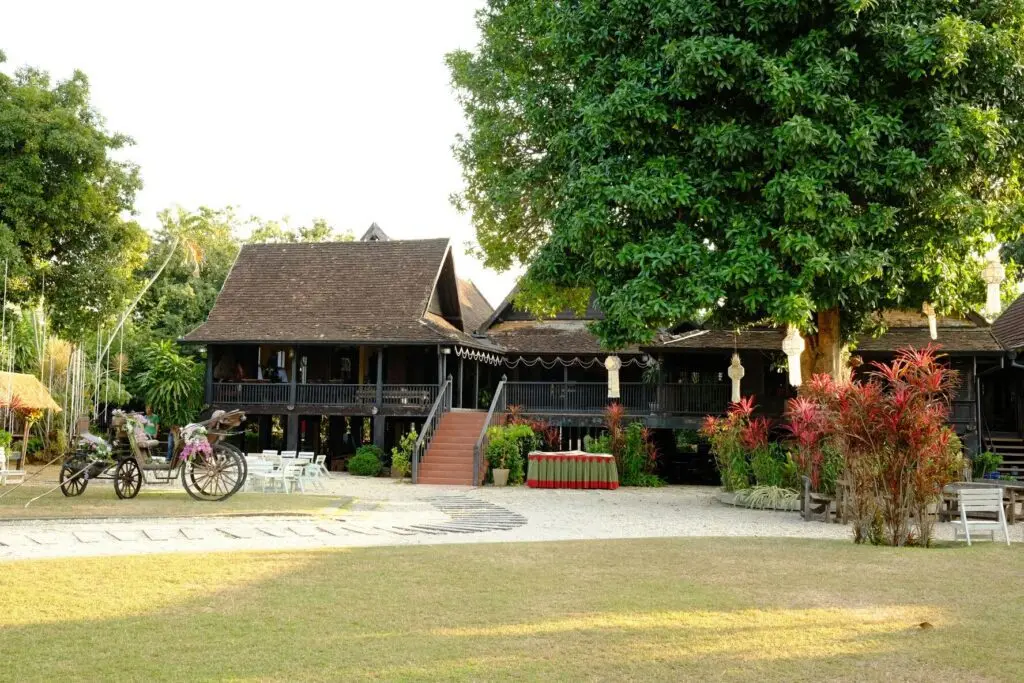
As in other parts of the Thai hinterland, there are no taxis or tuk-tuks in Lampang. Commuters and tourists use horse-drawn carriages, motorcycle taxis, and the green and yellow "songthaew" vehicles, which can be hired similarly to a tuk-tuk.
You can book rental cars at Lampang Airport if you plan to drive in Lampang. You will need a valid driver's license to rent a vehicle.
Things to do in Lampang
In the 19th century, the British were commissioned to export teak from Thailand and brought Burmese people on board to assist them in their business, as some Burmese master lumberjacks had amassed fortunes in the teak industry. They married local women, built magnificent villas, and embraced Buddhism. Baan Sao Nak, meaning "House of Many Pillars," tells the story of the wealth of Lampang's teak barons. Built in 1895 by the wealthy and respected Burmese timber merchant Maung Chan Ong, Baan Sao Nak is distinguished by its 116 square teak pillars. The traditional wooden house served as the family home for decades before being converted into a museum. The entire house is furnished with Burmese and Thai antiques and testifies to the lavish lifestyle in Lampang.
Baan Sao Nak is a 15-minute drive from Nakhon Lampang train station.
5 Radwattana Rd., Mueang Lampang, Lampang
Opening hours: 10:00-17:00
Price: 50 Baht (1.59 USD)
Small but graceful, Wat Lai Hin is the crown jewel of Lampang Province. Built in 1683 by a prince and his entourage from Keng Tung, the small chapel hall with its multi-tiered roofs impressively demonstrates that Lampang's architecture is more elaborate than that of Chiang Mai. The arched entrance, adorned with intricate stucco work depicting small angels and guardians, served as a model for the opening of Wat Phrathat Lampang Luang – the city's holiest pagoda. This beautiful archway significantly influenced the design of the Dhara Dhevi Hotel in Chiang Mai. In front of the chapel hall, a tall column topped with a swan recalls the Burmese influence.
Wat Lai Hin is a 35-minute drive from the city of Lampang.
234 Moo 2 Sala, Ko Kha, Lampang
Opening hours: 8:30–18:00
For history buffs, a visit to Lampang is incomplete without a trip to Wat Phra That Lampang Luang. The climb up the Naga Staircase to the main entrance, whose arched gateway is inspired by Wat Lai Hin, is quite strenuous. The temple itself is worth visiting for its exceptional stucco decorations. Inside the open chapel hall is a bronze Buddha statue called Phra Chao Lan Thong. At the far end of the hall stands a gilded Lanna-style pagoda housing a sacred Buddha relic. The temple boasts beautiful wooden murals, among the oldest in the north. They depict stories from the Jataka epics through representations of snakes, elephants, and Buddha, as well as tales from the Ramayana and some Lanna folktales.
Wat Phra That Lampang Luang is a 25-minute drive from the city of Lampang.
The Thailand Elephant Conservation Center (TECC) is located in the heart of a lush forest reserve between Lampang and Chiang Mai and was founded in 1993. It serves as a retirement home for domesticated Thai elephants and simultaneously as a research and conservation center for Asian elephants. The TECC provides on-site medical care and operates Thailand's first mobile clinic, where elephants in need receive free treatment. In addition to the proper care and well-being of the elephants, the TECC attracts visitors with a diverse range of activities. Those who wish to experience the elephants up close can participate in mahout courses, which last from one day to one month.
The Thailand Elephant Conservation Center is a 30-minute drive from the city of Lampang.
North of Lampang lies Chae Son National Park, renowned for its natural hot springs and breathtaking scenery. The park's nine natural hot springs offer a mesmerizing spectacle in the mornings, as sunlight and steam dance across the water. While the water is too hot for bathing, it's perfect for preparing Onsen Tamago. Visitors place raw eggs in the thermal water until cooked. The eggs, cooked in the sulfurous and mineral-rich water, emit a characteristic sulfurous odor. The egg whites remain soft, while the yolks stay creamy.
In the park, you can enjoy a leisurely stroll along the waterfall trail, relax in the bathhouses with their large pools and private huts, or treat yourself to a traditional Thai massage. There's also a campsite with breathtaking views of the adjacent evergreen forest. Tents and camping equipment are available for rent in the park. The park is also one of the best places for stargazing, should you be interested in this nocturnal activity.
Chae Son National Park is located 72 kilometers north of the city of Lampang.
Entrance fee: 400 Baht (12.74 USD)
Telephone: +6689 851 3355
Stroll through the historic Kad Kong Ta market street and soak up the unique atmosphere of vibrant culture and tradition. Perched high above the Wang River, Kad Kong Ta is a favorite with tourists and locals alike for its shopping and dining options. Founded in the late 19th century, Kad Kong Ta served as a trading hub for Thai, Chinese, Burmese, and European merchants. Old teakwood villas and historic buildings lining both sides of the street bear witness to the time when Lampang was the center of the flourishing teakwood industry. Most of the historic houses have been restored to their former glory. This heritage-rich district has reinvented itself and is now a trendy area with artisan shops and cafes, including Amara Brew & Bistro (+6681 530 8017) and Hug at Home, a restaurant with a small hotel located in the Lampang Art Center. On weekends, the historic lane transforms into a pedestrian zone, attracting artisans, shoppers, designers, and musicians. Also visit the Moung Ngwazin Building, one of Thailand's award-winning gingerbread houses.
It's nearly impossible to get a lunch reservation at Khanom Jeen Pa Boon Sri, a restaurant right next to the historic Rassada Phisek Bridge. The restaurant is famous for its classic northern Thai noodles. For example, they serve a bowl of "Khao Soi," egg noodles with a rich, creamy flavor thanks to a stew of tenderly braised chicken. "Khanom Jeen Nam Ngiaw" is another dish that reflects the Burmese influence on Lampang's cuisine. Thin, fresh noodles are served with a hearty, spicy tomato broth, along with minced meat and ribs. The food here is delicious, and most guests eat more than they can possibly eat.
Khanom Jeen Pa Boon Sri, Talad Gao Road, Mueang Lampang, Lampang
Hidden away on Sanambin Road in the heart of Lampang lies the small Thai restaurant Saengwa, which consistently delights its guests with authentic Thai cuisine. Most of the dishes on the menu are reinterpretations of classic and almost forgotten recipes. Try, for example, "Kaeng Ranjuan"—a sweet and sour red curry with grilled pork (or beef) and aromatic herbs. Also highly recommended are the fried mackerel (served with chili paste and steamed vegetables) and the "Saengwa" prawn salad with lemongrass and kaffir lime dressing. The restaurant also offers classic European dishes such as duck confit with northern Thai chili dip, egg yolk confit, and rice crackers.
Saengwa, 9/3 Sanambin Rd, Hua Wiang, Mueng Lampang
Opening hours: 11:00-22:00
Lampang is famous for its rooster bowl, crafted from high-quality kaolin (white clay). A rooster, the emblem of Lampang, and a ceramic bowl form a perfect pair, making them the ideal souvenir from Lampang. Besides these characteristic rooster bowls, local ceramic artists offer ceramic enthusiasts much more.
The rooster bowl was made in China over a hundred years ago by the Hakka people in Guangdong Province. However, its Thai history only began in 1955 when E. Simyo Saechin, a descendant of the Hakka people, discovered kaolin in Lampang. The Dhanabadee Ceramics Museum is Lampang's most important cultural landmark, as it traces the entire history of Lampang ceramic development in terms of techniques and designs. While watching the ceramic designers at work, the museum's traditional and modern ceramic collections invite you to take a piece home with you.
The Dhanabadee Ceramics Museum (Dhanabadee.com) is about a 15-minute drive from the city of Lampang.
32 Watjongkam Rd, Mueang Lampang, Lampang
Telephone: +6654 821 558-9 Ext. 103
Selected articles about Lampang
Thailand adventures off the beaten track
Sometimes switching off means escaping the hustle and bustle. Many people deal with traffic and crowds in their daily lives...
The best travel destinations for couples in Thailand
Thailand is a travel destination that conjures up images of tropical beaches and delicious food. But there is so much more to discover...
Where in Thailand you should travel depending on your zodiac sign
With so many destinations to choose from in Thailand, deciding on a specific one can be overwhelming. But wouldn't it be...
Do you need travel information?
Discover everything you need to know before your trip – from visa requirements and entry guidelines to essential travel tips and frequently asked questions.




Community
Comments 0
Start the conversation.