Heritage and further development: • Huai Sam Kha reservoir project • Ban Pa Miang health center • Chae Son National Park
Huai Sam Kha Reservoir
Water resource development project for agriculture under the royal initiative
Visit the Huai Sam Kha Reservoir Project, which was operated as part of King Rama IX's Royal Project for the Development of Agricultural Water Resources.
Lifestyle of the Ban Sam Kha – model of the upstream community
The Ban Sam Kha commune borders the Mae Chang National Protected Forest, a watershed forest consisting mainly of plateaus and mountains.
The village lies in the lower part of the forest. It is a flat area suitable for agriculture and community-based tourism.
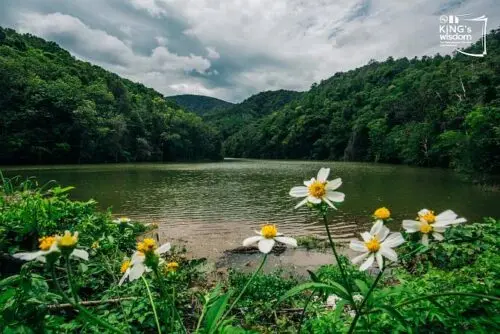
The pool is about 700–800 meters long, the boardwalk about 1–2 kilometers. The water is crystal clear, and various herbs and trees such as Ya Ka Sang, teak, Pradu, and Mai Daeng grow along the path.
Development plan Ban Sam Kha
Previously, the village of Ban Sam Kha struggled with debt and water scarcity. Visionaries like Mr. Boonruen Thao Kham developed a development plan for the village, and teacher Sri Nuan Wongtrakul designed the curriculum for the primary schools. This curriculum, entitled "Huay Sam Kha: Hed Pa Na Khao," emphasizes practical learning based on the village's real-world problems.
Thanks to a water management plan, a wildfire prevention campaign, and the construction of weirs, the community of Ban Sam Kha has a year-round supply of usable water, which encourages the settlement of more and more wildlife in the region. This, in turn, provides locals with additional income through the harvesting of forest products. There are currently over 10,998 weirs in the forest area.
Settlement and ethnicity – Ban Sam Kha community
Hua Suea Subdistrict, Mae Tha District, Lampang Province
The Sam Kha are descended from the Lua, who migrated from Ban Lao Nong Pong and Ban Phrabat Nong Moo. The Lua settled in the forest and founded a village called "Ban Mae Yuak," named after a banana field. Later, the village was flooded, forcing the inhabitants to evacuate again and retreat to the eastern foothills of the mountains.
The name "Ban Sam Kha" comes from a legend about a villager who went hunting one day. He killed a muntjac but couldn't drag it back. So, he cut off one of its hind legs with a knife and brought it with him. The next morning, the muntjac was gone, because a large snake had dragged the rest of the carcass into the cave (the present-day location of Ban Sam Kha). The villagers killed a dog and used it as bait to lure the snake. The end of the rope was tied to a tree at the cave entrance.
The next day they managed to catch the snake. It was dragged out of the cave, and the snake meat was distributed to all the villagers, except for the widow, since she had not helped drag the snake out.
As night fell, an angel appeared to her in the form of an old man and came up the stairs. He said to her, "If you hear anything tonight, do not leave the house, for it could be dangerous." The widow was startled by the sound of a landslide. She went outside to see what had happened, but found only emptiness; all the houses had vanished. Afterward, she went to the Buddha image to pay her respects.
In the morning, the widow left the house and saw the village collapse. She then moved into a cave in the north. This cave was later called Tham-Ya-Gek Cave, and the area where the village had collapsed was named Pong Lom.
Later, there were no more banana plants in Ban Mae Yuak because the forest had been destroyed. Therefore, according to the legend of the three-legged barking deer, the name was changed to "Ban Sam Kha." In this case, Sam Kha represents Buddha, Dharma, and Sangha.
Ban Pa Miang Tea Cushion Group
Community Health Center
On this trip we will visit an ecological tourist attraction in the Chae Son subdistrict, Mueang Pan district, the Ban Pa Miang Community Health Learning Centre, where visitors can experience firsthand the way of life of the people of Ban Pa Miang.
Furthermore, the Ban Pa Miang community offers many other attractive products, including cute tea leaf pillows and deodorant dolls made from real tea leaves. These products are said to support the respiratory system and reduce stress.
Ban Pa Miang is rich in resources. The climate is cool year-round. Miang trees thrive in the shade of larger trees across an area of 300 to 1000 meters. Young leaves are suitable as a snack, while older leaves can be used as pillows. Due to their stress-relieving and odor-neutralizing properties, they are a popular souvenir.
Furthermore, this community lies within a protected water forest. Arabica coffee is considered an important crop for the community and is cultivated without the use of chemical substances. Ban Pa Miang now offers homestays, allowing tourists to experience the community's way of life.
The Ban Pa Miang community consists of a variety of groups, namely tea pillows, host families, folk music groups, herb gathering groups, and processed coffee production groups.
Chae Son National Park
Before heading home, we'll visit Chae Son National Park. There you'll find many beautiful natural wonders, such as waterfalls, hot pools, and thermal springs. Have fun boiling eggs in the hot springs and bathing in the pools!




Community
Comments 0
Start the conversation.