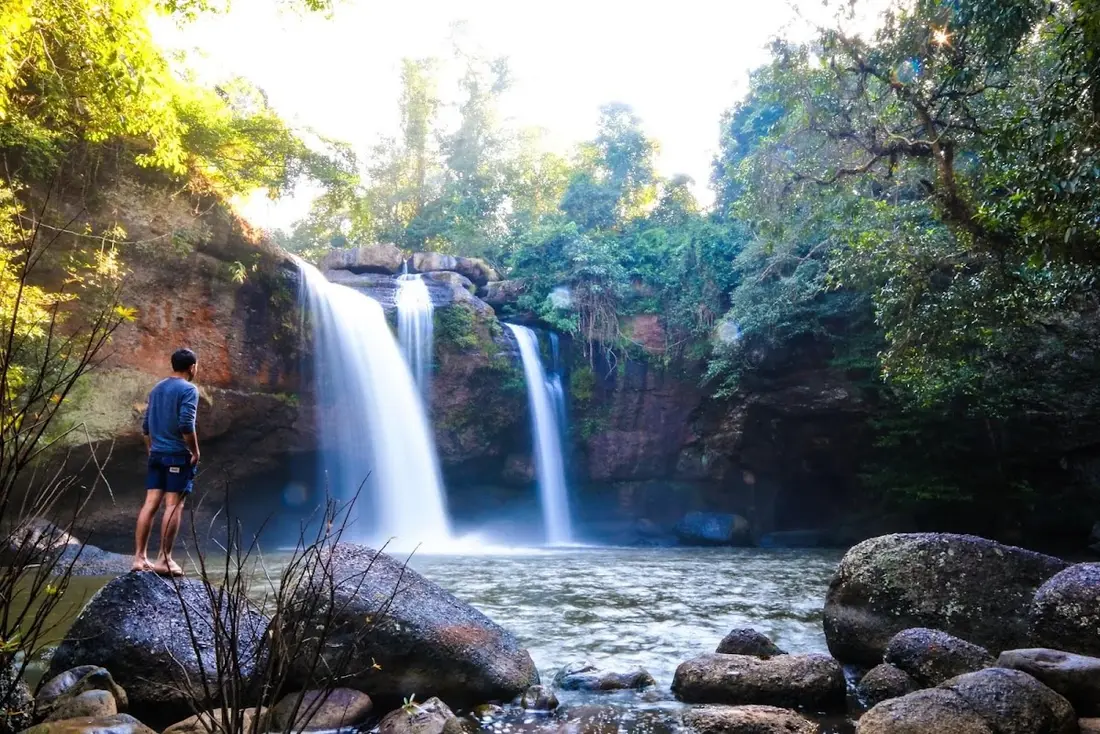
Khao Yai National Park covers 2,166 km² of forest and grassland and is located about a three-hour drive northeast of Bangkok. Thailand's first national park, it opened in 1962 and is part of a UNESCO World Heritage forest complex. Here, wildlife is most easily observed without a guide. Elephants wander along the main road, deer graze in the campground, and hornbills circle the visitor center almost daily.
Pak Chong is the gateway to the park, and the road leading into the park, Thanarat Road, is lined with resorts, wineries, and cafes. Floods in late September 2026 destroyed the bridge to Haew Narok Waterfall and the road up to Khao Khiao, so check which attractions are open before your trip. All other attractions have been open again since October 6th.
Where to stay in Khao Yai
This route ends in Khao Yai. Search for hotels in Khao Yai for your desired travel dates. Filter for hotels with free cancellation if you'd like to book a room and decide later.
Open Booking.com with your travel dates · also on Expedia
Key facts
Foreign adults pay 400 baht, cars 30 baht.
Children pay 200 baht, motorcycles 20 baht. A day ticket allows entry and exit on the same day; campers and guests of the park lodges receive a three-day ticket.
The gates are open from 6:00 AM to 6:00 PM.
The visitor center reception is staffed from 8:30 am to 4:30 pm. Driving in the park after dark for wildlife viewing is prohibited, therefore the night safari is the only way to get out at night.
Haew Narok and Khao Khiao Street are closed.
A flash flood on September 26, 2026, destroyed the bridge to the Haew Narok viewpoint. Pha Diao Dai, Pha Trom Jai, and the entire Khao Khiao road remained closed when the rest of the park reopened on October 6.
The night safari costs 600 baht per truck.
Ranger-led tours are offered at 7:00 PM or 8:00 PM for up to eight people for one hour. Booking and payment are made at the visitor center before 6:00 PM on the day of the tour.
You need a bike in the park.
Songthaews from Pak Chong stop at the north gate; the visitor center is another 14 km away. Transportation options include a car, a scooter, a driver, or a tour.
Two nights is the right length
A day trip from Bangkok takes eleven hours, six of which are spent in a minibus. Two overnight stays allow you to experience a sunrise in the park, a night safari, and a relaxing morning at the observation tower.
Is Khao Yai worth a visit?
Yes, and I would choose it over any other national park within day-trip distance of Bangkok. The reason is the wildlife. Wild elephants are so frequently spotted on the roads and grasslands that rangers stop traffic for them. The park is home to one of Thailand's largest hornbill populations, with hornbills and white hornbills seen almost daily above the visitor center, and gibbons call from the forest along every road. You don't have to go on long hikes. Most of the attractions are within easy walking distance of the parking lot.
Be prepared for two things: The park is accessible by car. Without a car, scooter, or tour, you'll spend more time organizing transportation than observing the animals. And the surroundings aren't pristine nature. Thanarat Road, from Pak Chong to the entrance, is a weekend destination lined with resorts, theme parks, farms, and cafes, built specifically for Bangkok drivers. While it's pleasant to stop for a coffee, it's rather unbearable during Saturday rush hour.
What will be closed in Khao Yai after the 2026 floods?
Heavy rainfall beginning on September 25, 2026, led to flash floods in the park, and on the night of September 26, the water swept away the entire bridge to the Haew Narok viewpoint. The park was subsequently closed to visitors and overnight stays, reopening most attractions and campsites on October 6.
At the time of writing, Haew Narok Waterfall, Pha Diao Dai and Pha Trom Jai viewpoints, Kaeng Hin Phoeng, and the entire length of Khao Khiao Road remain closed due to landslides. Pha Diao Dai and the Khao Khiao viewpoints are also closed annually from June 1st to September 30th. Check the park's Facebook page or call the visitor center at +234 86 092 6529 before your visit.
Entrance fees and prices for Khao Yai
Please refer to the park's website for fees (entrance and camping). Night safari prices can be found on the park's website, and lodge prices on the Thai National Parks website (as of June 2026). Thai National Parks lists camping at 80 Baht per night, so please bring some extra cash.
The best things to do in Khao Yai
The list is ordered according to how important each place would be to me during a first two-night visit. The first seven are located in the park, the last two on the way there.
The wildlife of Khao Yai and your chances
Deer are almost guaranteed to be seen at the campsite, the observation tower, and on the night safari. Hornbills are almost certainly spotted around the visitor center. Gibbons can be heard long before you see them if you have the windows down. Elephants are seen more by chance; they are occasionally sighted on the roads and grasslands near the tower, often enough that rangers stop traffic to let them pass.
There are no tigers to be found here. None have been sighted for years, although camera traps have recorded them in the neighboring areas of Thap Lan and Pang Sida. Haew Narok, on the other hand, has a sad elephant history. Eight elephants plunged over the falls in 1992, and eleven more in October 2019 – hence the name "Elephant Graveyard."
Khao Yai as a day trip from Bangkok
If you only have one day, a tour is the best option, as the park is a three-hour drive each way and there is no transport within the park itself. Small-group tours depart from Bangkok around 7:00 AM, travel via Kilometer 33 to Nong Phak Chi, stop at Haew Suwat and at the deer sanctuary in Lam Ta Khong, and return to the city approximately eleven hours later. However, you will miss the morning and night safaris, which are among the most memorable experiences. Therefore, if possible, try to include a night safari in your itinerary.
From Pak Chong, the Greenleaf Guesthouse offers its own full-day tour of the park by songthaew for 1,500 baht in cash, and Thai National Parks lists guided tours of one to four days for 1,800 to 6,200 baht per person.
How many days does it take to stay in Khao Yai?
Two nights' accommodation. Arrival in the afternoon, check-in and booking of the night safari at the visitor center before 6:00 PM. The next morning, a sunrise hike to Nong Phak Chi Tower is planned, followed by a guided walk to Haew Suwat and sunset at Sai Sorn. On the final morning, you can either climb the tower again or stop at a winery on your return journey to Bangkok.
Overnight stays are possible if you have a car. A day trip is only possible as part of a guided tour.
If you are arriving by car, stay overnight on Thanarat Road, the road from Pak Chong to the park entrance. The resorts there are the closest accommodations outside the park. If you are arriving by train or bus, stay overnight in Pak Chong. Stay overnight in the park, either at a campsite or in a park lodge, to experience the sunrise.
Camping and overnight stays in the park
Lam Ta Khong is the main campsite, a meadow by the stream with toilets, showers, electricity hookups, and a café. Everything from tents to pillows can be rented there. A three-person tent costs 225 baht per night, a sleeping bag 30 baht, and the camping fee is also 30 baht per person. Reservations can be made 60 days in advance for up to three nights. If there are still spaces available, you can also simply arrive and pay at the campsite office. On holiday weekends, the alternative campsite in Khao Rom is also open.
The park also offers lodges starting at 800 baht for two people. Online bookings are unreliable, so it's recommended to call the park or inquire at the visitor center.
Getting to Khao Yai and getting around locally
Khao Yai is located approximately 180 km northeast of Bangkok. The resorts on Thanarat Road can be reached by car in about two and a half hours. Private rides from Bangkok to the park are offered on 12Go starting at around 2,050 baht. Trains from Krung Thep Aphiwat, as well as vans and buses from Mo Chit, run to Pak Chong (approximately two and a half to three and a half hours). All options, including travel times and prices, can be found in my travel guide "From Bangkok to Khao Yai".
From Pak Chong, songthaews and a park bus (15 baht) run to the north gate of Chao Por Khao Yai Shrine during the day. However, the visitor center is another 14 km away and not accessible on foot. In Pak Chong, you can rent a scooter for about 300 baht per day; at the gate, it costs 600 baht. It's even more convenient to rent a car or have a hotel driver take you. A scooter is a good way to explore the park independently, provided you're used to driving.
When should you go?
The best time to travel is from November to February. It's dry and cool, with daytime temperatures around 22°C and nighttime lows of 9–10°C. Bring a jacket for your night safari. It's best to book campsites and resorts for weekends well in advance.
The rainy season lasts from May to October, with September being the wettest month. The forest is lush and green, and the waterfalls are particularly high in volume. However, the hiking trails are muddy, the viewpoints in Khao Khiao National Park are closed from June to September, and in 2026, flooding at the end of September led to a park closure of more than a week. March and April are hot but ideal for birdwatching, as this is when migratory birds pass through.
Plan the rest of your trip.
Frequently Asked Questions
Frequently asked questions about the Khao Yai National Park travel guide.
Yes. It's the easiest place in Thailand to spot wildlife on your own: deer at the campsite, hornbills above the visitor center, and with a bit of luck, even wild elephants on the road – all about three hours from Bangkok.
400 Baht for foreign adults and 200 Baht for children under 14, plus 30 Baht for a car or 20 Baht for a motorcycle. The ticket is valid for one day. Campers and guests of the park lodges receive a three-day ticket.
Mostly. The park reopened on October 6, 2026, following the floods at the end of September; however, Haew Narok Waterfall, Pha Diao Dai and Pha Trom Jai viewpoints, Kaeng Hin Phoeng, and Khao Khiao Road remained closed. Please check the park's Facebook page or call 086-092-6529 before your visit.
Not that anyone has seen them for years. Camera traps have recorded tigers in the neighboring Thap Lan and Pang Sida national parks, but in Khao Yai, people are more likely to be looking for elephants, gaur, deer, gibbons, and hornbills.
From November to February, the weather is dry and cool with daytime temperatures around 22°C and nighttime temperatures of 9–10°C. September is the wettest month, and some viewpoints are closed from June to September.
Tickets are available at the visitor center before 6:00 PM. The ride costs 600 baht per vehicle (up to eight people) and takes place at 7:00 PM and 8:00 PM for approximately one hour. Driving your own car in the park at night is not permitted.
No. Swimming is prohibited at all waterfalls in the park, and the current at Haew Suwat is dangerous during the rainy season.
Yes, but plan it well. Take the train, minibus, or bus to Pak Chong and rent a scooter there, book a driver through your hotel, or join a tour from a guesthouse in Pak Chong. Public songthaews stop at the North Gate, 14 km before the visitor center.
A two-night stay allows you one evening for the night safari, a full day for the tower, Haew Suwat, and a hike, as well as a second sunrise. A day trip from Bangkok is possible as part of a tour, but takes approximately 11 hours.
Where to stay overnight on Khao Yai
Compare current hotel prices in Khao Yai for your desired travel dates. Filter for rooms with free cancellation if you'd like to book a room and decide later.
Compare prices on Booking.com
We may receive a commission for bookings made through these links – this will not incur any additional costs for you. Learn more.
You might also like this
Wellness retreats in Thailand, all types sorted by destination and cost
From forest monastery retreats accessible by donation to Asia's most awarded wellness havens, Thailand offers the perfect getaway for every need. Choose the right one for you, depending on your goals and budget.
Meditation retreats in Thailand: From monasteries and silent retreats to 3-day programs
A forest monastery that demands nothing, a ten-day silence that demands everything, and the three-day variations in between.
Bangkok travel guide
A city with three zones and a river – once you understand the structure, everything else falls into place.
Chiang Mai City Guide
A walled square, a mountain, and the best value for money for good living in Thailand – if you know the calendar.
Best time to travel to Thailand
The best time to travel is from November to February; the rest of the year is best on the east coast.
I lived in Bangkok for four years and traveled throughout the country from there. The guidebooks reflect my personal opinion and are written as I would explain things to a friend planning a trip.
Ready to create your travel itinerary?
Use our free trip planner to save places, organize days, and share your trip.
Community
Comments 0
Start the conversation.