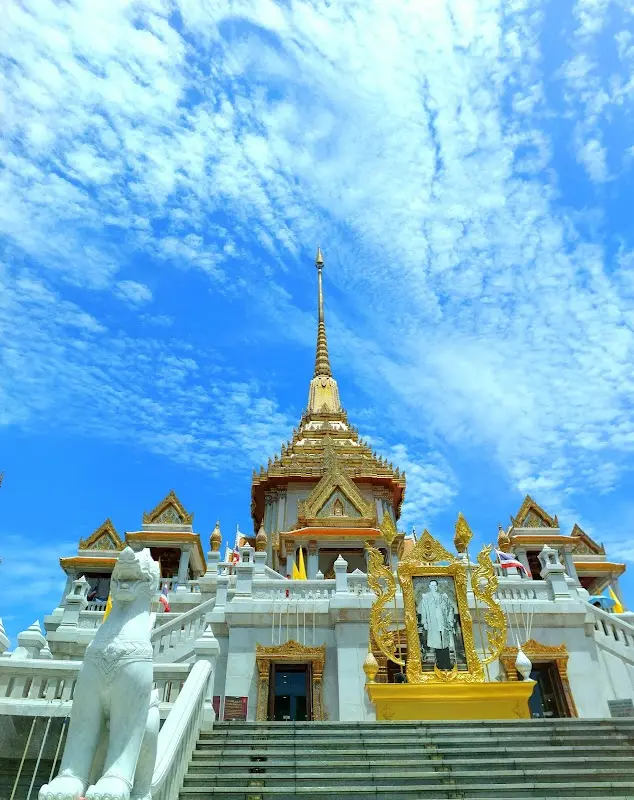
Why should you go there and how do you do it right?
Visit the Buddha and read its story before you climb. Phra Phuttha Maha Suwanna Patimakon is a Sukhothai-style seated Buddha, about three meters tall and made of five and a half tons of gold. For roughly two centuries, no one knew about it. It was covered in plaster and colored glass, presumably to conceal it before the fall of Ayutthaya in 1767. It stood unnoticed in Bangkok until a relocation took place in May 1955. During the move, the ropes broke, it toppled over, and the plaster cracked, revealing the gold beneath. That's the difference between admiring a large gold statue and understanding why people cross the city to see it.
Since 2010, the statue has been located on the fourth and top floor of the Phra Maha Mondop, the white and gold hall at the end of Yaowarat Road near Odeon Circle. Below are two floors of exhibits: the Yaowarat Chinatown Heritage Center on the second floor and the history of the statue on the third. Those interested in the history should set aside an hour, but it can be skipped if time is short. The building itself is modern and well-maintained and is used as a place of worship. Please speak quietly and allow others to pray.
Recent visitors report a fee of 100 baht for the Buddha floor and another 100 baht for the exhibitions; Thai citizens enter free. Older guidebooks mention 40 baht, but this is no longer accurate. The complex is open daily from 8:00 AM to 5:00 PM, but the exhibitions are closed on Mondays. If you want to see both, visit on a different day. There is both an elevator and stairs.
The Hua Lamphong MRT station is the closest, about a five-minute walk from Exit 1 on Mittraphap Thai-Chin Road. The gate to Chinatown is right in front of it. Please cover your shoulders and knees and remove your shoes in the entrance hall. As the gate closes at 5:00 PM, it's an ideal day trip to Chinatown before the yaowarat food stalls open in the evening.
Community
Comments 0
Start the conversation.