Why should you go there and how do you do it right?
You look, take photos, and move on. That's what a visit to the Sao Ching Cha looks like, that scarlet teak scaffold that rises 21 meters above the square in front of Wat Suthat. It was built in 1784, two years after the founding of Bangkok, for the Triyampawai, a Brahmanic ceremony in which men swung in high arcs to grasp a bag of money attached to a pole. Accidents, some fatal, ended the swinging in the mid-1930s. The ritual itself continues quietly at the nearby Brahmanic temple Bot Phram.
The visible framework is not the original. The columns have been replaced several times, most recently in 2006 with six teak logs from Phrae Province. King Bhumibol rededicated the structure in 2007. The original beams are housed in the National Museum. It has been listed as a monument by the Ministry of Fine Arts since 1949.
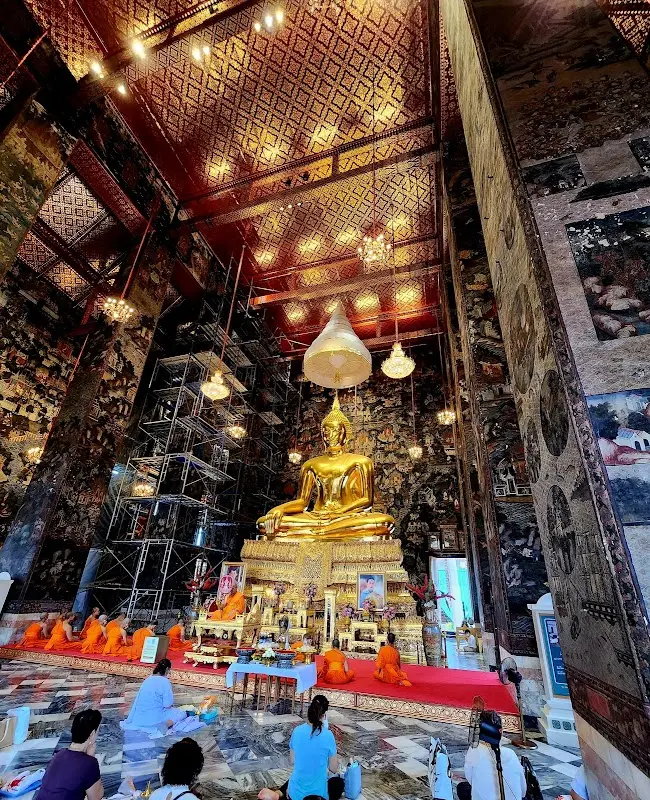
Don't visit the swing alone. Wat Suthat is right behind it, so it's worth combining the two. The swing is free and can be seen at any time, but it stands on a raised platform in the middle of traffic. It's meant to be admired from the square rather than touched. Bamrung Mueang Road, which flanks the swing, is lined with shops selling Buddha statues and monks' supplies. The Democracy Monument is about 550 meters to the north.




Community
Comments 0
Start the conversation.