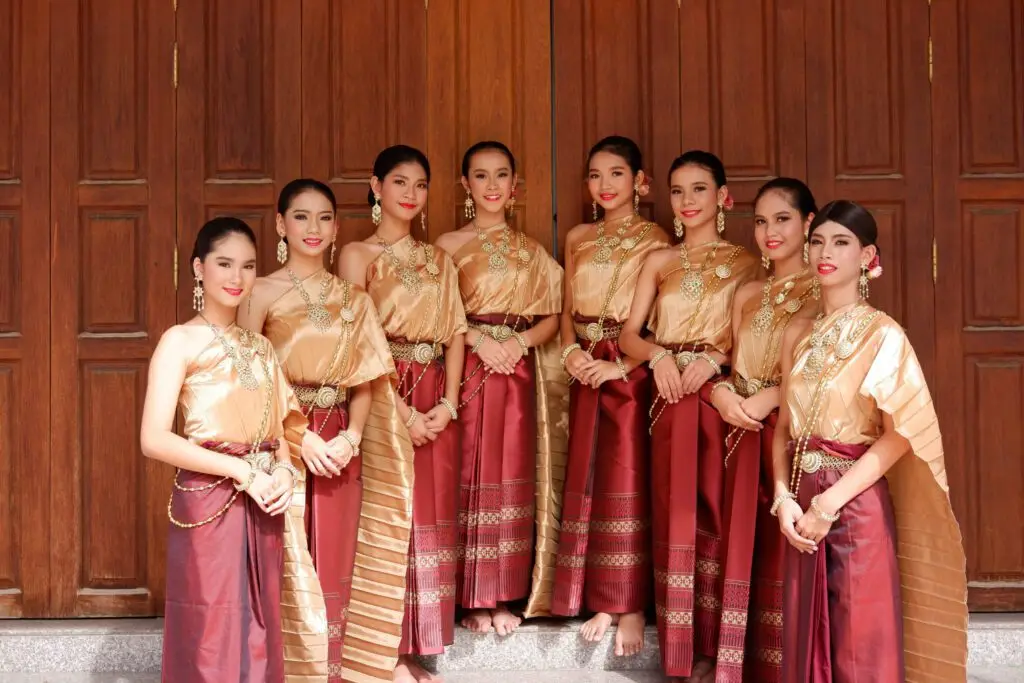
Today is National Dress Day, and so we'd like to showcase the beautiful traditional clothing of Thailand! While there isn't an official national dress code, the colorful and culturally diverse Thai clothing is widespread and frequently worn to festivals and celebrations. Men, women, and children wear this form of Thai fashion, with different outfits being customary for different occasions.
History of traditional Thai clothing
From the 6th to the 13th century, under the rule of the Dvaravati kingdom, Thai clothing was heavily influenced by India. Loincloths, gold chains, and metal belts were among the stylistic elements that shaped fashion in Thailand.
Traditional Thai clothing by region
The Ayutthaya era has shaped the fashion of central Thailand for almost 200 years. The most popular style among women is the ankle-length tube skirt. Older generations of women, however, wear the traditional "Jong Krabane," a skirt made of handwoven cotton that is gathered, rolled, and tied between the legs.
The tribal groups of Thai-Lue, Thai Kern, and Thai Yai continue to significantly influence the fashion of northern Thailand. Their styles include indigo-dyed blouses with side button plackets and ankle-length tube skirts. For formal occasions, the tube skirts are designed to be more elegant, with colorful woven patterns down the center and decorated hems.
In southern Thailand, men and women wear colorful sarongs with batik patterns. Women combine their sarongs with loose-fitting lace blouses worn over them, open at the front. The Malaysian "yaya" style influences this popular look. According to Muslim regulations, women also wear a scarf to cover their head and shoulders.
Types of traditional Thai clothing
Chong Kben
Both men and women wear the Chong Kben, a silk wrap-around garment originating in Cambodia that covers the lower body. This trouser-like garment resembles wide breeches and is fastened between the legs. From 1350 to 1767, the Chong Kben was worn by men with their torsos bare and barefoot—an acceptable formal style of dress.
Sinh
Thai women often wear a floor-length "pha sinh," a tubular skirt that wraps around the waist and is usually made of Thai silk. Pha sinhs come in many colors with contrasting ribbons at the hem, combined with long-sleeved silk blouses.
Sabai
A sabai, an elegant, scarf-like garment worn by women, covers only one shoulder, is wrapped around the torso, and reaches to the floor. Traditionally, it can be worn alone; however, nowadays it is common to wear a garment underneath.
Women in traditional dress at Wat Putt Thai Sawan, Ayutthaya Province, Thailand | Thailand Insider
Before the 1960s, there was no traditional dress for formal occasions in Thailand. In 1964, Queen Sirikit designed the traditional Thai dress, Chut Thai (Thai outfit). Her Majesty wanted to create a modern national dress for formal events and gatherings. This charming traditional dress is colorful, elegant, and understated, and is worn to the most festive occasions, including weddings, festivals, and other special events.
There are various types of Chut Thai dresses, all impeccably designed and unique in style, pattern, garment and accessories.
Types of Chut Thai dresses
Ruean Ton
The Ruean Ton, a casual garment, is often worn to informal occasions such as religious ceremonies. It consists of a tubular silk skirt with a striped or solid-colored surface and embroidery at the hem. It is worn with a collarless blouse featuring a button placket and elbow sleeves. The Ruean Ton is a two-piece outfit; the blouse and skirt are separate.
Chakkri
As one of Thailand's most famous and elegant traditional dresses, the Chakkri boasts a splendor befitting any festive occasion. The outfit consists of a long, strapless skirt with two front pleats and a sabai. A sabai is a silk top that is draped over the shoulders and extends to the floor on one side.
The fabric for the Sinh is produced using a traditional weaving technique called yoke weaving, which creates a thicker fabric. This special technique generates extra thickness without the use of additional threads. In some cases, artisans weave in fine gold or silver threads to give the fabric an elegant finish.
Siwalai
For formal evening events such as royal ceremonies or receptions, the Siwalai is worn. This Thai dress is a one-piece garment consisting of two pieces sewn together: a long, tubular skirt with two front pleats and a blouse with buttons down the front and elbow-length sleeves. A Sabai, draped over the shoulder, completes the formal look.
Traditional clothing in Thailand for men
In Thailand, there are many different traditional costumes for men. However, the formal costume is the Suea Phraratchathan. This traditional Thai garment was designed in 1979 and is characterized by a button placket at the front, a long collar, and sleeves of varying lengths. For formal occasions, men wear long sleeves and a sash. The Phraratchathan is usually worn with Western-style dress trousers.
Thai dresses today
In 2003, Her Majesty Queen Sirikit, the Queen Mother, revitalized the Thai fashion industry with the opening of the Queen Sirikit Textile Museum in Bangkok. Located within the grounds of the Grand Palace, the museum showcases an impressive collection of Her Majesty's most prized textiles, as well as handcrafted works by Thai artisans. Don't miss the opportunity to explore this historic museum during your visit to Bangkok!
Fashion in Thailand has changed over the years, but traditional Thai clothing is still seen at festive occasions and celebrations. Thanks to weaving techniques, Thailand's various ethnic groups create beautiful garments with diverse colors, patterns, and designs.
Thai clothing is easy to find throughout Thailand. Weekend markets like Chatuchak and the Sunday pedestrian zones in Phuket and Chiang Mai are particularly popular. However, if you're only staying in Bangkok and are looking for a wider selection or something more exclusive, the Old Siam Shopping Plaza is the place to go. Located in Bangkok's old town, the mall is complemented by vendors selling fabrics and ready-made clothing. It's a true paradise for traditional Thai clothing and much more!




Community
Comments 0
Start the conversation.