The capital and most populous city of the Kingdom of Thailand
Everything you need to know about the areas of Bangkok
With an area of 1,500 square kilometers, the Bangkok metropolitan area is undoubtedly one of the world's major cities. Add to that an estimated ten million inhabitants, over 30,000 taxis, and a constantly growing number of tourists. It quickly becomes clear that navigating this vast urban jungle isn't always easy – especially for first-time visitors. That's where our area guides come in… Some neighborhoods are more popular than others, mainly due to their convenient locations and diverse activities and attractions – from traditional sites and shopping highlights to the legendary nightlife. Thanks to the Skytrain (BTS) and the subway (MRT), which connect large areas, getting around this exciting city has become significantly easier. Get to know Bangkok a little better before your trip.
Thailand's longest street, Soi 4, and its many adjoining alleyways (sois), may lack traditional tourist attractions, but they offer a wealth of cutting-edge shopping, dining, and nightlife options. The numerous chic restaurants, bars, air-conditioned shopping malls, luxury hotels, and trendy clubs give the area a modern, cosmopolitan feel. It's also home to some of the city's most notorious red-light districts, such as Nana Plaza (Soi 4) and Soi Cowboy (off Soi 23). And in the charming cafes, atmospheric restaurants, and luxurious spas tucked away in many of the sois, you'll find little oases of peace and relaxation. Thanks to the BTS Skytrain, which runs through almost the entire city center, exploring this impressive street is effortless.
Silom is undoubtedly one of the city's most important financial districts, home to numerous bank headquarters, financial institutions, and office buildings. The area also boasts an abundance of upscale hotels, smaller shopping malls, and excellent restaurants—not to mention the famous Patpong nightlife. Bangkok's two most modern public transport systems—the Skytrain (BTS) and the subway—both connect to Silom, which is also easily accessible via the pedestrian walkway between the Silom and Sala Daeng MRT stations. Siam, Chidlom, Ploenchit, Sathorn, and the riverfront are just a few BTS stops away.
Siam is undoubtedly Bangkok's shopping hub, home to some of the city's most popular and important shopping centers, including MBK Center, Siam Discovery Center, Siam Center, and Siam Paragon. Siam Square alone offers a wide variety of shops and services, including restaurants, cafes, designer boutiques, record stores, cinemas, bookstores, a Hard Rock Cafe, hotels, and banks. Its clientele ranges from school and university students to office workers, trend-conscious locals, and countless tourists.
Bangkok originated around 200 years ago as a small trading center and port city on the west bank of the Chao Phraya River. Today, although the city keeps pace with modernity, the splendor and magnificence of its glorious past are still palpable. Whether magnificent temples, spectacular palaces, a world-famous floating market, or the colorful Chinatown – each of these places has a fascinating story to tell.
>>IT PLAN<<
Bangkok BTS Explore Bangkok with the Skytrain (BTS).
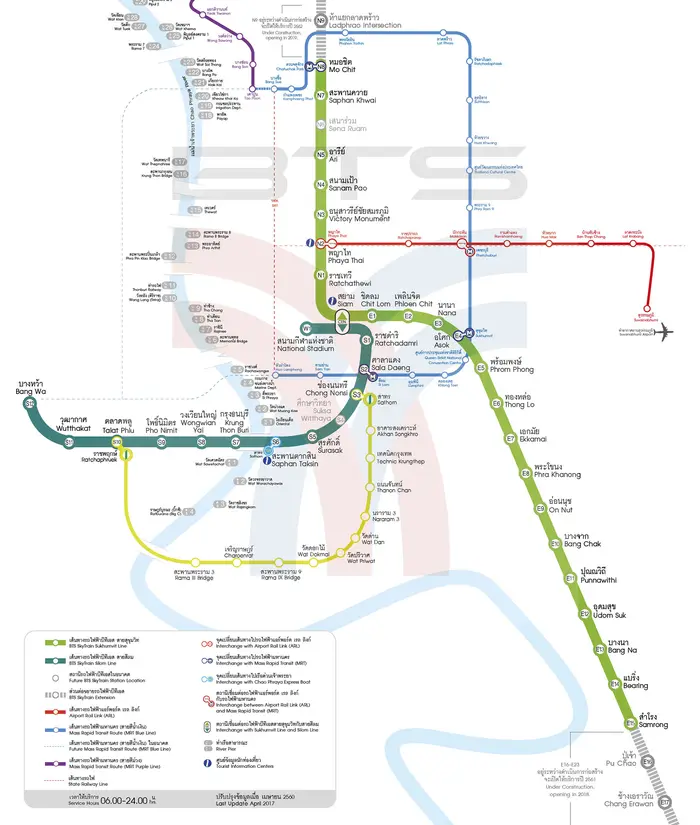
This Bangkok BTS route guide is designed to help you discover all the interesting sights and activities around each station, so you can make the most of your BTS Hopper experience in Bangkok.
The SILOM LINE runs from west to south, between the National Stadium in the Siam Shopping Centre and Bang Wa in Thonburi (beyond the Chao Phraya River).
The Sukhumvit Line runs northeast from Mo Chit to Bearing. The two lines meet at Siam Station and also connect to the MRT at two points: Sala Daeng Station (Silom Line) and Asok Station (Sukhumvit Line). Trains depart approximately every 3–6 minutes between 6:30 a.m. and midnight. The last train departs between 11:30 p.m. and 11:50 p.m. Fares start at 15 baht per station (more information on BTS passes).
Please note that trains can get quite crowded during peak hours (07:00 – 09:00 and 16:00 – 19:00) as the BTS has become the preferred means of transport for people who live and work in Bangkok.
Bangkok MRT (Subway) Bangkok Subway - Mass Rapid Transit
The fast and efficient Mass Rapid Transit (MRT) network serves 18 stations and stretches over 20 km in a horseshoe shape from Hua Lamphong in the south (near Chinatown) to Bang Sue in the north. Trains run every 5–7 minutes and connect to the BTS Skytrain stations Sukhumvit and Silom.
Particularly interesting stations for visitors are Kampaengphet (Chatuchak Weekend Market, Or Tor Kor Market, and Rod Fai Market), Sukhumvit (Asok BTS Skytrain), Silom (Saladaeng BTS Skytrain, Pat Pong Night Market, and Lumpini Park), and Hua Lamphong (Chinatown and Main Train Station). Petchaburi Station is about 300 meters from the Makkasan Airport Rail Link interchange station, from where you can take the express train to Suvarnabhumi International Airport.
Bangkok MRT network: The Bangkok MRT subway line runs beneath Rama IV Road and Ratchadapisek Road, the two main thoroughfares that cut through the heart of downtown Bangkok. Although further lines and extensions are planned, the network currently consists only of the 18-station Blue Line between Hua Lamphong and Bang Sue. Trains run every five minutes during peak hours (7:00–9:00 and 16:00–19:00) and every seven minutes outside of these times.
The MRT subway runs from 6:00 AM to midnight. Parking is available at seven stations: Sam Yan, Sukhumvit, Phetchaburi, Thailand Cultural Centre, Huai Khwang, Ratchadaphisek, and Kamphaeng Phet. All stations are wheelchair accessible (elevators). To go to Lumpini Park, do not get off at Lumpini Station, but at Silom Station. To go to Central Lad Phrao, do not get off at Lad Phrao Station, but at Phaholyothin Station. To go to Chatuchak Market, do not get off at Chatuchak Park Station, but at Kamphaeng Phet Station. To go to the Thailand Cultural Centre, you will need to take a taxi from the station. The Thailand Cultural Centre is a considerable distance from Thailand Cultural Centre Station. MRT prepaid cards are not compatible with the BTS Skytrain or the Airport Rail Link. You must purchase tickets separately.
Bangkok Airport Link, Suvarnabhumi Airport, train transfers to Bangkok city
The Bangkok Airport Rail Link (6:00 AM–12:00 AM) connects downtown Bangkok with Suvarnabhumi International Airport and is a convenient alternative to the airport's express buses and taxis. The City Line makes six stops between downtown (Phayathai Station) and the airport, with each journey taking 30 minutes. This makes the Airport Rail Link a fast and convenient way to travel to and from Bangkok. You can connect to the MRT at Makkasan City Interchange (Petchaburi MRT Station) and to the BTS Skytrain at Phayathai Station. Please note that baggage check-in is no longer available at Makkasan Station. Access to the Airport Rail Link is on the first floor of Suvarnabhumi Airport.
Route guide for the airport rail connection
The Airport Rail Link SA City Line starts at Phayathai Station in Bangkok city center.
– SA City Line – 45 Baht Phayathai > Rathchaprarop > Makkasan > Ramkhamhaeng > Hua Mark > Ban Thap Chang > Lat Krabang > Suvarnabhumi
Airport fares and ticketing
There are two types of tickets: single tickets and prepaid smart passes. Single tickets are more suitable for visitors. You can purchase your tickets from one of the ticket machines at each station. Simply select your destination and the number of passengers, and the fare will be calculated based on your entries. The machine accepts coins and bills. Always print out your receipt; you might need it later.
SA City Line: The surcharge starts at 15 Baht and is a maximum of 45 Baht. You can also buy your tokens at the ticket counter. In this case, always ask for a receipt.
Baggage Check-in: The baggage check-in at Makkasan railway station is closed.
The Airport Rail Link operates from 6:00 AM to midnight. For groups of three or more, a taxi is recommended – it's cheaper and more comfortable. Airport Rail Link Smart Passes, which are purchased in advance, are not valid for the BTS Skytrain or the MRT subway. You must purchase tickets for these separately. The Express Line was discontinued in 2015.
Tuk-tuks in Bangkok: 5 tips for a tuk-tuk ride in Bangkok
Tuk-tuks, or "sam lor" (three-wheelers), were the most popular mode of transport in Bangkok before the advent of the BTS, MRT, and colorful taxis. Originally derived from the old-fashioned rickshaws of World War II, a tuk-tuk is essentially a rickshaw with a small motor. Today, tuk-tuks are among Bangkok's most recognizable forms of transport and remain popular with tourists and visitors. A tuk-tuk ride is more of an experience than a practical means of transportation, so if it's your first time in Bangkok, you should definitely give it a try.
10 things to keep in mind when taking a taxi in Bangkok
Things to know about taxis in Bangkok
Besides the BTS and MRT, taxis are the easiest and most convenient way to get around Bangkok. Most taxis are new and spacious, and in addition to the traditional green-yellow and red-blue colors, they also come in more unusual colors like bright orange, red, and even pink. Finding a taxi is straightforward, especially near hotels, shopping malls, and other tourist attractions.
Expect long waits during rain and rush hour. The base fare is 35 baht and remains the same for the first two kilometers. After that, it increases incrementally by 2 baht per kilometer. A surcharge applies in case of traffic jams (1.25 baht per meter for speeds under 6 km/h). A taxi ride of a few kilometers typically costs around 50 baht. Communicating with most taxi drivers in Bangkok can be difficult, as they often speak limited English. Be resourceful and creative.
In this city that never sleeps, there's generally no shortage of taxis – except, of course, when it rains. They're inexpensive and practically available around the clock. Metered taxis are now commonplace, but sometimes you have to politely (but firmly) ask them to turn on the meter to avoid haggling later. Since taxis are cheap and the drivers work around the clock in the legendary traffic, a small tip is often appreciated.
10 useful tips for Bangkok taxis
1. Color codes for taxis? The taxis in Bangkok are known for their vibrant colors, especially the pink ones: This means nothing to us, they are simply different companies, but the fares and equipment are the same.
2. How to recognize available taxis: Available taxis can be recognized by the bright red "Free" sign.
3. Fair Prices: In Bangkok, all taxis are equipped with a meter (or almost all of them). Don't haggle over the fare, as you don't need to do anything else. If a driver refuses to turn on the meter, be cautious. If he insists on a fixed price instead of using the meter, it's best to find another taxi. Taxis waiting outside hotels are generally suspicious.
4. Unwilling drivers: Don't be surprised if a driver refuses your fare. While there's not much you can do about it, you can report it to the Rural Transport Authority's hotline on 1584 and report the taxi if you were quick enough to photograph the license plate (it's located both inside and outside the taxi). Alternatively, you can download the "DLT Taxi" app to report the taxi. Your best bet is to try your luck with the next taxi you see.
5. Hailing a taxi. It is okay to take a taxi at a bus stop if no bus is coming; otherwise, you should expect to be honked at.
6. Taxi scams: As with tuk-tuks, beware of overzealous taxi drivers who offer you rides to "good" places. Ignore such offers or decline them! Trust your gut feeling. If you don't have a good feeling about a taxi driver, it's better to wait for the next one. Taxis waiting outside hotels are usually suspicious.
7. Taxis unfamiliar with the area: Don't expect taxi drivers in Bangkok to know every corner of the city, as no driving license is required. It's advisable to always have a map or the name and location of your destination written in Thai. (Get a business card when leaving your hotel if you're on a small street in Bangkok.)
8. Be careful when getting out! Look behind you and make sure no motorcycle is approaching before opening the car door. It frequently happens that passengers open the door without looking and are then hit by a motorcycle. This can result in serious injuries to the motorcyclist and the taxi passenger, as well as significant damage to the taxi itself.
9. Tip? Change? Tipping taxi drivers is not mandatory, but it's customary to round up the fare to the nearest 5 or 10 baht (this is a nice gesture, as they earn little and often work long hours under stressful conditions). But beware: taxi drivers often pretend they don't have any change, so always have some small change ready!
10. Lost Items Before getting out of a taxi, make sure you have not left behind any valuables or shopping bags.




Community
Comments 0
Start the conversation.