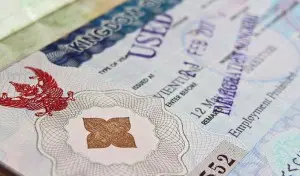
What is a visa?
Depending on the type of visa, you can enter Thailand for a specific period of time with a visa. Your passport or travel document indicates the entry date and the permitted length of stay.
What different types of visas are there?
Thailand has eight main visa categories according to its immigration law. Each category is limited to the purpose for which the visa was issued, and foreigners must strictly adhere to the respective regulations. Changes of address or status must be reported to the local police within 24 hours.
What is the permitted length of stay for each visa type?
The length of stay in Thailand depends on the type of visa issued.
Would an extension of the stay be possible?
A transit visa can be extended by 7 to 10 days, depending on the applicant's nationality. A tourist visa can also be extended by a maximum of 7 or 60 days (in 30-day increments), depending on the applicant's nationality. A government fee of 1,900 baht is charged for processing such an extension.
You must also submit the following documents with your application:
Non-immigrant visas of categories B or BA are generally extended for a maximum of one year from the date of entry. Exceptions are visas of categories IM, which are limited to two years, and IB, which are typically extended for two to three years, depending on the BOI's recommendation and the investment amount. Extending a non-immigrant visa requires a government fee of 1,900 baht and the submission of appropriate business documents.
Exceeding the permitted length of stay
Upon your arrival in Thailand, your permitted length of stay will be stamped in your passport. Passport and visa control in Thailand is strict, and violations are punished. Overstaying your permitted length of stay will result in a fine of 500 baht per day, up to a maximum of 20,000 baht. This fine can be paid at the immigration office or upon your departure at the airport. If you are unable to pay the fine, you will be detained in immigration custody.
Visa change
If you are already in Thailand on a tourist visa, you can apply for a non-immigrant visa if you wish to extend your stay. This process can be completed within the country. However, you must apply for the visa change at least 29 days before your current visa expires and submit various supporting documents.
Re-entry permit
Foreigners leaving Thailand but wishing to return before their visa expires without reapplying for a new one must apply for a re-entry permit before their departure. This permit allows them to re-enter Thailand and use the remaining validity period of their visa. If a re-entry permit is not applied for, the visa will automatically expire, even if it has not yet expired.
In addition to immigration offices throughout Thailand, re-entry permits can be obtained at Suvarnabhumi International Airport (Bangkok), Chiang Mai, Phuket, Hat Yai, and Sukhothai, as well as at other designated entry control points nationwide. Suvarnabhumi International Airport (Bangkok) is open 24 hours a day, while the other control points are open Monday through Friday from 8:00 a.m. to 4:00 p.m.
The fee for a single re-entry is 1,000 baht, and for multiple re-entries it is 3,800 baht. If you frequently leave Thailand, a multiple-entry visa is recommended. Should you wish to leave Thailand and return before your visa expires, but do not have a re-entry permit, you must apply for a new visa at a Thai embassy or consulate abroad. Departure is only legal at designated border crossings.
Crossing borders is considered an exit for immigration purposes, regardless of whether the point of departure is checked or not. Returning to Thailand from such trips constitutes a new entry, requiring the appropriate visas or re-entry permits.


Community
Comments 0
Start the conversation.