Why should you go there and how do you do it right?
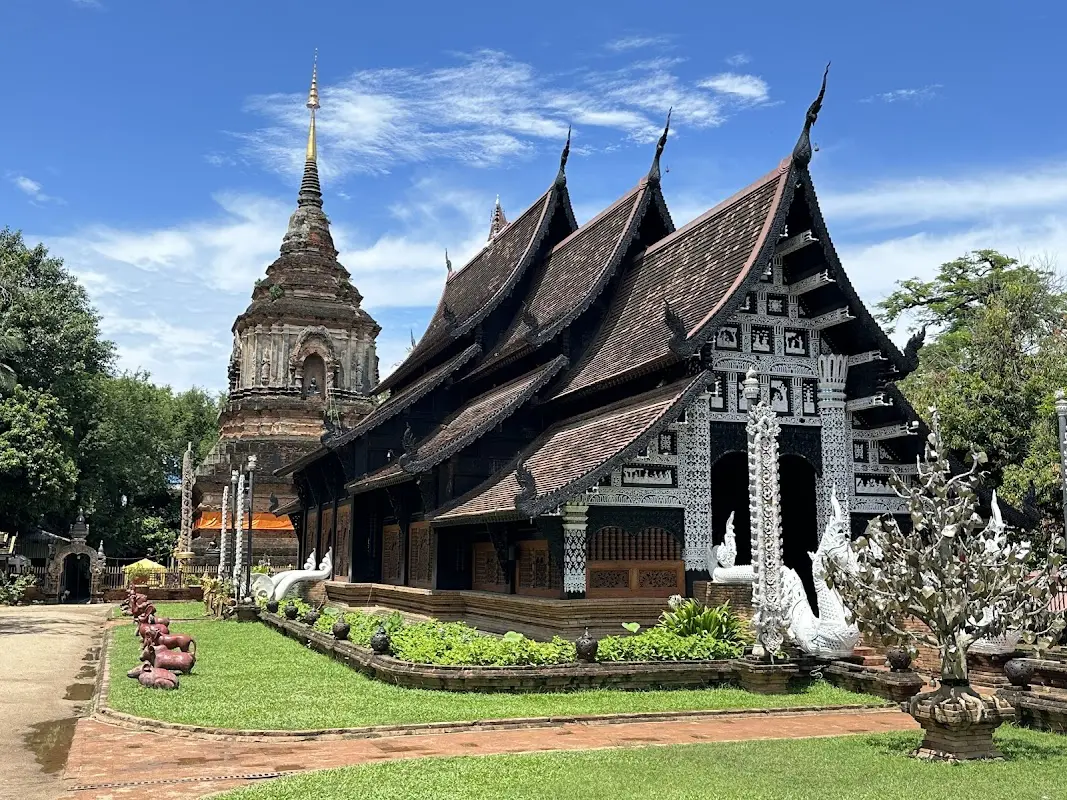
This is primarily an active temple and only secondarily a tourist attraction – and that's precisely why it's worth a visit. Wat Lok Moli is located on Manee Nopparat Road, north of the castle moat, about 400 meters west of the Chang Phueak Gate, and is old even by Chiang Mai standards. A document first mentions it in 1367, when King Kue Na hosted ten monks from Burma here. King Ket had the large chedi built in 1527 and the hall in 1545. The ashes of members of the Mengrai dynasty, which ruled Lanna, were interred here.
Unlike most of the city's chedis, this one was left with its original, unplastered brickwork, rather than freshly plastered. The carved nagas and the dark wooden facade of the hall make it a place worth pausing for a few minutes. Locals come to pray and lay flowers; there is a community of monks who live here. If there is chanting in the hall, feel free to sit quietly in the back. You can also write down a wish and hang it on the string or pull the rope that waters the Buddha statue.
The temple is illuminated after dark, and that's precisely why most visitors come to take photos. According to Google, the gate closes at 6:00 PM, while a guidebook mentions 7:00 PM. Therefore, I would recommend taking advantage of the last hour of the day to watch the lights come on, rather than relying on a nighttime visit.
Entry is free, donations are welcome. Please cover your shoulders and knees. From Chang Phueak Gate, it's about a five-minute walk west along the moat. A ride in a red songthaew from elsewhere in the old city costs about 30 baht. There are only about ten parking spaces in front of the gate. Khao Soi Khun Yai, a khao soi stall open only at midday, is about 100 meters away on the other side of the moat. It's open from 10:00 AM to 2:00 PM and closed on Sundays.




Community
Comments 0
Start the conversation.