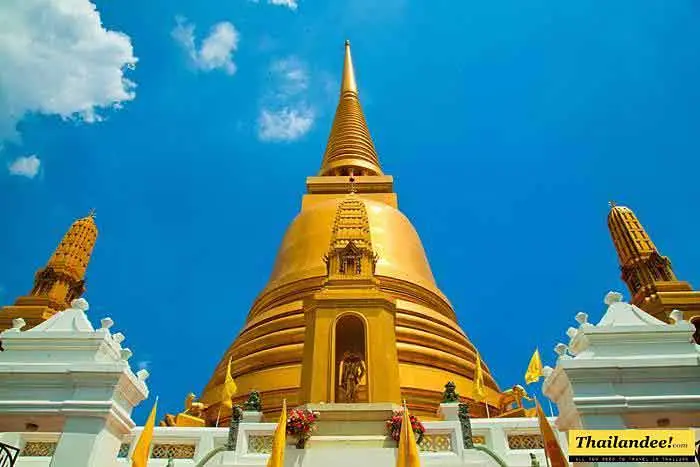
Wat Bowonniwet Vihara is a first-class royal temple, just a five-minute walk from Khao San Road. Wat Bowon, or simply Wat Bowon, was founded in 1824. It is a significant site in the royal and religious history of Thailand, as several kings were monks there, and some even served as the temple's abbey, including King Rama IV, also known as King Mongkut, and more recently, King Bhumibol Adulyadej, Rama IX, who lived there as a monk in 1956. Four of Thailand's Supreme Patriarchs have also served as abbots of this temple. Originally, Wat Bowonniwet consisted of two monasteries separated by a canal: Wat Mai (meaning "new temple") and Wat Rangsee Suddhawas. Since Wat Mai lacked an abbot, King Rama III (1824–1851) appointed Prince Mongkut to the position in 1836. Later, during the reign of King Rama VI, Wat Bowonniwet was expanded to include Wat Mai. (1910–1925), the two monasteries were merged to form Wat Bowonniwet. The temple's most striking feature is undoubtedly its golden chedi, but the Buddha statues in the ordination hall are also magnificent. The most important statue contains in its base the ashes of Kings Rama VI and Rama IX (interred on October 29, 2017, three days after his cremation). Wat Bowonniwet also houses a small Chinese temple.
Free admission. Open from 6:00 AM to 6:00 PM.
The temple is a five-minute walk from Khao San Road. Several bus lines from Bangkok stop directly in front of Wat Bowoniwet, including lines A4, S1, as well as lines 33, 68, and 516.
Wat Bowonniwet is a temple, and when visiting a temple in Thailand there are some rules to follow: appropriate clothing (knees and shoulders should be covered), take off your shoes when entering the building, be quiet, do not hug or kiss, do not point your feet at the Buddha statue, do not smoke.
How to get there
How do I get to Wat Bowoniwet? The temple is a 5-minute walk from Khao San Road. Several bus lines from Bangkok stop directly in front of Wat Bowoniwet, including lines A4, S1, 33, 68, and 516.




Community
Comments 0
Start the conversation.