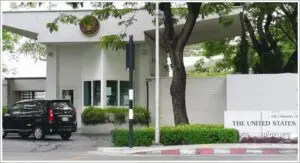
The U.S. Embassy in Thailand provides consular services to U.S. citizens, processes U.S. visa applications from Thai and other non-U.S. citizens in Thailand, and promotes the interests and diplomatic relations between the governments of the United States of America and Thailand. The current U.S. Ambassador to Thailand is the Honorable Michael George DeSombre.
American Citizens Services
The Consular Section of the US Embassy is tasked with assisting US citizens, both residents and visitors of Thailand, by providing support with passport applications, including the issuance of emergency passports and other related travel documents, birth and death registrations in Thailand, document legalization, facilitation of applications for government benefits, and the provision of emergency assistance to US citizens in need in Thailand.
Issuance of US passports
For U.S. citizens who have lost or had their passport stolen in Thailand, the U.S. Embassy issues emergency passports to facilitate their return to the United States. The U.S. Embassy can also renew existing U.S. passports and issue new U.S. passports for infants and children. Applicants can appear in person at the U.S. Embassy or submit their application by mail. Required documents include two passport photos, proof of U.S. citizenship (such as a copy of a valid passport), and proof of identity. The passport will be mailed to your Thai address.
US citizenship and birth registration
If you are a U.S. citizen and your child was born in Thailand, they automatically receive U.S. citizenship. To prove your child's U.S. citizenship and obtain a U.S. passport, you must register the birth at the U.S. Embassy or Consulate in Thailand. Your child must appear in person at the embassy or consulate with both parents. After registration, your child will receive a citizenship certificate and can apply for a U.S. passport.
Notarial services
The consular officers at the U.S. Embassy in Thailand can provide notarization services for all U.S. citizens. The embassy can authenticate signatures, issue powers of attorney, and make certified copies of U.S. passports. Certain services are not offered, including the authentication of copies of academic transcripts and marriage, birth, and divorce certificates issued in the U.S. without U.S. State Department authentication. If the consular section cannot provide the notarization services you require, you can contact a qualified Thai notary public to have your documents authenticated, especially if they are intended for use in Thailand.
Marriage certificate
U.S. citizens wishing to have a civil marriage ceremony in Thailand require a sworn statement from the U.S. Embassy or Consulate confirming their legal capacity to marry. To obtain this statement, you must appear in person at the U.S. Embassy in Bangkok and sign it in the presence of a consular officer. If you are marrying another U.S. citizen, your spouse will also need this sworn statement.
Proof of income
The US Embassy in Bangkok and the US Consulate in Chiang Mai no longer issue income verification forms for Thai spousal and pension visas. US citizens must now open a Thai bank account and transfer their monthly income, such as from employment or social benefits, to meet the requirements of the Thai immigration authorities.
Emergency aid
If you are a U.S. citizen and have been arrested or the victim of a crime in Thailand, you have the right to meet with a consular officer. This officer will inform you about the Thai legal system and connect you with a reputable Thai lawyer. The consular officer will monitor your treatment, track the progress of your case, and assist you in communicating with your family in the United States.
When a U.S. citizen dies in Thailand, Thai authorities notify the U.S. Embassy in Bangkok. The embassy confirms the death and the identity of the deceased, notifies next of kin, and assists with repatriation arrangements. If the deceased was a resident of Thailand and had a Thai will, you should consult an estate attorney to administer the will or the estate. It is also important to know that the U.S. Embassy does not provide financial assistance or help with medical expenses.
US citizens in Thailand who need emergency assistance can call +66 2 205 4000. This number is available 24/7.
US Visa Department
In addition to its consular section, the U.S. Embassy in Thailand also has a visa section that provides visa services for Thai and foreign nationals residing in Thailand who wish to enter the United States. The embassy in Bangkok processes all types of U.S. visa applications, including nonimmigrant and immigrant visas. Nonimmigrant visas include tourist and business visas, while commonly issued immigrant visas include K-1 fiancé(e) visas, CR-1/IR-1 spousal visas, and work-related visas. The U.S. Consulate in Chiang Mai, on the other hand, processes only nonimmigrant visas and assists U.S. citizens who live in or are visiting Chiang Mai province or its surrounding areas.
How do I apply for a US visa at the US Embassy in Thailand?
The US Embassy in Bangkok processes US visa applications from Thai citizens. The final step in the visa process is an interview at the US Embassy in Bangkok. In some cases, the visa interview may also take place at the US Consulate General in Chiang Mai if this is more convenient for the applicant.
Types of US visas
The visa section of the US Embassy in Bangkok processes applications for non-immigrant and immigrant visas in the following categories:
US tourist visa
Visitor visas are non-immigrant visas for Thai or foreign applicants who wish to enter the United States temporarily, either for business purposes (visa category: B-1), for tourism purposes (visa category: B-2), or for a combination of both purposes (B-1/B-2).
K1 and K2 visas
The US K-1 visa is also known as the fiancé(e) visa. It is intended for Thai nationals or foreigners who wish to marry their US partner in the United States. After receiving the visa, the marriage must take place within 90 days of entering the US. Eligible children of a visa applicant can also apply for a K-2 visa to enter the US.
K3 and K4 visas
The US K-3 visa is a nonimmigrant visa intended for the Thai spouse of a US citizen. Eligible children of visa applicants can apply for a K-4 visa. Both the K-3 and K-4 visas allow applicants to remain in the US while their immigrant visa application is being processed.
How can I contact the embassy?
US Embassy in Bangkok, 95 Wireless Road, Bangkok, Thailand 10330. Monday to Friday, 7:00 a.m. to 4:00 p.m. Closed on US and Thai public holidays. Tel.: +66-2-205-4000. Website: http://bangkok.usembassy.gov/
US Consulate General in Chiang Mai, 387 Witchayanond Road, Chiang Mai, Thailand 50300, Tel.: +66-53-107-700, Website: http://chiangmai.usconsulate.gov/
NOTE: Visitors to the Consular Section and Visa Section of the Embassy will only be admitted if they have booked an appointment via the US Embassy website.
US Embassy Thailand
Hiring a US visa advisor
The US Embassy does not have a section where visitors can obtain visa information. Information on this can be found on the embassy's website. Thai citizens requiring visa information can also contact an immigration consultant specializing in US tourist visas (B2) and business visas (B1). This consultant may have experience with immigrant visa categories K1, K2, K3, K4, CR-1, and IR-1, as well as with US visa refusals and exemptions.
Contact Siam Legal
[column size='1/2']
LIVE SUPPORT
CALL
CHAT
Chat with our employee
From Thailand: Monday – Friday 4:00 – 18:00 (Bangkok time)
Community
Comments 0
Start the conversation.