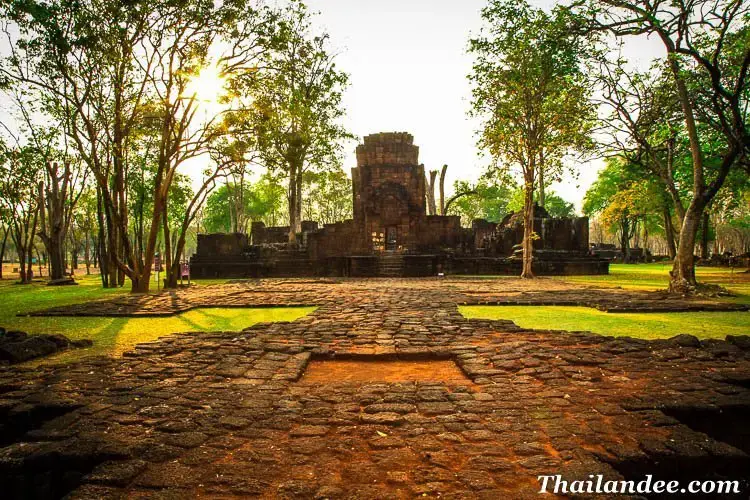
Prasat Muang Singh is a Khmer complex whose central feature is the ruins of a temple dedicated to the Hindu god Shiva. It is the westernmost Khmer ruins discovered in Thailand. The complex dates back to the 13th and 14th centuries. The city (muang means city in Thai) was abandoned until the reign of King Rama I (1782–1809). Muang Singh is situated on the banks of the Kwai Noi River. The seven-meter-high perimeter walls were constructed of laterite. The complex has entrances and exits on all four sides. There are six ponds and four significant religious structures to visit. The most important archaeological site is the Prasat (fortress) directly opposite the main entrance. The second archaeological site is the stone castle in the northwest, adjacent to the glass wall. Archaeological excavations unearthed numerous bases of sandstone sculptures, including the statue of Avalokiteshvara, the statue of the Buddha seated beneath the Naga, the statue of Prajnaparamita, and many terracotta Buddha depictions. Archaeological Site No. 3 is a small building constructed of brick and laterite. Stone tablets, presumably used as temple boundary markers, are located at each of the building's exterior corners. Numerous metal Buddha depictions with a lead-like texture were discovered during the excavations. Archaeological Site No. 4 is a square, one-story laterite building located further southwest. Muang Singh was declared a historical park in 1987. While it is not the most important Khmer site in Thailand—the finest temples of this style remain at Phimai and Phanom Rung, as well as Prasat Muang Tham in Buriram Province—Prasat Muang Singh Historical Park is well worth a visit.
Open from 8:00 AM to 6:00 PM. Admission: 100 THB per person + 50 THB per car. The park is extensive, so exploring all corners on foot is not easy. However, the Prasat, the central feature, is easily accessible on foot. There is no bicycle rental at the entrance.
There is no public transport directly to the entrance of Prasat Muang Sing Historical Park. However, it is only a short walk of about one kilometer from Tha Kilen Station. Three trains run daily from Kanchanaburi (see the Kanchanaburi – Tha Kilen timetable here) and two to Kanchanaburi, but only one during the day and the other early in the morning (see the Tha Kilen – Kanchanaburi timetable here). Therefore, plan your journey to Prasat Muang Sing Historical Park carefully, although having your own vehicle is naturally more convenient. A visit can often be combined with a trip to the Tham Krasae Bridge, the most visited section of the Kanchanaburi Death Railway.
How to get there
How do you get to Prasat Muang Sing Historical Park? There is no public transport that goes directly to the park entrance. However, it is only a short walk of about one kilometer from Tha Kilen Station. Three trains run daily from Kanchanaburi (see the Kanchanaburi – Tha Kilen timetable here) and two trains run to Kanchanaburi, but only one during the day and the other early in the morning (see the Tha Kilen – Kanchanaburi timetable here). Plan your journey to Prasat Muang Sing Historical Park carefully if you intend to travel by train. However, having your own vehicle is much more convenient. A visit can often be combined with a trip to the Tham Krasae Bridge, the most visited section of the Kanchanaburi Death Railway.
Community
Comments 0
Start the conversation.