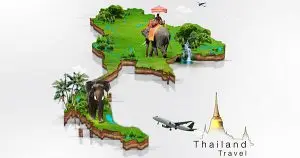
Thailand is an absolute gem among Southeast Asia's travel destinations – with enchanting islands, paradisiacal white sand beaches, and one of the world's most vibrant capital cities. The warm-hearted people, pleasant weather, and delicious food all contribute to the magic of this holiday, which will undoubtedly be among your most unforgettable experiences.
VISA
Visitors from approximately 59 countries can stay in Thailand for up to 30 days with a visa on arrival. Alternatively, there is a 60-day multiple-entry tourist visa, which can be obtained for a fee before travel. This visa can be extended for another 30 days within Thailand for a fee. Visitors from certain countries may stay in Thailand visa-free for a maximum of 15 days, while others may stay for up to 90 days.
The rules, regulations, and requirements for obtaining a visa on arrival are subject to change. It is therefore advisable to check visa requirements before booking and, in any case, before departure.
TOURIST SEASON
The peak season in Thailand, when the climate is cooler, lasts from November to April. The off-season, between June and October, includes the rainiest months. Some tourists prefer the quieter months, when prices for accommodation and excursions can be significantly lower and sunny days are only interrupted by rain showers.
WEATHER / SEASONS
Thailand has a tropical climate; hot and humid. The monsoon season begins in Phuket in May and in Samui in September. The dry season lasts from November to February in Phuket and begins in December in Samui. The hottest time of year starts in March, with April and May being the hottest months.
TYPES OF ACCOMMODATION
Thailand offers accommodation for every budget, from luxurious, internationally renowned hotels to family-run guesthouses. Besides backpackers, Thailand also attracts so-called flashpackers who value a high-quality stay. Bungalow and villa complexes are very popular with this type of traveler.
Numerous wealthy tourists are also drawn to Thailand, where they often rent luxury villas in Phuket and Koh Samui – two of the largest and most popular holiday islands. Most of these private luxury villas offer amenities such as swimming pools, private cinemas, personal butlers, and even chefs.
Often, the best deals can be found through local searches, not on the major booking portals and not necessarily with their own website. However, Thailand is a leader in social media, and even privately run accommodations usually have an online presence.
On the islands, it can be worthwhile to spend more for an infinity pool, top-notch facilities, privacy, and a stunning location like right on the beach, especially for families on vacation and couples looking for a romantic getaway. Consider what's important to you in your accommodation and plan your search accordingly.
POPULAR TOURIST DESTINATIONS
Most visitors to Thailand spend a few days in Bangkok, ideally at the beginning or end of their beach holiday. However, the capital is a dynamic metropolis with fascinating cultural attractions, excellent restaurants, a wide range of activities for families, and a vibrant nightlife. A somewhat quieter, yet still lively, destination is Chiang Mai. Here, visitors can explore the hill tribes of the north and enjoy more pleasant temperatures.
Pattaya is the closest beach resort with a large stretch of sand to Bangkok, and while the east coast is developed for tourism, it's not as picturesque as Thailand's southern islands. Further south along this coast are Koh Samet and Koh Chang, ideal for a weekend getaway. Hua Hin, a popular destination for a weekend beach holiday, is also not far from the capital.
Phuket, Thailand's largest island in the Andaman Sea, attracts the most visitors thanks to its successful combination of tropical island splendor and a diverse range of activities and attractions, including Phuket Old Town. The island has also become a popular destination for food lovers, and its west coast, known as the "Millionaire's Mile," boasts some spectacular accommodations.
Koh Samui in the Gulf of Thailand is less developed for tourism, yet still manages to combine the charm of a secluded beach with shops, restaurants, and entertainment options. At the same time, it also boasts lively spots like Chaweng with its exuberant beach party atmosphere.
Krabi, in the southwest of the mainland, is a legendary travel destination, whose Railay Beach is considered one of the most beautiful beaches in the world. This idyllic spot is famous for its impressive limestone formations and mangrove forests, and offers fantastic island-hopping tours as well as being a diver's paradise. The nearby island of Phi Phi has changed significantly over the years and is now considerably more touristy.
Away from the beaches, Issan in northeastern Thailand and Khao Yai, which is only a few hours' drive from Bangkok, are popular rural retreats.
VARIOUS TYPES OF ATTRACTIONS
Besides year-round sunshine, delicious food, and friendly people, Thailand offers excellent value for money – you can experience more without spending a fortune. If you're looking for variety and unforgettable moments, Thailand promises incredible travel experiences.
Each destination boasts its own unique charm, attractions, and activities for travelers of all ages and with diverse interests. Stroll through night markets, enjoy al fresco dining, and admire the sunset with breathtaking views of the coast or the city.
At the top of the list of sights to see are Thailand's glittering temples, breathtakingly beautiful and offering a glimpse into the importance of Buddhism in Thai culture. Thailand's temples, which encourage mindfulness, are not relics of the past. Therefore, you'll see saffron-robed monks in many temple complexes. It's important to be aware of the dress code. If you know your day trip includes a visit to a wat (sacred temple), bring clothing that covers your legs and arms.
Thailand is home to several UNESCO World Heritage Sites, and a trip to Bangkok alone is a true adventure. During your stay in the capital, visit Wat Pho with its reclining Buddha, one of the city's many sky bars, including the newly opened Skywalk, and enjoy dinner on the Chao Phraya River during a dinner cruise. Beyond the city, Thailand also offers numerous national parks and marine reserves.
Enjoy cave kayaking and island hopping during your beach holiday, for example, exploring the 42 islands of the Ang Thong National Marine Park, many of which are uninhabited. Snorkeling and diving, as well as fishing and water sports, attract tourists to Thailand; PADI courses are also available. Thailand also boasts numerous golf courses of international standard, including eight on Phuket and several on Koh Samui.
One of the best ways to experience Thailand is to wander off the beaten tourist track.
FESTIVAL
Thailand not only offers a wealth of scenic wonders, but is also a true treasure trove of unique cultural diversity. And there's no better way to experience this than by participating in the country's numerous festivals.
The most important and probably most popular festival is Songkran, the Thai New Year, which takes place every year on April 13th. Locals and tourists, young and old, splash each other with water – a boisterous celebration like children's.
Another festival that's a must-see is Loi Krathong, where flower-adorned baskets are set adrift on the water. At the same time, Yi Peng takes place, where hundreds of lanterns are released into the sky from boats – a truly spectacular sight. Both festivals are held in November, on the eve of the full moon.
Learn more about Thailand's festivals and events.
HOW TO MANAGE YOUR MONEY
The currency in Thailand is the Baht, and ATMs are plentiful in cities and tourist areas. Compared to many other countries, taxis and public transport are inexpensive. However, as in any capital city, accommodation, food, and entertainment in Bangkok can be pricey, although traveling on a mid-range or low budget is certainly possible, especially if you eat at street stalls and markets.
For a one-hour massage, you should tip at least 50 baht; many people even tip 100. A small tip is customary for taxi drivers, while in bars and restaurants, follow your instincts. Service is often included in the price, and tipping rules are much more relaxed there.
Learn how we can help you open a bank account in Thailand.
LANGUAGE
While you'll find English speakers in Bangkok's tourist areas, don't expect most employees in bars, restaurants, shops, and banks, including taxi drivers, to speak more than the basics. Once you leave the tourist hotspots, you'll definitely find a few words of Thai very useful.
Learn some of the most basic Thai words and phrases.
BASIC THAI ETIQUETTE
In Thailand, it is important to observe etiquette, respect Buddhist culture and traditions, and dress appropriately when visiting temples. Outbursts of anger are considered absolutely taboo in Thailand and are seen in Thai culture as a loss of face that embarrasses others.
It is customary to greet and say goodbye with the "wai," by pressing your palms together and nodding your head. There are some complex rules surrounding this, but generally speaking, children and service sector employees should not be greeted with the "wai." Thailand is known as the "Land of Smiles," and a smile will get you very far with the friendly Thai people.
Learn the dos and don'ts of Thai customs.
THAI FOOD
Some of the best Thai dishes can be found at street stalls and night markets. A must-try is Som Tam, a spicy papaya salad freshly prepared by the vendors in a mortar and pestle. It goes perfectly with grilled chicken and sticky rice. If you like it a bit spicier, you can ask for "Mai Pet" when ordering.
Souvenirs
Pack light to bring home clothes, souvenirs, and handicrafts. The Chatuchak Weekend Market is the perfect place to shop; some companies also offer shipping. Be aware of the laws regarding the export of Buddha images: a written permit is required, as is the case for statues taller than 12 cm, and the head, hands, and feet of Buddha are prohibited.
ETHICAL TOURISM
Environmental awareness is growing in Thailand, and sustainable travel is gaining increasing importance. This includes promoting tourism activities that appreciate the country's natural beauty without damaging it. However, tourism activities continue to harm the diverse ecosystem, wildlife, and cultural heritage of Thailand. Therefore, it is crucial that every visitor commits to the ethical principles of responsible travel.
Avoid tours that exploit minority cultures or encroach on their habitats, such as visits to hill tribe villages or sea nomads. Only visit elephant sanctuaries with an established reputation, and only dive and snorkel where it is permitted to protect the coral reefs.




Community
Comments 0
Start the conversation.