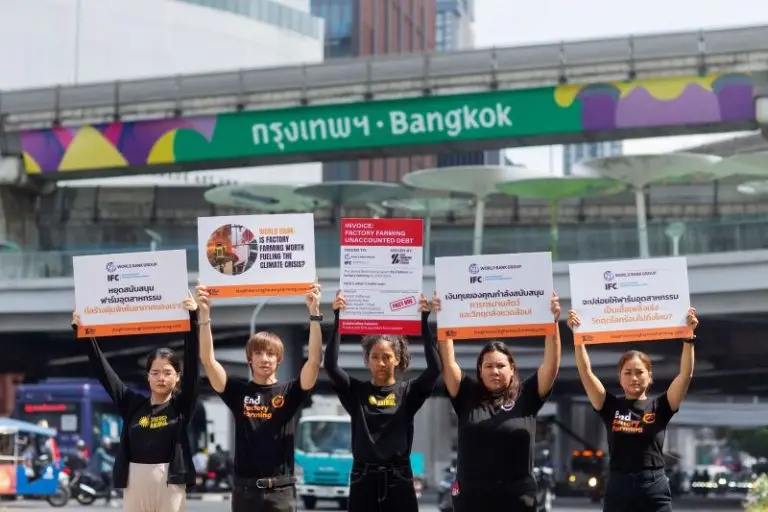
Bangkok, Thailand, April 29, 2025 / TRAVELINDEX / Activists from Sinergia Animal Thailand and World Animal Protection Thailand joined over 2,570 supporters worldwide in a global day of action to call on the World Bank and its subsidiary, the International Finance Corporation (IFC), to end funding for factory farming. The activists delivered a joint letter to the World Bank office in Bangkok demanding an end to all investments in factory farming, which promotes environmental destruction, endangers human and animal health, and undermines global sustainability goals.
The World Bank Group, which includes the IFC, is an international financial institution that provides loans and financing for projects in developing countries. Its goal is to reduce poverty and promote sustainable development. However, recent research shows that the World Bank's continued support for factory farming contradicts these goals, as it contributes to biodiversity loss, climate change, and a decline in public health.
Although the World Bank does not currently invest in factory farming in Thailand, the country is nevertheless affected by these global investments. The Thai government holds a 0.51% voting stake in the World Bank, which means that public funds from Thailand are flowing into harmful factory farming projects in other countries.
Saneekan Rosamontri, Country Director of Sinergia Animal Thailand, explained: “Thailand is a shareholder in the World Bank, which means our government has a say in where funds are invested. We do not want our public funds to support industrial factory farms that harm communities, animals, and the planet.”
“This is a crucial moment for the World Bank to transition to sustainable and equitable food systems that protect people, animals, and the environment. We urge our government to use its voting rights at the World Bank to support this change,” Saneekan added.
Despite Thailand's growing awareness of sustainable development and climate resilience, the effects of global investments in industrial animal farming are already being felt within the country, ranging from increasing air pollution and deforestation to rising antibiotic resistance, food insecurity and extreme weather events.
Recent research by World Animal Protection reveals a comprehensive analysis of current policy gaps at the World Bank and the IFC. These include a lack of transparency, inconsistency with international climate and biodiversity frameworks, and inadequate protection of local communities' land rights and labor standards. For example:
“Factory farming is exacerbating a global crisis – and Thailand is already paying the price. We are experiencing increasingly frequent floods, extreme heat, and dangerously polluted air that threatens the health of millions of people. These are not distant problems. They are here, now, and they are getting worse. Climate change, public health threats, and food system crises do not stop at national borders. That is why Thailand must take a stand – to protect our people, our environment, and our future,” said Chokdee Smithkittipol, Program Director at World Animal Protection Thailand.
In response, over 270 organizations and civil society groups, including international and local NGOs, academics, farmers, and activists, have signed a joint letter to the leaders of the World Bank and the IFC. The letter urgently calls on both institutions to:
“Time is running out. The World Bank cannot claim to be fighting poverty and climate change while simultaneously supporting a system that is destroying the planet and harming the most vulnerable, including animals. We need decisive leadership now – starting with ending all support for factory farming,” Chokdee added.
Activists emphasize that Thailand should not be complicit in financing this destructive model through its participation in the World Bank. Instead, the country could take a leading role in promoting sustainable, ethical, and resilient food systems for future generations.

Community
Comments 0
Start the conversation.